


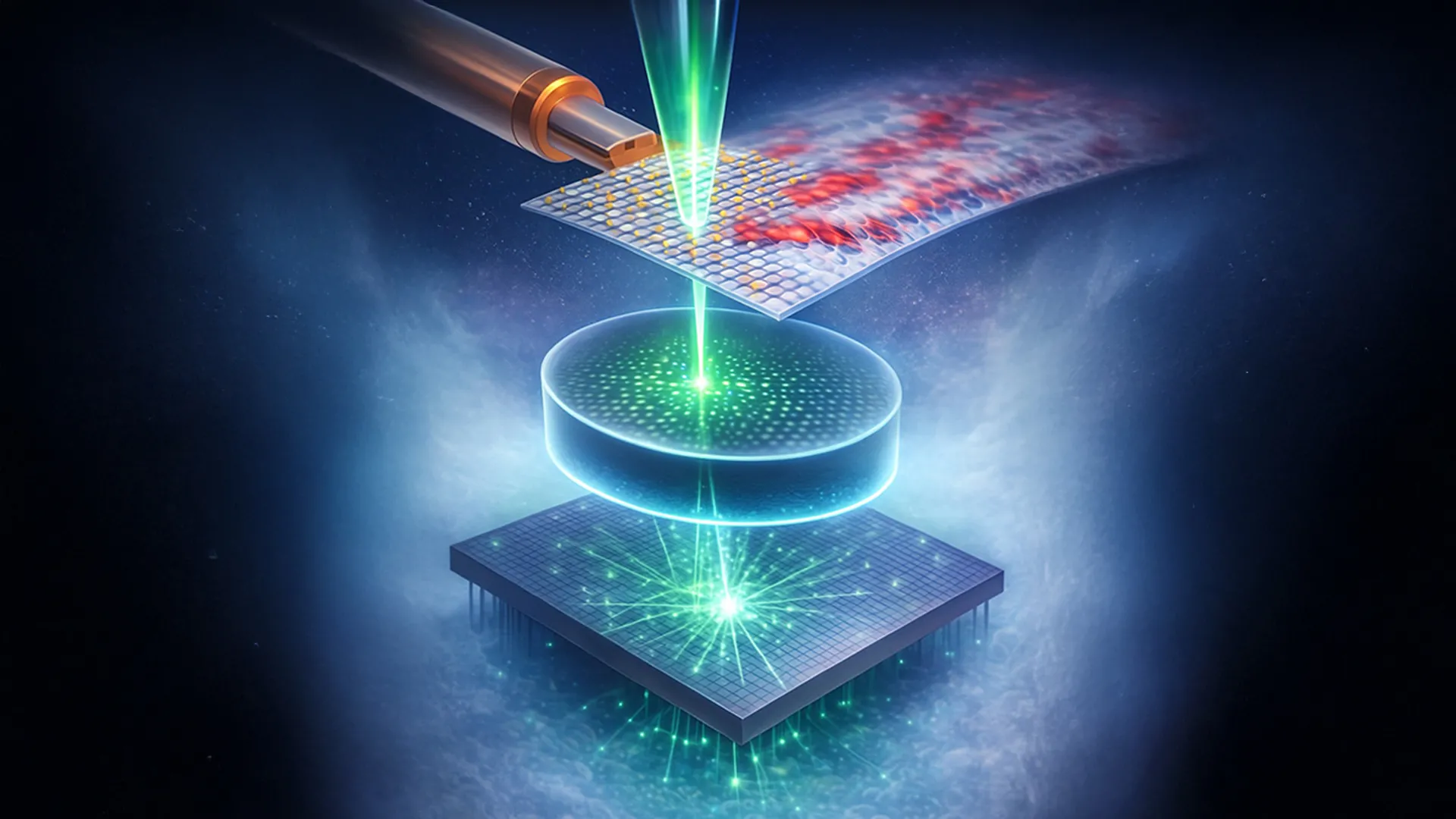
In quantum materials, electronic order rarely forms smoothly and uniformly. Rather, they often emerge as complex patterns that vary from region to region. One well-known example is charge density waves (CDWs), a condition in which electrons are organized into repeating patterns at low temperatures. Although CDWs have been studied for many years, researchers have struggled to directly observe how their intensity and spatial coherence change during phase transitions.
A research team led by Professor Young-soo Yang from the Department of Physics at KAIST (Korea Advanced Institute of Science and Technology), in collaboration with Professors Sung-bin Lee, Professor Hee-jun Yang, Professor Young-kwang Kim, and collaborators at Stanford University, have made significant progress. For the first time, they directly visualized how the wave order amplitude of the charge density varies across space within a quantum material.
Nanoscale imaging reveals patchy electronic patterns
To accomplish this, the researchers used liquid helium-cooled electron microscopy and four-dimensional scanning transmission electron microscopy (4D-STEM). This advanced setup allowed us to track how the CDW order forms, weakens, and disintegrates as temperature changes. More importantly, they were able to create detailed nanoscale maps that show not only whether electronic order is present, but also how strong it is and how it is connected between different regions.
This process can be compared to observing ice crystals that form as water freezes under very high magnification. However, in this case, the researchers observed that the electrons aligned at temperatures around -253°C. Their microscope was able to resolve structures as small as 1/100,000 times the width of a human hair. These images reveal that electronic ordering is not evenly distributed. In some areas, clear and distinct patterns were seen, while in nearby areas there was no pattern at all, resembling a lake where the ice forms in scattered patches rather than covering the surface all at once.
Tension and collapse of electronic order
The study also found that these non-uniform patterns are closely related to small strains within the crystal. Even small amounts of strain, too small to be detected by traditional optical methods, were sufficient to significantly weaken the CDW amplitude. This strong link between strain and electronic order provides direct evidence that subtle lattice distortions play an important role in shaping how these patterns form.
Another surprising result was the discovery that small pockets of CDW order can persist beyond the transition temperature at which long-range order is normally expected to disappear. These isolated regions suggest that migration is not a simple, uniform process. Electronic order does not disappear all at once, but gradually loses its spatial coherence.
Measuring how electronic orders disappear
The main outcome of this study is the first direct measurement of CDW amplitude correlations. By examining how the strength of electronic order at one location is related to the strength of electronic order at another location, the researchers showed how coherence breaks down across transitions while local amplitudes remain present. It was not possible to access this level of detail using traditional diffraction or scanning probe techniques.
A new framework for understanding quantum matter
Charge density waves are a fundamental feature of many quantum materials and often interact with other electronic states. This study provides a new experimental approach to understand how collective electronic orders form and evolve in real systems by directly mapping their spatial structure and correlations.
Dr. Yongsoo Yang emphasized the importance of this discovery. “Until now, the spatial coherence of charge density waves has been mainly inferred indirectly. Our approach allows us to directly visualize how electronic ordering changes over space and temperature, and to identify the factors that locally stabilize or suppress it.”
The study was co-first authored by Seok-jo Hong, Jae-hwan Oh, and Jaemin Park from KAIST. physical review letter.
This research was mainly supported by National Research Foundation of Korea (NRF) grants (Individual Basic Research Program, Basic Laboratory Program, Nanomaterials Technology Development Program) funded by the Korean government (MSIT).
The authors thank E.-G. Mr. Moon, for a helpful discussion. This research was mainly supported by the National Research Foundation of Korea (NRF) grants (RS-2023-00208179 and RS-2025-02243032) funded by the Korean government (MSIT). YY also acknowledges support from the KAIST Singularity Professorship Program. SBL was supported by an NRF grant (2021R1A2C109306013) and an MSIT-funded Nanomaterials Technology Development Program through NRF (RS-2023-00281839). YK was financially supported by NRF Grant (No. RS-2022-00143178 and No. RS-2024-00345856) and Korea Institute of Standards and Science (KRISS) (Grant No. KRISS-GP2025-0015). HY was supported by NRF grant number RS-2024-00340377 funded by MSIT. 4D-STEM, ADF-STEM, and EELS experiments were performed using dual Cs-corrected Titan cubed G2 60-300 (FEI) and Spectra Ultra (ThermoFisher) instruments at the KAIST Center for Research Advancement and Analysis (KARA). We would like to thank Bae Hyun Bin, Choi Jin Suk, and the KARA staff for their wonderful support. We declare that the authors used ChatGPT only for language editing purposes and that all original manuscript texts were written by human authors and not by artificial intelligence.
