


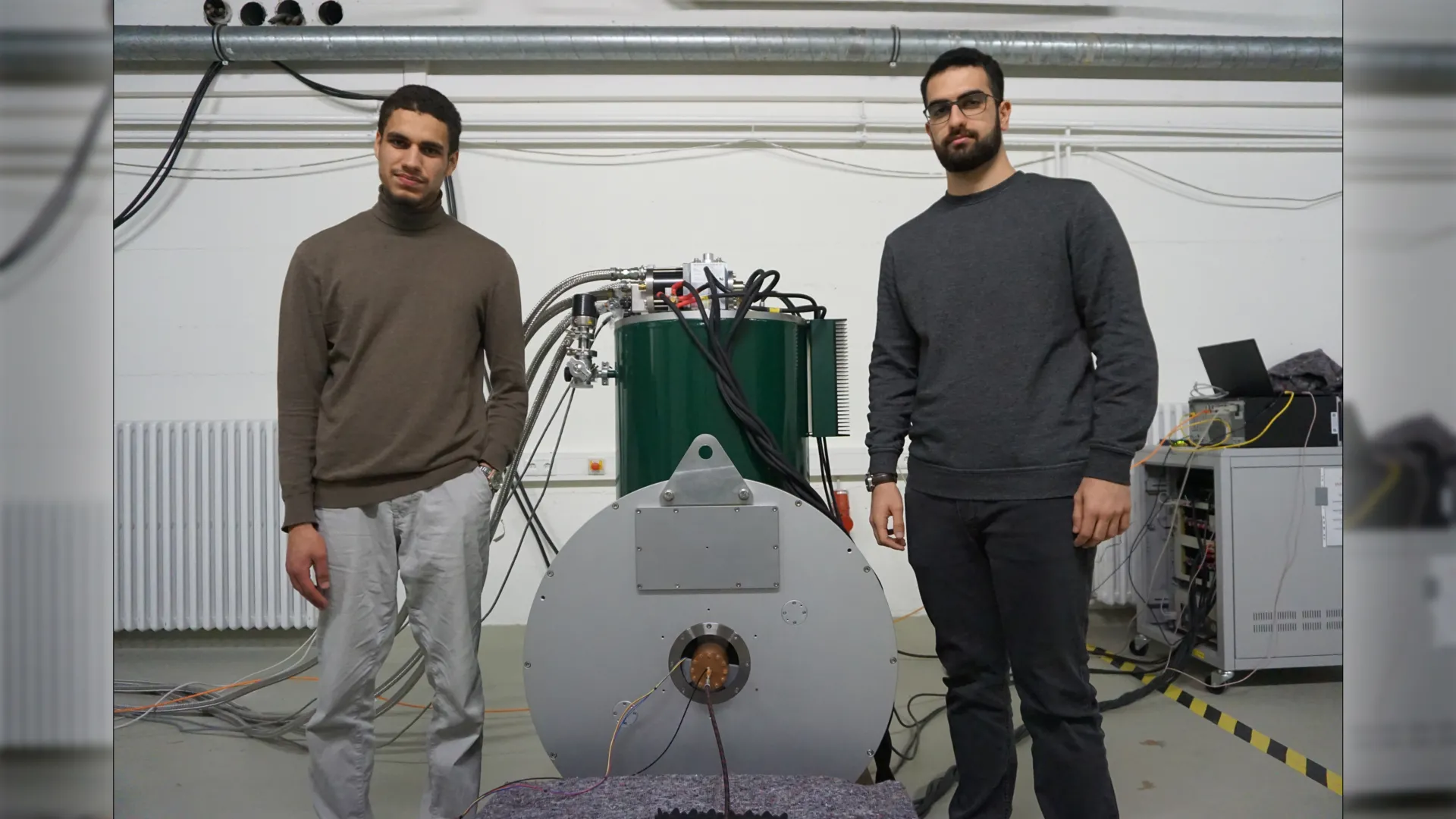
Modern cosmology is often associated with large-scale international collaborations, backed by large observatories, advanced instruments, and large amounts of funding. However, meaningful progress does not necessarily require such scale. Even in the complex search for dark matter, small teams with creative approaches and organizational support can still make important contributions.
Recent research published in Journal of Cosmology and Astroparticle Physics (JCAP) emphasizes this idea. A group of undergraduate students at the University of Hamburg designed and built a cavity detector to search for axions, one of the leading candidates for dark matter. Despite working with limited resources, they were able to establish new experimental limits on the properties of axions, demonstrating that even small-scale experiments can advance one of physics’ biggest open questions.
Student funding and institutional support
This project was funded by a University of Hamburg student research grant provided by the Hub for Crossdisciplinary Learning. This program supports student-led independent research projects.
“We were kind of integrated into the research group for the MADMAX dark matter experiment,” explains Nabil Salama, one of the study’s authors and a current master’s degree student. student of physics at the University of Hamburg. “MADMAX has conducted similar experiments at a much larger and more complex scale, and we benefited from their expertise and support.”
“We are very grateful for this support. We are also grateful to the University of Hamburg and the Quantum Universe Cluster of Excellence for providing funding, access to important equipment such as magnets, and valuable support from researchers,” he added.
Building a simple detector to search Axion
“The advantage of working with dark matter, or axions, is that we can expect it to be present everywhere in the galaxy,” says Ajit Akgyums, the study’s first author and a master’s degree student. in Mathematical Physics from the University of Hamburg. “Basically, no matter where you do your experiment, you have dark matter at hand to experiment with.”
Using their funding, the team assembled a compact experimental setup centered around a resonant cavity made of highly conductive material. We also integrated the necessary electronics, cabling, structural support, and measurement tools.
“The detector we built is essentially the simplest version of a dark matter cavity detector,” Salama says.
The students weren’t starting from scratch. We utilized existing facilities, equipment, and guidance provided by universities and collaborative research groups. After construction, the system was carefully tested, calibrated, and operated to collect data.
“We took a very complex experiment and narrowed it down to its critical components,” Salama says. “As a result, the settings are less sensitive and the search window is smaller and more restricted, but still able to generate new scientific data.”
Not detected, but there is an important new constraint
“The search for axions involves extensive investigation of possible parameters,” Akgümus added. “Although our experiment only covers a small area and has limited sensitivity, it still helps narrow down the possibilities. To actually find the particle, we would need either a much larger experiment or many different experiments, each looking at a specific area.”
After completing data collection, the team detected no signals that could be attributed to axions. However, the results still have scientific value. This allows researchers to rule out the presence of axions with certain properties within the mass range tested, especially axions that interact more strongly with photons. By eliminating these possibilities, this study will help refine searches and guide future experiments.
A model for scalable dark matter experiments
“I think the point of our experiment is that we can do things on a smaller scale,” Salama says. Akgümüs continued, “Naturally, our results are more limited than those from large-scale experiments; performance varies depending on resources and complexity. However, we have shown that these setups can be scaled down to a much smaller scale while still producing real scientific data, even for projects developed almost independently by students.”
During the review process, one reviewer made a particularly noteworthy point, Salama recalls. The reviewers suggested that once axions were discovered and their properties, especially their masses, known, such experiments would become much more accessible and could even be used in educational laboratories.
“We were told that a setup like ours might one day become a standard experiment in student labs,” Salama says. “In some ways, we may have been anticipating such a future. This shows that it is already possible to build and operate such experiments on a small scale.”
