


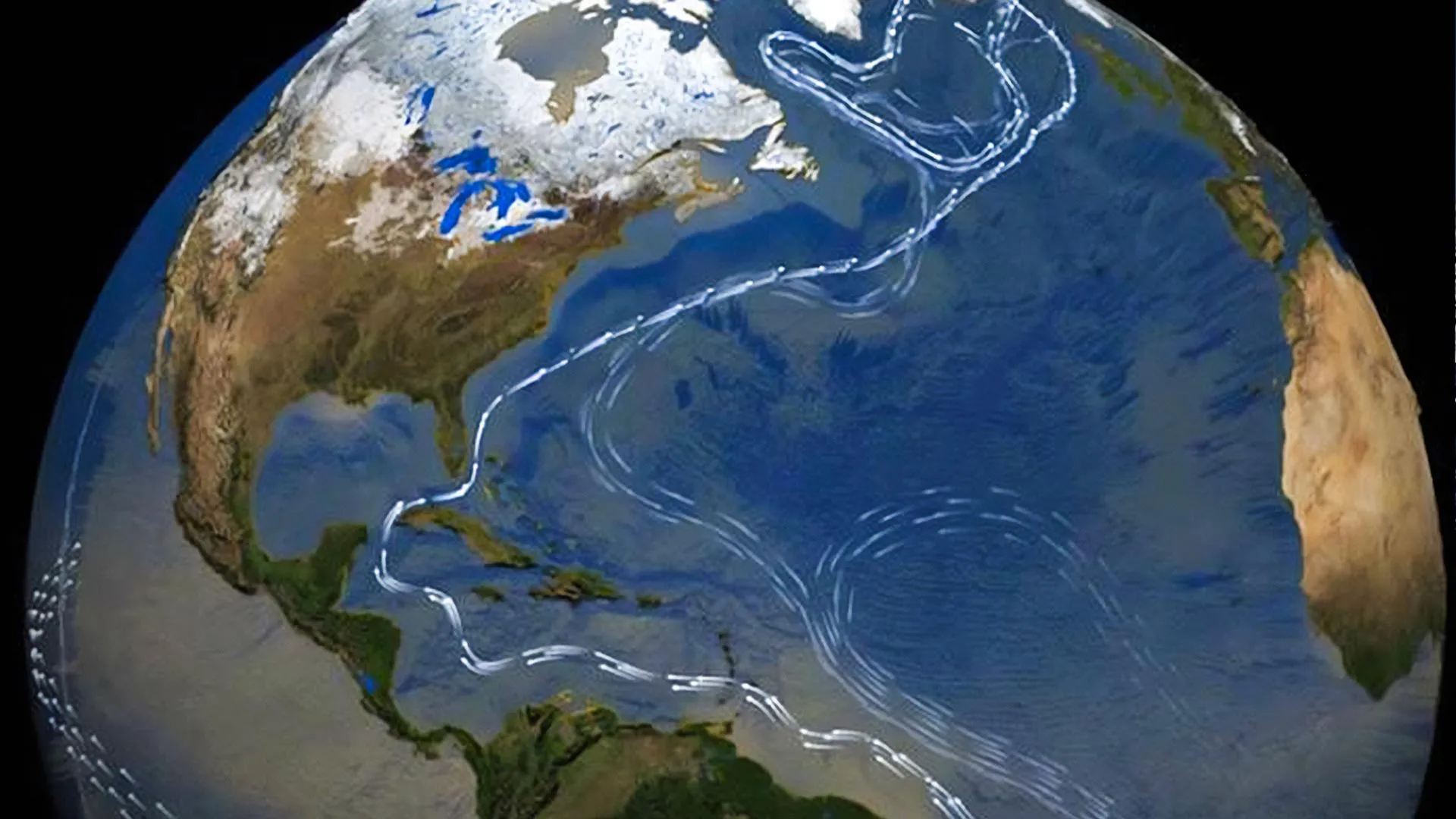
The Atlantic Ocean’s giant ocean current system, which plays a key role in regulating Earth’s climate, has been weakening for almost two decades, a new study has found. Scientists say this slowdown could spread across a wide swath of the Atlantic Ocean and ultimately change weather patterns around the world.
The study was led by scientists from the University of Miami’s Rosenstiel School of Ocean, Atmospheric, and Earth Sciences. Their findings provide some of the strongest direct observational evidence to date that the Atlantic Meridional Overturning Circulation (AMOC) is losing strength. The results could help researchers improve climate models and better understand how ongoing climate change will affect the future.
“Weakening of the AMOC could change weather patterns, leading to more extreme storms, changes in rainfall, or colder winters in some regions,” said Shane Elipot, senior author of the study and a physical oceanographer at the Rosenstiel School. “It could also impact sea level rise along the coastline, impacting local communities and infrastructure.”
Deep sea measurements reveal climate trends
To investigate changes in the AMOC, researchers examined long-term data collected from four ocean monitoring arrays located along the western side of the North Atlantic Ocean. Monitoring locations ranged from tropical waters to high latitudes.
The researchers used instruments fixed to the ocean floor that continuously measure pressure, temperature, density, and ocean currents. The researchers applied the same method at each location, using changes in seafloor pressure to estimate movement in the deep ocean below about 1,000 meters. By comparing measurements collected over time and across multiple regions, scientists were able to identify long-term changes in the circulation system.
Their observations revealed a steady decline in a significant portion of the AMOC along the western boundary of the Atlantic Ocean, which extends from the subtropics to mid-latitudes (approximately 16.5°N to 42.5°N). The slowdown was so widespread that researchers say it likely reflects large-scale changes in the Atlantic Ocean, rather than a temporary fluctuation.
Why is AMOC important?
The AMOC is one of the most important systems influencing Earth’s climate. It moves heat through the Atlantic Ocean and helps shape temperatures, weather patterns, and sea levels, especially around the North Atlantic region.
Scientists say a weakening of the AMOC could affect many aspects of the world’s climate, including winter in Europe, hurricane activity and rainfall patterns around the world.
Researchers also believe the measurements taken along the western edge of the Atlantic Ocean could serve as an early warning system for long-term climate change. They compared this monitoring approach to a canary in the coal mine. This is because it may provide an efficient way to detect large changes in this climate-regulating cycle.
“This research will help scientists better predict how the climate will change in the coming decades, information that governments, businesses and communities will use to prepare for future environmental conditions,” Elipot said.
The study is titled “Meridional Consistent Decrease in the Observed Western Boundary Contribution to the Atlantic Meridional Overturning Circulation.” scientific progress.
This research was supported by US National Science Foundation grants (OCE-2148723 and OCE-2334091) and UK Natural Environment Research Council grants (NE/Y003551/1 and NE/Y005589/1).
