


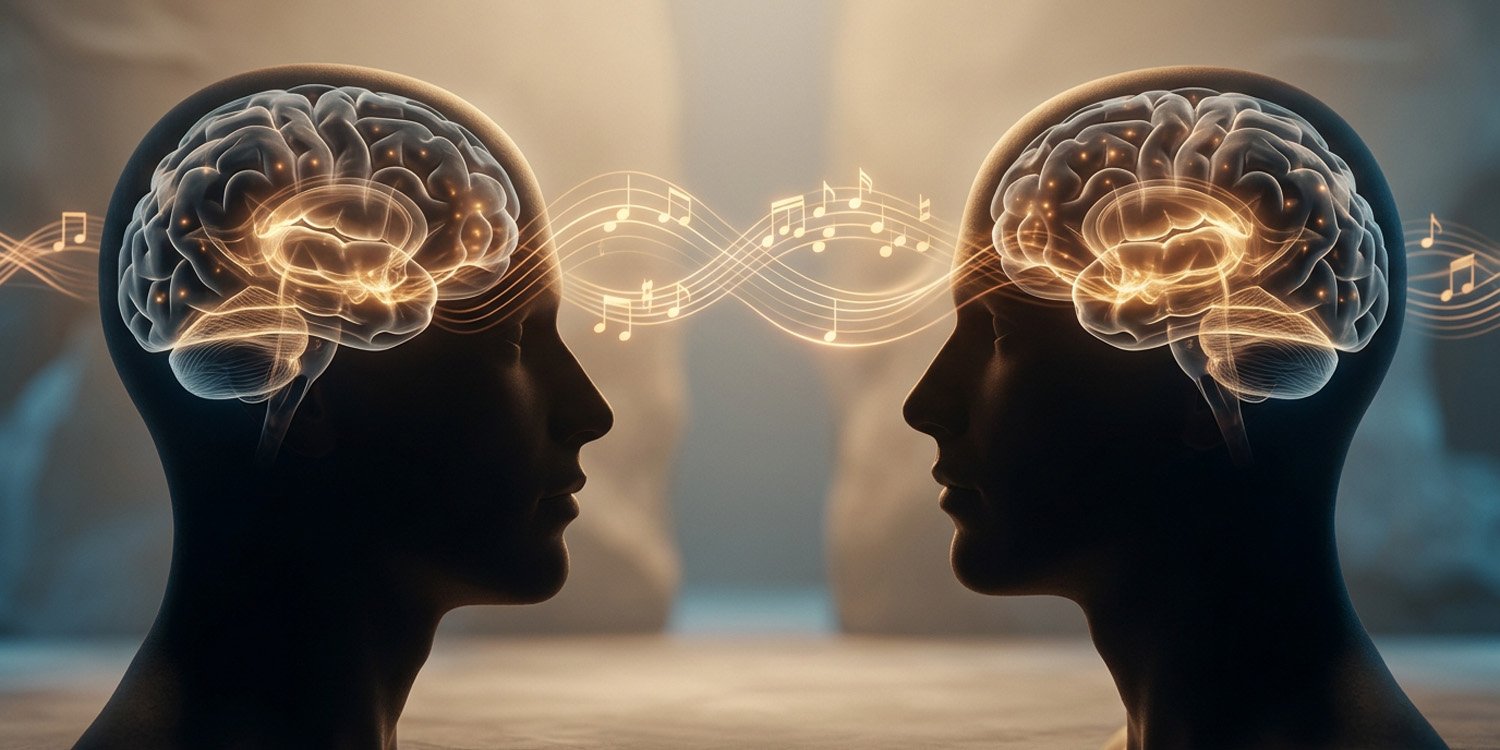
A new study shows evidence that listening to familiar, predictable musical chord progressions while making eye contact with another person increases activity in parts of the brain associated with social interaction. This combination of music and eye contact also tends to make people feel more socially connected to each other. These findings recently neuroscience journal.
The authors conducted this study to investigate the exact brain mechanisms that explain why music brings people together. Many people experience a sense of connection through music, but the biological processes behind this feeling are largely unknown. The main motivation was to explore how certain musical elements could ultimately be used as a treatment for symptoms associated with social isolation.
“The question of how and why listening to music enhances social behavior has a long history in neuroscience,” said study author Joy Hirsch, the Elizabeth Mears and House Jameson Professor of Psychiatry, Comparative Medicine, and Neuroscience at Yale School of Medicine. Hirsch, who is also director of the Brain Function Research Institute and affiliated with Yale University’s Wu Tsai Institute, added that the main reason for exploring this topic is the possibility of developing music therapy to treat clinical conditions with social symptoms.
Study author AZA Stephen Alsop, assistant professor of psychiatry at Yale University and affiliated assistant professor at Howard University, shared his personal motivation for the study. “I’m a lifelong musician and professional independent artist, as well as a physician-scientist,” Allsop explained. “I have always been fascinated with understanding how sound activates neural circuits and promotes social connection and healing.”
Allsop also serves as director of the Center for Mass Healing and medical director of the Center for Rapid Assessment, Stabilization and Treatment.
“This study allowed us to directly test what we have observed as musicians about how chord progressions shape people’s responses to music, especially in social settings such as music concerts and church,” continued Allsop. “It’s very gratifying to be able to start addressing these questions that I had as a musician through a scientifically validated tool and think about how I can use this information to help patients.”
Another reason this research is happening now is because of new brain scanning tools. Previous brain scans required people to lie completely still inside large, noisy machines, making natural social interaction impossible.
“Before this paradigm shift, functional imaging was primarily performed in MRI scanners without the possibility of real social interaction,” said Hirsch. “New dual-brain technologies, along with advances in multimodal approaches such as neural variables and synchronized behavioral variables, dramatically expand opportunities to study questions such as how music interacts with neural systems that enhance social behavior.”
To conduct the experiment, scientists recruited 40 healthy adults, 20 men, 18 women, and two non-binary people. The average age of participants was approximately 27 years. These people were divided into groups of 20 pairs. The pair sat across from each other across a table separated by a specially designed glass that could switch between transparent and opaque on the fly.
The researchers recorded the participants’ brain activity using a technique called functional near-infrared spectroscopy. This method uses a special cap fitted with a small sensor that shines safe, low-level light onto the scalp to measure changes in blood oxygen levels. Active brain areas consume more oxygen, so this technology allows scientists to map brain activity while participants sit and interact normally.
During the experiment, participants listened to two different types of music tracks. One track featured a predictable, harmonious chord progression that is very common in Western popular music. The other track had the exact same notes and instruments, but the timing and structure of the piano and bass were completely disjointed, making the melody unpredictable. Both tracks featured the same steady drumbeat.
As participants listened to music, the glass between them moved back and forth. At times the glass was transparent, allowing the two to make natural eye contact. Sometimes the glass fogged up, blocking each other’s view. After each round of listening, participants used a digital dial to rate how socially connected they felt with their partner on a scale of 0 to 5.
Scientists found that feelings of social connection peaked when participants looked at each other while listening to structured and predictable chord progressions. “There are some take-home messages,” Hirsch explained. “Music with predictable chord progressions (unlike typical jazz, for example) was found to be most effective in increasing a sense of social connection.”
Brain scans revealed that specific areas light up during this exact combination of eye contact and predictable music. The right angular gyrus, a brain region involved in processing social information and understanding events, showed increased activity. The researchers also observed increased activity in the somatosensory association cortex, an area normally associated with physical touch and sensation, and the prefrontal cortex, which deals with complex planning and social behavior.
“We believe these findings are the first to break through traditional barriers that have traditionally prevented rigorous studies of how raw social influences are modified by music and the underlying neural systems that mediate social cognition,” Hirsch said. “There are specific areas of the brain that respond to the combination of living faces and structured chord progressions. There are also specific areas of the brain that are associated with subjective feelings of social connectedness, evoked by both the mutual gaze and predictable chord progressions of living faces.”
In addition to measuring individual brain activity, the researchers looked at how the two participants’ brains synchronized with each other. They observed that while listening to structured music face-to-face, the two partners’ brain waves began to mirror each other. This brain synchronization suggests that the pair was experiencing a shared state of social cooperation and emotional congruence.
The authors noticed some unexpected elements in the data. “The main finding is that predictable chord progressions enhance the social nervous system and the perception of social connections between people, which is surprising because without this finding there would have been no basis for such predictions,” Hirsch said. “These findings allowed us to propose a new hypothesis that the predictability of music enhances natural socially interactive behavior and also predicts the reactions of others.”
Hirsch added that this common anticipatory behavior may be a core feature of human bonding. “The idea is that predictable music may upregulate this unique social mechanism,” she explained. “Of course, this idea requires further testing.”
Alsop also highlighted unexpected details about the brain regions involved. “We were surprised to see the apparent involvement of the somatosensory cortex in music-based social connections,” Allsop said. “This suggests that our sense of social connection is mediated by this part of the brain, which is known to be important for physical sensations. How musical features can activate this area as a mediator of social connection remains a mystery.”
These observations suggest that songwriters and composers may be tapping into basic human biology. “Familiar and common musical chord progressions make us feel more connected through the activation of neural networks that are important to how we process social information and feel subjectively connected,” Allsop explained. “Musicians probably arrived at these songwriting formulas intuitively because they felt the effects on their neurophysiology.”
The authors noted that there are several limitations that should be considered for future directions. Because measuring social connectedness is based on personal feelings, different people may interpret the concept of connectedness differently. Future research should use multiple methods to measure these emotions, perhaps including questions about how comfortable participants felt with the music.
“This study is the first ‘proof of principle’ that music is a salient and potentially therapeutic stimulus,” said Hirsch. “To harness the full potential of music for medical applications, we need a clear understanding of its neural mechanisms of action. This study provides a fundamental starting point for more sophisticated quantification of the music-social brain interface.”
Hirsch also pointed to the logistical challenges of doing this type of work. “This study took several years to complete because there was no dedicated funding,” she said. “The importance of funding for this type of research cannot be overestimated, and safeguarding funding mechanisms is paramount to future progress.”
Looking ahead, researchers hope to apply these concepts to real-world settings to help people with specific mental health needs. “Our next step is to understand not only how these specific features can activate the unique neural networks we are observing, but also how these features can be used to deliver music-based treatments for a variety of conditions such as anxiety, depression, schizophrenia and autism,” concluded Allsop.
“One of the very exciting next steps in this area of research is clinical trials to test the clinical benefit and how it is realized,” Hirsch added.
The study, “Hearing consonant progressions with face-to-face gaze enhances neural activity in the social system,” was authored by Dash A Watts, AZA Stephen Allsop, Simone Compton, Xian Zhang, J Adam Noah, and Joy Hirsch.
