


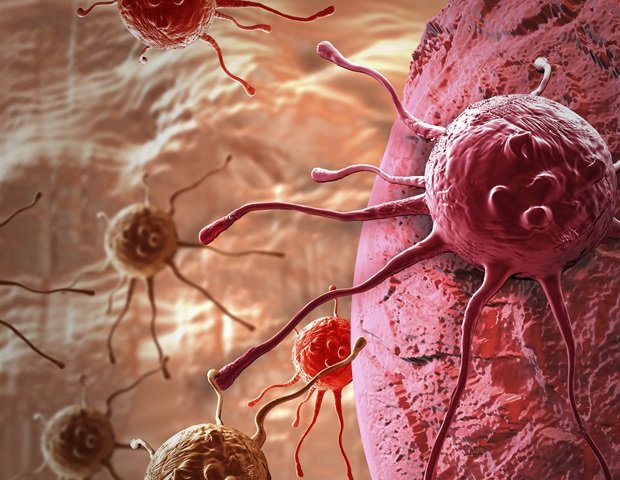
A new analytical method allows scientists to accurately track where drugs accumulate in living cells for the first time, potentially improving the way cancer treatments are designed. Researchers at the University of Surrey and King’s College London have developed a method to detect trace amounts of metals in individual living cells and their internal compartments without first killing the cells.
The study, published in Spectrochimica Acta Part B, looked at a type of cancer treatment called targeted radionuclide therapy. It works by attaching radioactive particles to molecules that seek out tumor cells and delivering radiation directly to the cancer. Where within the cell the drug reaches is important. Once the drug reaches the nucleus, it targets the DNA and damages the cancer. Until now, there was no reliable way to measure this in living cells.
Dr Monica Felipe Sotelo, study co-author and senior lecturer in radiochemistry and analytical chemistry at the University of Surrey, said:
“We developed this method using two specialist facilities: the SEISMIC facility at King’s College London and the ICP-MS facility at the University of Surrey. By working together, we were able to combine the steps of cell sampling and metal detection into one workflow for the first time. This combination made it possible to examine not only whether a drug entered the cell, but also precisely where it went once it entered the cell.”
The researchers used tiny glass capillary tips, 10 micrometers wide for whole cells and 3 micrometers wide for subcellular structures, to extract material from individual living pancreatic cancer cells and their interiors under a microscope, including the cells’ powerhouses, the mitochondria.
King’s SEISMIC facility, a Biotechnology and Biological Sciences Research Council-funded specialist system for extracting material from single living cells, provided the sampling capabilities. Surrey’s Laser Ablation Inductively Coupled Plasma Mass Spectrometry (ICP-MS) facility has enabled the detection and measurement of thallium present using LA-ICP-MS. LA-ICP-MS is a technique that uses a laser to vaporize trace amounts of materials before a mass spectrometer identifies and quantifies the metals inside. The combination of capillary sampling and LA-ICP-MS at the subcellular level has never been performed before.
The researchers used thallium chloride as a chemically stable alternative to thallium-201, a radioactive isotope being investigated as a potential cancer treatment. For the first time, thallium has been successfully detected in minute amounts within individual cancer cells and in mitochondria-rich material extracted from those cells.
Thallium-201 is attracting attention as a potential cancer treatment precisely because its radiation acts over a very short distance. This means it may be possible to destroy tumor cells while sparing the surrounding healthy tissue. But that accuracy goes both ways. This means that for a drug to do its job, it must eventually reach the right part of the cell. This method provides a way to discover it in living cells for the first time and is an important step toward making this type of therapy work in practice. ”
Dr Claire Davison, King’s College London
Dr Danny Beste, Senior Lecturer in Microbial Metabolism at the University of Surrey, said:
“The possibilities here go far beyond cancer. Metals play important roles in a wide range of diseases, from infections to diabetes to liver disease, but there are few tools to study exactly where metals accumulate inside cells. This methodology provides a way to do it with a level of precision, in conditions much closer to biological reality. This opens up many questions that could not be asked before.”
Professor Melanie Bailey from King’s College London said:
“We continue to develop this methodology at our SEISMIC facility and are working with a variety of users to determine exactly where other drugs go when they enter cells and what they do when they get there.”
The technique could be extended beyond cancer research to study how metal-based drugs and toxic substances are distributed within living cells. The researchers identify an important next step to extract additional cellular compartments, including the nucleus, where radiation damage to DNA occurs. Improving methods to verify the purity of extracted intracellular material has also been identified as a priority for future development.
sauce:
Reference magazines:
Davison, C. others. (2026). Combining intracellular capillary sampling with laser ablation-inductively coupled plasma-mass spectrometry (LA-ICP-MS) enables targeted analysis of thallium in radiopharmaceutical models. Spectrochimica Acta Part B: Atomic Spectroscopy. DOI: 10.1016/j.sab.2026.107521. https://www.sciencedirect.com/science/article/pii/S0584854726000728.
