


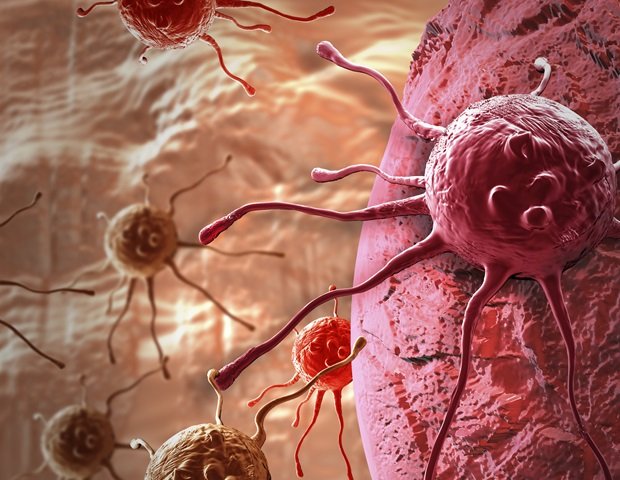
Anticancer drugs can shrink rapidly growing tumors. However, sometimes a small number of tumor cells survive. These “persistent” cells seed new tumors and force cancer patients into difficult cycles of testing and treatment.
The problem is that persistent cells are rare, making up about 1 in 1,000 tumor cells, and they are difficult to find because they are genetically identical to the tumor. Moreover, their tenacity may be temporary, and by the time scientists can transfer them to petri dishes, the properties that helped them survive may have faded.
To find a way to overcome them, researchers at the University of California, San Francisco have built a robotic system that treats thousands of small tumors at once in the lab. This platform allows scientists to systematically identify, track, and treat surviving cells. It revealed common characteristics among persister cells that may help explain why cancers recur, characteristics that could be exploited in future drug treatments to defeat cancer.
A few years ago, people were still wondering if persister cells were real. Now you can find them and test ideas on how to eliminate them. ”
Xiaoxiao “Vany” Sun, Ph.D., first author of the paper and associate research scientist in the UCSF Department of Pharmaceutical Chemistry
Here are the findings: scientific progress June 12th.
The team assembled 94 drug candidates that other labs had flagged as having potential for sustained therapy. They wanted to test each drug at different doses in persistent patients with two types of lung cancer treated with standard therapy. It requires 10,000 painstaking experiments over a week, so we built a robotic platform to eliminate manual labor and inconsistent work.
Thousands of small tumors were in stacks of 384-well plates in a controlled incubator. A robotic arm, like those used in drug screening, moved the plates between experimental stations.
One station used sound waves to deliver tiny, precise doses of drugs to each tumor (first for lung cancer treatment, then for an experimental sustained therapy). Other stations stained tumors with antibodies and took microscopic images of each tumor or group of survivors.
Of the drugs tested, nine consistently weakened persister cells. This suggests that persister cells may have common vulnerabilities, even if they emerge under different treatment conditions.
The team plans to expand the platform to include more tumor types and treatment conditions. They hope the resulting dataset will become a resource to help researchers eliminate persister cells before they cause drug-resistant disease.
“We expected each tumor to act as its own special case,” said Dr. Steve Altshuler, professor of pharmaceutical chemistry at UCSF and co-senior author of the paper. “Instead, we found a pattern that held true across many different samples, suggesting there may be underlying rules that help predict which treatments will be most effective.”
sauce:
University of California, San Francisco
Reference magazines:
Sun, X, Others. (2026). ResMap: A community resource for systematically mapping treatment persistence residual cancer cell dependence across contexts. scientific progress. DOI: 10.1126/sciadv.aed7476. https://www.science.org/doi/10.1126/sciadv.aed7476
