


If the draft report submitted to the state last week by the Coastal Resources Board’s science committee was a master class in explaining beach erosion processes along the state’s 320 miles of Atlantic coastline, some state lawmakers may have been hoping they could skip the lesson.
Just days before lawmakers rushed to introduce a bill to the Senate Appropriations Committee that would lift a 40-year ban on hardened structures along beaches, Science Committee Chair Dr. Laura Moore, a professor in the Department of Earth, Marine, and Environmental Sciences at the University of North Carolina at Chapel Hill, presented the committee with a 47-page draft report titled “Report on the Impact of Hard Structures on Sandy Open Ocean Shorelines” during Thursday’s regular meeting in New Bern.
Senate Bill 1009, which lifts the ban on reinforced structures such as breakwaters, bulkheads, seawalls, piers, seawalls, and end groins, was introduced Wednesday by the Senate Agriculture Committee in the Appropriations Committee.
Another related bill, Senate Bill 1001, was also referred to the same committee. The measure would allow state funds to be used for permitting, construction and repairs of the Terminal Groin, a sand-trapping wall built perpendicular to the shore of an inlet.
Moore is a coastal scientist who has conducted extensive research on the North Carolina coast with colleagues on a nine-member scientific committee. The panel’s draft report is divided into sections: introduction to shoreline change and dynamics, and erosion control practices. The impact of structures that trap and block sand. A case study of some structures and lessons learned. Coastal erosion policies of other countries. And finally, while some recommendations were made based on the best science and engineering, they offered no easy solutions to address the alarmingly severe erosion along parts of the coast or ways to protect coastal infrastructure.
This report aims to provide scientific and technical information to policy makers, regulators and legislators.
“Section 2 is really the heart of the report, and this is where we talk about the impacts of sand-trapping structures and shoreline hardening structures: purpose, physical impacts, adverse impacts, and ecological impacts,” Moore said. “We frame all of this primarily in terms of tradeoffs because there are benefits and costs. And really, it’s all about tradeoffs.”
Pointing to a slide diagram of a section of the coast showing sand moving in and out of an area, Moore explained that whether there is accretion or erosion is a result of wave processes and the orientation of the coastline on the ocean floor offshore, whether more sand is moving in and out of different parts of the coast.
“When I teach this in class, I tell my students, ‘This is just like your checkbook,'” Moore told the committee. “If you’re adding more money than you’re spending, your balance will be positive and you’ll be in the black. And if you’re actually withdrawing more money than you’re adding to your checking account, you’ll be in the red. For this coastline, we’re going to be eroded.”
Moore said it’s not the major hurricanes that are causing the most dramatic destruction currently seen on Hatteras Island in Dare County. Thirty-two houses on the island have collapsed into the sea in Rodanthe and Buxton in recent years.
“If you think about the issues that need to be addressed along the coast, storm impacts are probably the first thing that comes to mind,” she said. “However, it is chronic erosion over time that makes homes and infrastructure vulnerable to storm impacts. Most of our coastline is naturally eroded to varying degrees over long periods of time, and in some places, such as the northern flank of Cape Hatteras, the natural background erosion rate is very high. Between 1852 and 1946, and for many centuries before, it eroded at a rate of more than 20 feet per year.”
But Moore added that waterfront building codes are generally based on a 30-year setback, even though buildings have a life expectancy of 30 years or more. Another complication is that the effects of large storms are reaching more landmass and will become even more pronounced in the future, she said, noting that sea levels are expected to be about a foot higher by 2050 than in 2000. As with other climate impacts, “mitigating erosion and trying to protect infrastructure or reduce risks to infrastructure is unfortunately going to become increasingly difficult,” Moore said.
During the public comment portion of the meeting, Buxton resident Brian Harris, representing the Hatteras Island Village Citizens Association, urged the commission to support the proposed legislation and a “responsible, modern approach” to erosion control. He described the devastation in Buxton as “not just a failure of nature, but a failure of humanity”, but urged the committee to seek a bipartisan approach and work in partnership to find innovative solutions.
“Coastal Policy, drafted 40 years ago, was never intended to be a suicide pact for our nation’s coasts,” Harris said. “Hatteras and Ocracoke are currently in a state of emergency. As North Carolinians, we can all do better.”
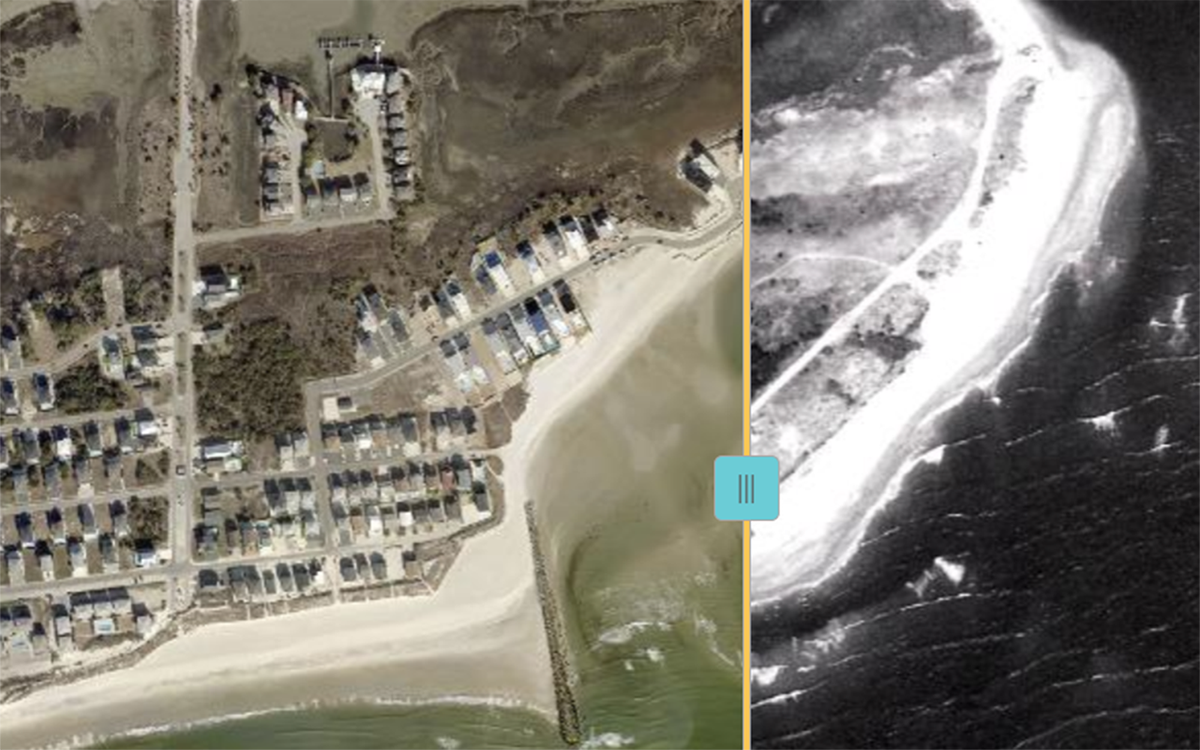
But after decades of flashing early users of seawalls and groins, as exemplified by the thin beaches in front of New Jersey’s seawalls, coastal scientists are warning that barriers and sand traps are robbing beaches of sand by causing drift erosion and blocking the movement of sand to the shoreline.
“North Carolina lawmakers have maintained this policy for generations because these structures don’t work,” Zach Wallace, Audubon North Carolina policy director, said in a prepared statement June 11. “They take sand from other parts of the beach, worsen erosion, and put habitat and coastal areas at greater risk. It’s like balancing a budget by shifting debt onto someone else’s books.”
In its recommendations at the end of its report, the Scientific Committee urged careful consideration of adverse impacts and the use of experts before proceeding with proposed projects. Projects are almost always expensive and long-term endeavors. Even emergencies like the Hatteras Island house collapse can’t change the reality of a hardened coast.
“While the Buxton case study shows that the groin area where erosion occurs may be temporarily altered, it does not exclude an underlying erosive process,” one of the recommendations states. “Furthermore, maintaining the intended shoreline position requires regular replenishment, and hardened structures deteriorate over time and can be damaged during storms, necessitating repeated structural repairs and emergency measures.”
