


Quantum entanglement is one of the strangest features of the quantum world. This refers to a situation in which particles such as photons are deeply interconnected, and their properties cannot be completely understood one by one. Instead, you need to treat the system as a whole. This idea is in sharp conflict with the classical view that every particle should have its own independent reality, and this conflict famously troubled Einstein.
Today, tangles are more than just philosophical puzzles. This is a key element in many technologies that researchers hope will define the future, including quantum computing, quantum communications, quantum teleportation, and quantum networks.
The challenge of reading quantum states
Building these technologies requires scientists to do more than create entanglements. We also need a reliable way to know exactly what kind of entanglement we have created.
That’s the difficulty of the problem. A standard method called quantum tomography can estimate the quantum state, but as more photons are added, the number of measurements required explodes. For systems consisting of many entangled photons, it causes a severe bottleneck.
A more powerful solution is entanglement measurement, which allows specific entangled states to be identified in a single shot. Scientists had already demonstrated this type of measurement in the Greenberger-Horn-Zeilinger (GHZ) state. But another major type of multiphoton entanglement, the W state, remained out of reach. Prior to this work, such a measurement of the W state had not been proposed or experimentally demonstrated.
Scientists target the elusive W state
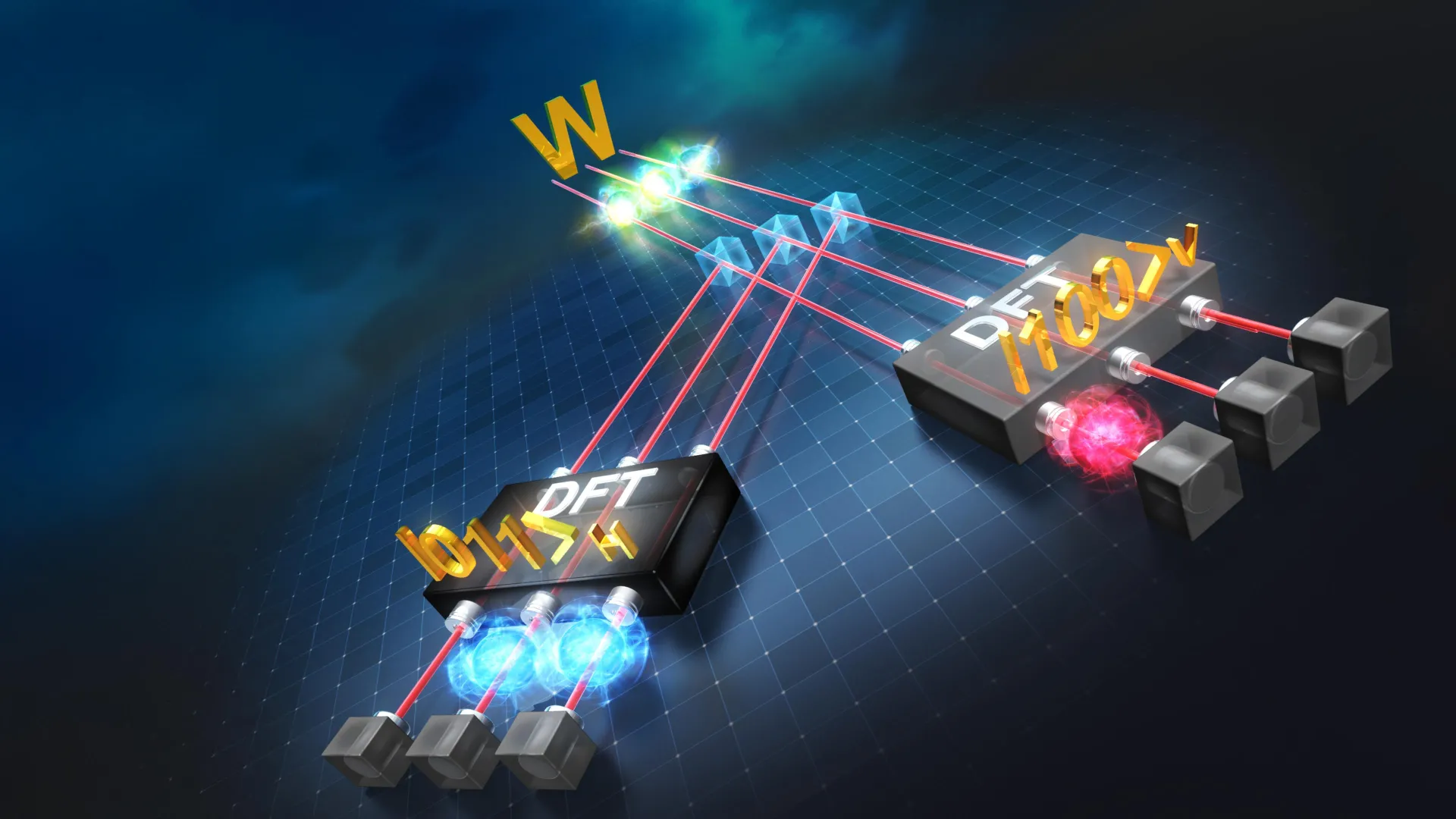
A team from Kyoto University and Hiroshima University set out to address that missing piece. Their work led to a method to perform entanglement measurements that can identify the W state through an experimental demonstration using three photons.
“More than 25 years after the first proposal for entanglement measurements of the GHZ state, a true experimental demonstration of the three-photon W state finally provides an entanglement measurement of the W state as well,” said corresponding author Shigeki Takeuchi.
This breakthrough came from focusing on a special feature of the W state known as cyclic shift symmetry. Taking advantage of its properties, the researchers proposed an optical quantum circuit that performs a quantum Fourier transform of the W state with an arbitrary number of photons. In practical terms, this provided a way to turn the hidden structure of the W state into a measurable signal.
Stable device made from light
To test this idea, the team built a device for three photons using highly stable photon quantum circuits. This system was able to operate for long periods without active control. This is an important feature for future quantum technologies that cannot rely on fragile and constantly adjusted laboratory setups.
The researchers inserted three single photons into the device with carefully chosen polarization states. The device then identified different types of three-photon W states. Each of these states represented a specific nonclassical correlation between the three incident photons.
The team also evaluated the fidelity of the entanglement measurements. In this case, fidelity refers to the probability that the device will give the correct result if the input is a pure W state.
Why is it important for quantum technology?
The result could help advance quantum teleportation, which transfers quantum information rather than moving matter from one place to another. It could also support new quantum communication protocols, multiphoton entangled state transfer, and new approaches to measurement-based quantum computing.
“To accelerate research and development in quantum technology, it is important to deepen our understanding of fundamental concepts and generate innovative ideas,” says Takeuchi.
This effort fits into broader efforts to move quantum communications and optical quantum systems from delicate laboratory demonstrations to more scalable platforms. Since the 2025 W-State survey, related advances have continued across the field. In late 2025, researchers demonstrated all-photon quantum teleportation using photons from individual quantum dots in a hybrid urban network. In 2026, another team reported an integrated photonic chip that can generate, manipulate, and measure multipart cluster state entanglement on a single device. Although these results are not a direct extension of W-state experiments, they demonstrate why better control and measurement of complex entanglements remains of great importance.
Quantum networking is also moving into real-world infrastructure. In 2026, researchers tested a three-node quantum network across an existing fiber optic cable in New York, using entanglement swapping to connect quantum links into smaller networks. Advances of this kind highlight the long-term need for accurate entanglement measurements, as future quantum networks will depend on the ability to create, route, verify, and transport fragile quantum states.
Towards larger quantum systems
The Kyoto University and Hiroshima University teams now plan to extend the method to larger and more general multiphoton entangled states. They also aim to develop on-chip optical quantum circuits for entanglement measurements.
If successful, this effort could make the ability to read complex quantum states faster, smaller, and more practical. For technologies built on entanglement, this would be an important step toward systems that can reliably move quantum information through future computers and networks.
