


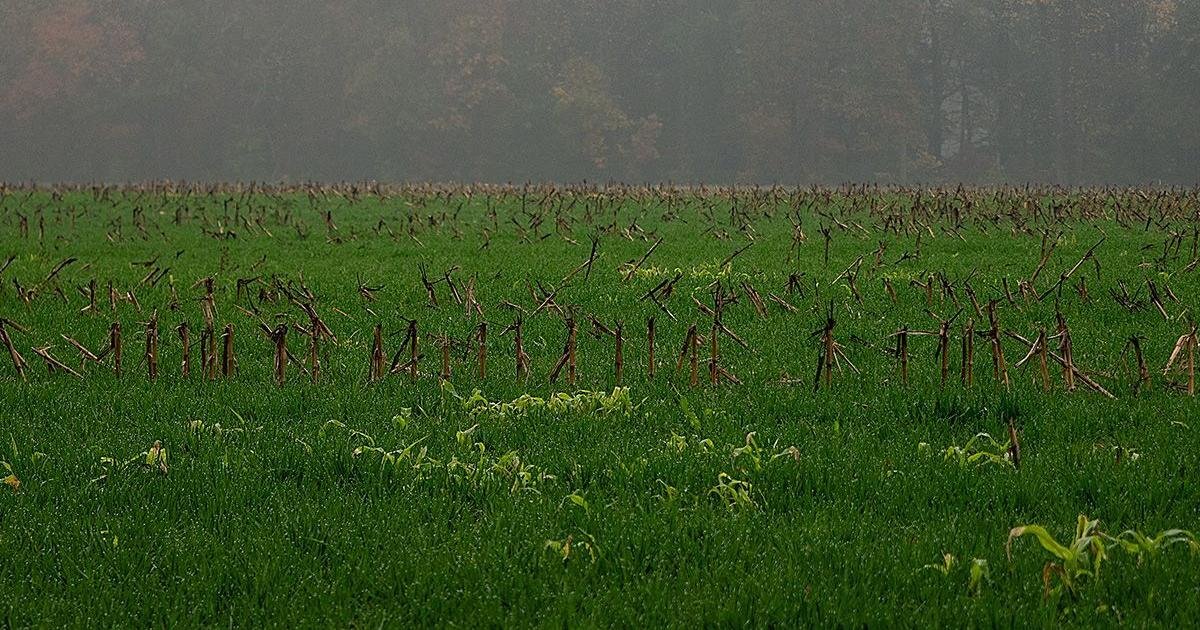

The Thriving Ag project supported research in Maryland to better monitor when and how nutrients that cause water pollution leave fields. (Dave Harp)
Farming in the Chesapeake Bay watershed is difficult. Part of the reason is that much of it takes place in the shadow of urbanizing landscapes, often bringing farmers in close proximity to people who don’t like the smell of freshly applied fertilizer or who have concerns about dust, chemicals, and water quality.
Will those groups be able to coexist for decades to come?
For more than six years, dozens of researchers and students from the region have been thinking about what the landscape of sustainable “thriving agriculture” will look like 25 years from now.
As is often the case in agriculture, the answer is complex and full of trade-offs.
“People often talk about water quality and agricultural profitability and farm survival as contradictory things,” said Dave Abler, an agricultural economist at Penn State University who led the project. “In a sense, I think so. This project started with the idea that there are areas where we can achieve victory in both categories.”
Indeed, while we found opportunities to improve both water quality and conservation programs, the study also identified significant long-term headwinds from climate change and ongoing agricultural intensification.
The findings, summarized in a recently completed final report, challenge some conventional wisdom. For example, the belief that people will pay more for locally produced food, or that taking agricultural land out of production will significantly reduce pollution runoff.
The official name of the project is “Thriving Agricultural Systems in Urbanized Landscapes.” The emphasis is on urbanized landscapes, as approximately 95% of the Bay Basin’s agricultural income comes from counties adjacent to metropolitan areas, compared to about 60% nationally.
Project findings
Farms in areas adjacent to cities face the “double challenge” of not only direct development pressures, but also exacerbating the impacts of development-induced climate change, such as increased flooding, rising local temperatures and changes in soil moisture.
The project’s research found that encroaching development can encourage farmers to participate in conservation programs, as they face increased scrutiny from people who dislike the smells and noise associated with farming.
But the researchers found that some of these measures, particularly those that improve the appearance of land, such as forest buffers along streams, can actually increase the value of land to developers.
Although the report does not paint a picture of what “thriving agriculture” will look like in mid-century, it does highlight the challenges and opportunities. And a difficult question.
For example, researchers found that despite growing interest in locally grown food, most people who shop at grocery stores aren’t willing to pay more for it. In fact, they thought local food should be cheaper. The exception was the countryside. People there were willing to pay more.

According to the Thriving Ag project, cover crops absorb nutrients left in the field after harvest, but it is often too late to be fully effective. (Dave Harp)
Similarly, “decommissioning” agricultural land, or removing it from productive activities, is considered one of the most effective ways to reduce nutrient pollution in the Bay and its rivers, as it reduces the use of fertilizers. But researchers have found that these benefits are often smaller than expected because acreage is often replaced by producing crops on land that was previously pasture or fallow. Nationally, for every 100 acres of cultivated land retired under the federal Conservation Reserve Program, nearly 80 acres of previously uncultivated land are brought into production.
Incentive programs that encourage farmers to use less fertilizer are more effective in achieving nutrient reductions, the study found. But even that wasn’t clear. Reduced fertilizer use increases profitability and provides additional land for production.
One of the most important results of this project was the development of a calculator to better estimate the amount of nitrogen, a nutrient required for corn growth. Corn is the most widely grown crop in the region and the crop that often leaks the most nitrogen into the environment.
Developed by researchers at Penn State University, this calculator better takes into account nitrogen in the soil from the previous year and from other sources when making fertilizer application recommendations.
Tests on seven farms in Lancaster County found the tool reduced average nitrogen recommendations by 48 pounds per acre without compromising production. The greatest fertilizer reductions were seen on farms that had been applying fertilizer for a long time.
This suggests that “many farmers have a significant opportunity to reduce (nitrogen) fertilizer application to corn,” saving money and reducing runoff, the report says.
Many projects related to cover crops also present opportunities and caveats.
Researchers found that while cover crops have great potential to absorb excess nitrogen in the field in the fall, they are often planted too late to be fully effective. And plants often die out too early in the spring to improve soil health. They suggested changing incentive programs to encourage earlier cover crop planting and later end dates.
The improved soil health associated with cover crops benefits farmers beyond water quality. One study found that cover crops increased average yields of corn and soybeans by 9%, while reducing soil loss and improving nutrient uptake by plants.
Other studies have found that cover crop mixtures that include legumes (plants such as clover and vetch that pull nitrogen from the atmosphere and put it into the soil) can reduce the need for fertilizers without compromising the water quality benefits of cover crops.
Some projects that conducted detailed field-level monitoring found that most of the nitrogen lost to surface runoff occurred in a small number of rainfall events, suggesting that management practices should be designed to control heavy rainfall.
Because so many researchers come from land-grant universities in the basin (universities that focus on agricultural research and support), Abler said some of the research findings on crop management and fertilizers could become recommendations given to farmers in the coming years.
Other studies can also help inform support efforts. It was confirmed that funding is the most important factor to further implement farm conservation practices in the field. But we also found that improving our marketing to farmers could be helpful. For example, showing before and after pictures of a stream buffer increased interest significantly compared to a simple description.
Future of agriculture
Meanwhile, forward-looking research has found that climate warming poses challenges to profitable agriculture, as increased heat stress steadily reduces crop yields over time. Corn yields are projected to decline by 15% from 2050 to 2080 compared to current yields.

The Thriving Ag project found that climate change is likely to increase nutrient runoff from fields and reduce corn yields in the coming decades. (Dave Harp)
Reduced crop growth could increase nutrient runoff from fields, leading to worsening water quality from mid-century onwards.
A big-picture computer modeling study revealed how the Gulf region’s agricultural system is interconnected with broader markets.
Although the Chesapeake watershed imports large amounts of nutrients in the form of grain to feed animals, it actually exports more nutrients in food, primarily poultry, the study found. Without these exports, the amount of nitrogen in the basin would be even higher.
The modeling effort also found that agricultural intensification will make it difficult to meet future Bay nitrogen goals. In a “business as usual” scenario in which trends remain largely unchanged, nutrient runoff will increase by mid-century. Even some of the most aggressive nutrition reduction efforts, such as changing livestock diets and significantly reducing fertilizer use, have fallen short of the Bay’s cleanup goals.
The project, funded by the U.S. Department of Agriculture, has produced dozens of scientific papers by researchers and students, some of which are still in production.
In addition to researchers, we employed a team of stakeholders drawn from industry, conservation groups, and government agencies to ensure the research was grounded in reality.
“Academic modelers tend to oversimplify systems,” says Lisa Weinger, an economist at the University of Maryland Center for Environmental Science who worked on the Thriving Ag project. “I think we have proven to other academics that it is possible to effectively engage with farmers and get better inputs into the models, better scenarios, and better constraints on what policies to test.”
However, the project included one “disruptive” future scenario that many stakeholders did not like. That’s what would happen if most people switched to plant-based meat alternatives. This could lead to reduced livestock production and fertilizer use in the Bay Basin. However, it will also have a significant economic impact on agriculture, as two-thirds of farm sales in this basin come from livestock.
Again, the results were not clear-cut.
Preliminary results from the study estimate that the Susquehanna River, the Bay’s largest tributary, would likely meet its phosphorus reduction goals, but not fully meet its nitrogen goals, if people switched to a vegan diet that does not include animal products.
However, if people switched to a vegetarian diet in which they stopped eating meat and continued to consume eggs and dairy products, nitrogen loading on the Susquehanna would decrease by only 2.6% and phosphorus would increase by 13.3%.
The decline in meat consumption was more or less offset by increases in dairy and egg production.
Abrar noted that one possible development is that dietary changes here may not occur in other parts of the world. “If countries like China and India, which have four times the population of the United States, continue to increase their demand for livestock products, the Chesapeake Bay will continue to produce livestock products while exporting even more, perhaps even more.”
Read Thriving Ag’s final report here.
