


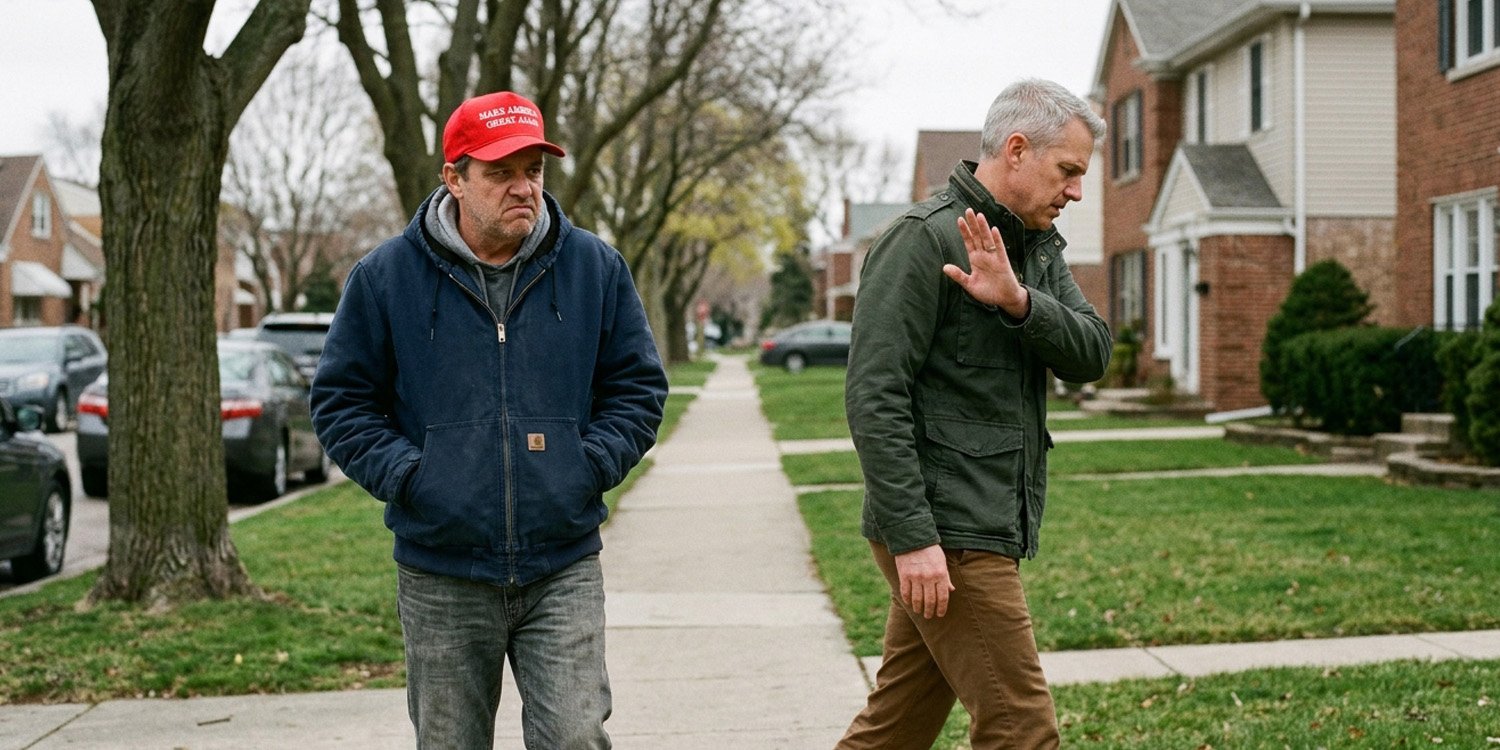
Recent research published in PNAS Nexus The study suggests that America’s political polarization is straining personal relationships, with more than one-third of Americans reporting losing a friend, family member, or loved one over political differences. This loss of relationships tends to further antagonize opposing voters, providing evidence that political divisions affect day-to-day social connections and psychological well-being.
Political polarization refers to the widening gap in political attitudes and growing aversion between members of opposing political parties. Democrats and Republicans are reported to have more negative feelings toward each other, and they tend to spend less time together in their daily lives. When choosing friends, spouses, and neighbors, people often look for people with similar political views. They may do this because they see political affiliation as a reflection of their core moral values.
Mertcan Güngör and Peter H. Ditto designed this study to understand the personal costs of these political divisions. Güngor said his interest in the topic grew from previous research on how people respond to offensive speech.
“I’m interested in how people react to speech and beliefs that they find morally offensive,” said Güngor, a doctoral candidate at the University of California, Irvine. “I had a project that looked at what people thought was an appropriate response to someone who posted offensive political content online. Some of the responses included social penalties such as being publicly censured and being excluded from colleagues.”
This led me to wonder how people apply these social punishments in real-life interpersonal relationships. “So I thought, how would people react if someone in their life held offensive beliefs?” Güngor explained. “Where do they draw the line and decide to cut that person out of their life?”
After running a series of studies using hypothetical scenarios, Güngor wanted to see what was happening outside the lab. “I wondered how often something like this happens in real life, and that became the ‘political divide’ thesis,” he said.
Güngor and Ditto wanted to measure how often these relationship endings occur, who initiates them, and how they affect how political opponents are viewed. The researchers defined political separation as the loss of a relationship with a friend, family member, or romantic partner due to political differences. They investigated this phenomenon across multiple datasets representing the U.S. population.
To investigate these trends, researchers analyzed data from four different studies that combined a total of 3,791 participants. The first study involved a nationally representative sample of 1,000 adult participants collected in April 2025. Participants answered a checklist question asking whether they had ever lost a relationship with a friend, family member, romantic partner, colleague, neighbor, or acquaintance because of political differences.
In this first study, researchers found that 37 percent of Americans reported experiencing political division. “When we looked at last year’s results, the overall prevalence of political division was quite shocking,” Güngor said.
Of those who reported losing a relationship, 62% lost a friend and 40% lost a family member. Another 29 percent lost a colleague and 10 percent lost a loved one. Most of these participants reported losing multiple types of relationships.
“I think the high percentage of Americans reporting political division is pretty surprising, but this is just too many cases,” Güngor told SciPost. “And we have to keep in mind that relationships don’t end but are strained in other ways. The influence of politics on our relationships can be broader than what our research can cover.”
The second study included 953 adult participants surveyed just before the November 2024 presidential election. In this study, researchers asked participants to focus on the political divide that affected them the most. This data provides evidence that friendships are particularly vulnerable, with 69% of the most impactful breakups occurring between friends. Only 20 percent of events were with family, and 5 percent were with a significant other.
Güngör and Ditto used this second study to see how these breakups occurred. They found that 48% of people who experienced a breakup reported that they were the ones who caused the relationship to end. About 27% said they were on the receiving end, and 20% said it was a mutual decision.
The researchers identified consistent partisan differences across all datasets. Democrats were more likely to report being politically divided than Republicans or independents. In the first survey, 47% of Democrats reported losing relationships, compared to 29% of Republicans and 39% of independents. Democrats are also much more likely to say they initiated the breakup, with 66% saying they ended the relationship, compared to just 27% of Republicans.
The third study looked at data from 1,000 adult participants collected in October 2017, focusing on the 2016 election breakup. The researchers compared these results to 2025 data, which asked about the divide caused by the 2024 election. They found that 14% of Americans reported breaking up in the 2016 election, and 18% reported breaking up in the 2024 election half the time. This comparison suggests that the prevalence of political divisions has increased in recent years.
The researchers supplemented these findings with data from the American National Election Study, which examined thousands of responses in 2020 and 2024. As an alternative, they used an indirect question asking participants how much their political differences had negatively affected their family relationships over the past four years. According to the data, 33 percent of Americans reported hurting their family relationships in 2020, rising to 39 percent in 2024.
Güngor and ibid. also investigated how political estrangement is related to individuals’ feelings toward political opponents. In the second study, participants used a rating scale from 0 to 100 to measure how warm or cold they perceived a particular group to be. Researchers found that people who experienced political division felt significantly colder toward opposing political candidates and the people who voted for them.
The researchers also found that people who experienced political division tended to have more negative perceptions of their opponents’ beliefs. “Another finding that I found surprising was that people who experienced political divisions had highly exaggerated perceptions of their opponents’ views,” Güngor noted. “Partisans are usually off the mark when asked to guess what the other person is thinking, but those who have experienced a breakup were completely off the mark.”
In the third study, participants were asked to estimate the proportion of voters of the opposing party who agreed with a particular extreme statement. “For example, in Study 3, Democrats were asked if they thought most white Americans were racist, and then Republicans were asked what percentage of Democrats thought they were,” Gungor said.
“Only 23% of Democrats said yes, but Republicans who did not report a breakdown already overestimate this number by 30 percentage points,” he explained. “Republicans who experienced dissolution overestimated even more. They thought 68% of Democrats would say most white Americans are racist.”
Researchers found this exaggeration across the political spectrum. “It wasn’t just Republicans who misunderstood their opponents; we found the same pattern among Democrats,” Gungor said.
“These misconceptions are typically attributed to partisans not having adequate contact with average people who vote, and instead relying on caricatures painted by partisan media and elites,” he added. “What’s interesting to me is that even though people who experienced political division would have been interacting with someone who thought differently in real life, their perceptions of their opponents were even worse.”
“American politics is so divisive that it’s tearing friends and families apart,” Güngor told SciPost. “I don’t want people to think I’m blaming individuals for making the difficult decision to end a relationship. I want them to draw attention to the circumstances in which someone might make such a decision. I think the phenomenon of political division is a clear demonstration of how familiar domestic politics has become for so many people.”
The authors noted several potential limitations to their findings, primarily related to the use of self-reported data. “I think the most important limitation is that we rely on self-reported measurements,” Güngor noted. “For example, one of the concerns is social desirability. Some people may not want to say they lost a relationship because of politics. Maybe they find it embarrassing.”
“On the other hand, some may say they did it because they thought it would make them look like good, loyal partisans,” he added. “While we attempted to address these concerns in supplementary analyses, we found no evidence that our results were influenced by social desirability, but it is still something to consider.”
These breakups can also be underestimated. “Another concern is that in the absence of arguments or confrontations, the people on the other end of the breakup may not know that they have been ‘dumped’ because of politics, so the proportion of cases that end in ‘ghosting’ is probably underestimated,” Güngor said.
Question wording can also influence how people respond to relationship surveys. “Another problem is that people may not know what counts as political division unless they specify something specific,” he explained. “For example, someone might have experienced a political breakup with an acquaintance, but they might report it because they don’t think it qualifies as a romantic relationship. I’m trying to make this measure as comprehensive as possible for future research.”
Because this study measured data from a single point in time, the researchers cannot prove an exact cause-and-effect relationship between hostility and breakups. Güngor hopes to study this mechanism in more detail in future research.
“We hope to follow participants over time to tease out the cause and effect of the associations we found,” Güngor said. “For example, we found that people who reported a political breakup were more hostile toward the opposition. But were they more hostile to begin with, which led to the breakup over politics, or did the breakup (or the negative interaction that led to the breakup) increase their hostility?”
The study, “Political Divide: The Interpersonal Impact of Polarization,” was authored by Merccan Güngör and Peter H Ditto.
