


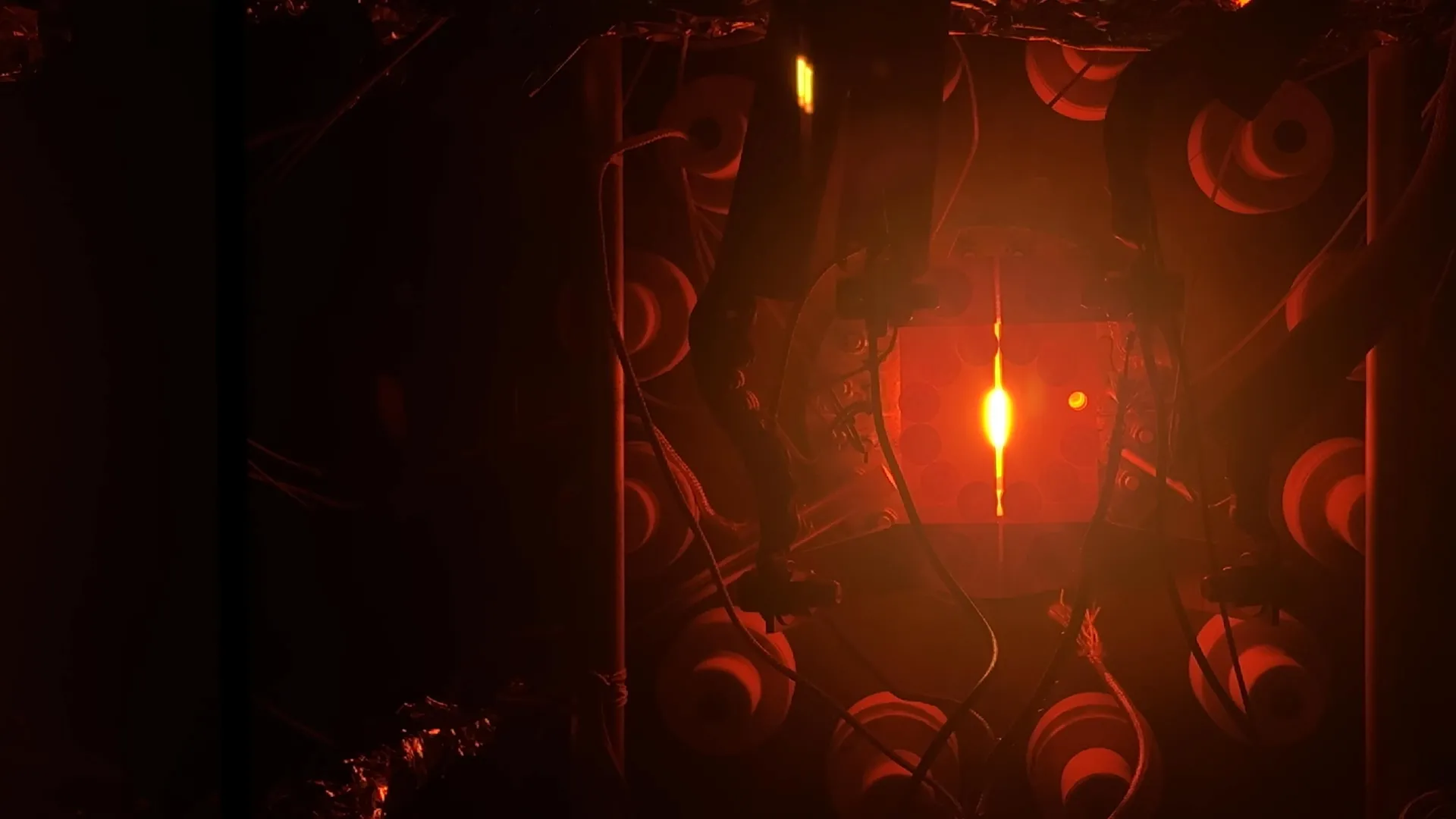
A new type of electromagnetic thruster has successfully completed initial tests at NASA’s Jet Propulsion Laboratory (JPL), offering a glimpse of how astronauts could one day reach Mars. If the technology is further developed, it could also power robotic missions throughout the solar system.
On February 24, engineers at JPL in Southern California conducted a large-scale test of an experimental engine, firing it at a higher power level than similar tests previously conducted in the United States. The thrusters run on lithium metal vapor and represent a major advance in electric propulsion.
This first test pushed the prototype beyond the capabilities of electric thrusters currently used on NASA spacecraft. The results are expected to guide a series of future experiments aimed at improving and extending the technology.
“At NASA, we work on many things at once, and we have never lost sight of Mars. The successful performance of the thrusters in this test marks real progress toward putting American astronauts on the Red Planet,” said NASA Administrator Jared Isaacman. “This is the first time in the United States that an electric propulsion system has operated at such high power levels, reaching up to 120 kilowatts. We continue to make strategic investments to power our next big leap forward.”
Extreme heat and high power inside JPL’s test chamber
During the five ignition cycles, the thruster’s central tungsten electrode heated up dramatically, glowing bright white at temperatures exceeding 5,000 degrees Fahrenheit (2,800 degrees Celsius). The tests were conducted within JPL’s Electric Propulsion Laboratory. The laboratory is equipped with a special vacuum chamber designed to safely evaluate engines that use metal vapor propellants at extremely high power levels.
How electric propulsion works
Electric propulsion systems are much more efficient than traditional chemical rockets, using up to 90% less propellant. Instead of a powerful burst of thrust, it generates a steady thrust over a long period of time, gradually accelerating the spacecraft to very high speeds.
NASA’s current missions already rely on this approach. For example, the Psyche spacecraft uses solar-powered electric thrusters to provide continuous thrust, eventually reaching speeds of 124,000 miles per hour.
The new engine being tested is a lithium-fed magnetoplasma dynamic (MPD) thruster. The concept has been around since the 1960s, but it has never been put into practice. Unlike existing systems, this design uses powerful electrical currents and magnetic fields to accelerate a plasma made from lithium, producing more thrust at higher power levels.
Record power levels and early successes
In this first test, the thruster’s power reached up to 120 kilowatts, more than 25 times the power of the engines currently flying on Psyche. This makes it the most powerful electric propulsion system ever tested in the United States.
“The design and construction of these thrusters over the past several years has been a long process leading up to this first test,” said James Polk, senior research scientist at JPL. “This is a big moment for us because we not only showed that the thruster works, but we also reached the power levels we were aiming for. And we know we now have a good test bed to start addressing scale-up challenges.”
Inside the test: glowing plasma plume
Polk observed the test through a viewing window in an 8-meter (26-foot) long, water-cooled vacuum chamber. When the thruster was activated, it generated a bright, glowing plume as the outer electrode heated up and released a stream of bright red plasma.
Polk spent decades researching this type of propulsion, contributing to early missions such as Dawn and Deep Space 1, which first demonstrated electric propulsion beyond Earth orbit.
Scale up for manned mission to Mars
The next challenge is to further increase the engine’s power output. Researchers are aiming for levels between 500 kilowatts and 1 megawatt per thruster in the next few years. Because the system operates at extremely high temperatures, engineers must prove that the system can operate reliably over long periods of time.
A manned mission to Mars could require 2 to 4 megawatts of total power. This could involve multiple thrusters working together for more than 23,000 hours.
Why Lithium Plasma Thrusters are Important
Lithium-fed MPD thrusters have several advantages. They can operate at very high power, use propellant efficiently, and generate more thrust than current electric propulsion systems. Combined with nuclear power, it can allow for heavier payloads for crewed missions while reducing the total mass required for launch.
This combination could make long-term missions to Mars more realistic and cost-effective.
Collaboration and future developments
The thruster has been in development for the past two and a half years. The effort is led by JPL, in collaboration with Princeton University in New Jersey and NASA Glenn Research Center in Cleveland.
The funding comes from NASA’s Space Nuclear Propulsion Project, which began in 2020 to advance key technologies needed for megawatt-class nuclear-electric propulsion systems. The program is based at Marshall Space Flight Center in Huntsville, Alabama, and is part of NASA’s Space Technology Mission Directorate.
