


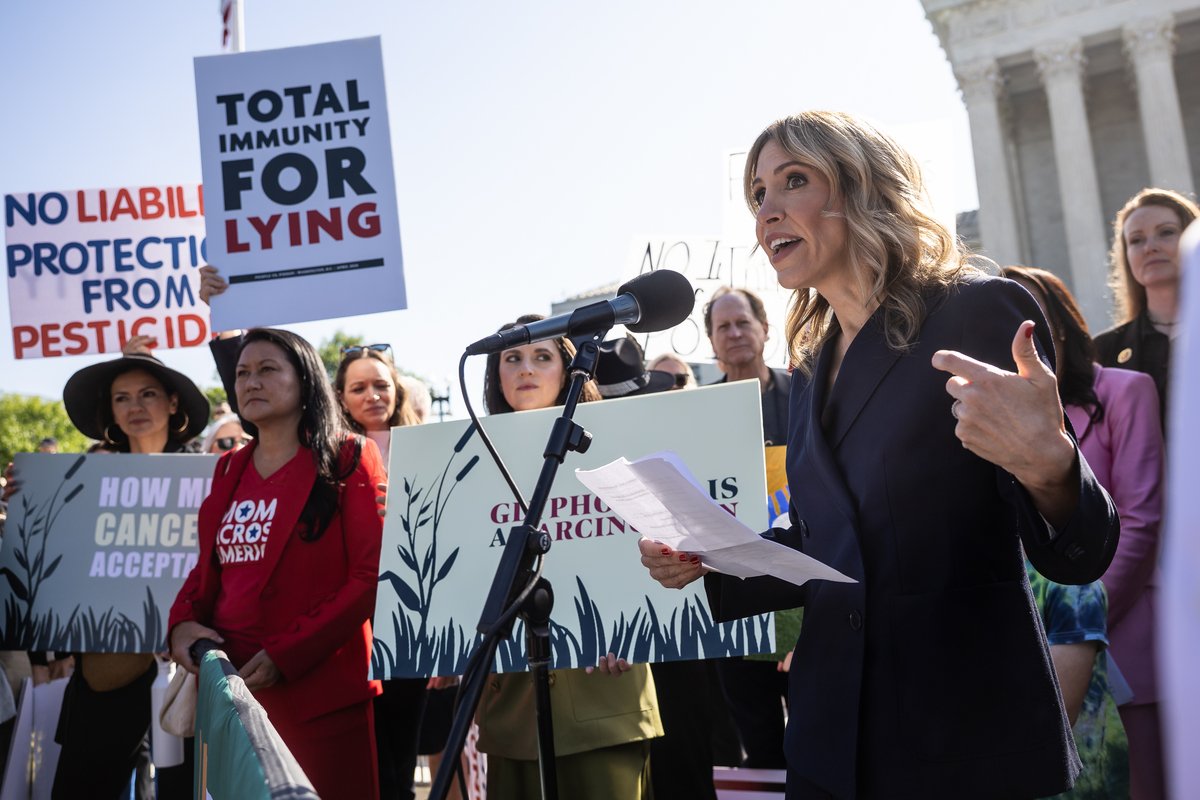
The Supreme Court’s decision to protect Roundup herbicide makers from cancer lawsuits is the latest in a series of rulings that the Coalition to Bring America Back to Health could hurt Republicans at the polls in November.
In a 7-2 decision Thursday, the nation’s highest court, encouraged by the Trump administration, reached an agreement with Bayer that federal law would prevent Roundup users from suing in state courts for failing to warn customers that the product’s active ingredient, glyphosate, could lead to cancer.
The Supreme Court’s decision closes the door on thousands of failure-to-warn lawsuits in state courts across the country, including one that resulted in a $1.25 million jury verdict against a Missouri man who developed non-Hodgkin’s lymphoma after using Roundup for decades.
“Today’s devastating SCOTUS decision was made possible by the Trump administration, which chose the interests of foreign pesticide manufacturers over the health of Americans, including children who grow up sick from exposure to toxic chemicals,” said MAHA influencer Kelly Ryerson, known online as “Glyphosate Girl.”
“This is inexcusable,” she continued. “We will let all voters know exactly how this domestic chemical attack happened.”
This is not MAHA’s first pesticide-related disappointment. The movement’s anger culminated in a protest outside the Supreme Court in April as the justices heard oral arguments in the case.
Earlier this year, after multiple meetings with Bayer executives and the agrochemical giant’s aggressive marketing efforts, President Donald Trump signed an executive order calling glyphosate critical to the U.S. food supply and triggering protections under the Defense Production Act.
Secretary of Health Robert F. Kennedy Jr., a former environmental lawyer who sued Roundup manufacturer Monsanto over alleged cancer risks, said at the time that he disagreed with Trump’s order. (Bayer acquired Monsanto in 2018.)
Glyphosate was one of two pesticides featured in a cross-agency MAHA committee report last spring that outlined factors that can cause chronic childhood diseases. But a second report released a few months later was much more agreeable to the pesticide review process, with a softer approach that MAHA supporters declared the result of corporate capture.
The EPA is expected to release a revised assessment of the herbicide’s health risks this fall, but so far “there is no evidence that glyphosate causes cancer in humans,” the agency’s website says.
In a post on social media site
“This is a defining moment. Every elected official now has a choice to make: stand with the families harmed by toxic chemicals, or stand with the companies that profit from toxic chemicals,” Hari wrote in the post.
The decision also drew the ire of Kentucky Republican Rep. Thomas Massie, who recently lost his primary bid to a pro-Trump opponent. The lawmaker called for amendments to the Roundup decision on social media Thursday.
“SCOTUS rules that Monsanto/Bayer cannot be sued for failing to warn even if their herbicide causes cancer,” Massey wrote in a post on X. “Even if the court’s legal reasoning in this case is sound, this is a blatant fraud on justice. Congress and the president can fix this, and we absolutely should.”
The Roundup decision also defeated the Supreme Court along non-ideological lines. In addition to Justice Brett Kavanaugh, the majority included liberal Justices Sonia Sotomayor and Elena Kagan.
Liberal Justice Ketanji Brown Jackson and conservative Justice Neil Gorsuch also dissented.
Bayer CEO Bill Anderson said in a statement following the Supreme Court’s ruling that the decision is “good for American farmers who feed the world” and provides regulatory certainty.
“This litigation has resulted in significant costs for the company and affected its public trust,” Anderson said. “This decision delivers overdue justice on a matter that should have come to light sooner. It’s time to put this matter behind us.”
Bayer said it expects the ruling will bring the Roundup lawsuit to rest after it has been in court for decades, noting that Monsanto continues to seek final approval of a proposed $7.25 billion class action settlement to resolve the glyphosate cancer lawsuit.
Christopher Seeger, proposed class counsel for the settlement, denounced the court’s decision.
“This Supreme Court decision unfairly closes the court’s door on Americans who have gotten sick from pesticides and underscores why we negotiated a $7.25 billion settlement that guarantees compensation to Roundup victims regardless of today’s decision,” he said in a statement. “We urge those who oppose this deal to end their campaign so that tens of thousands of cancer patients do not have to wait 10 years for justice.”
Grace Yarrow contributed to this report.
