


Written by Will Atwater
- Science is catching up to this concern.
The EPA has designated microplastics as a priority pollutant group for the first time. - Policy progress has been slow in North Carolina.
A statewide plastic bag fee was rejected by the General Assembly. Advocates say politics has not yet matched the urgency. - Change may start closer to home than you think.
Experts say meaningful progress on plastic waste typically starts at the local and state level.
In recent years, environmental activists and researchers in North Carolina have raised further red flags about how much plastic waste is accumulating in the environment, including in streams, parks and roadsides. This is paralleled by an awareness of how these plastics appear inside the human body.
Research reveals possible link between microplastics and hormone disruption, cancer and heart disease Researchers studying plastic particle fragments – some of which can be inhaled and are so small they can’t be seen with the naked eye – are warning single-use plastic producers and industry lobbyists that there is no definitive link between plastics and human health risks. Beyond Plastics scientific director Trisha Vaidyanathan and other scientists at the forefront of plastic health research said the evidence was mounting.
“It is important to remember that conclusive evidence or absence of harm is not the same as proof of safety.”
Advocates have lobbied for legislation, released reports on the amount, type, financial costs and cleanup of plastic waste, and tracked growing federal awareness of the issue.
Federal officials took a concrete step in April, when the EPA released a draft contaminant list designating microplastics as a priority pollutant group for the first time. This certification could move plastic waste from scientific watchlists to active oversight by regulators, which could potentially lead to drinking water standards.
According to the PlastChem Report, a peer-reviewed database published in 2024, researchers have identified 16,000 chemicals used in the production of plastics, at least 4,200 of which are considered highly harmful to human health and the environment. Only 980 of these dangerous chemicals are regulated globally, and more than 3,600 are unregulated.
In North Carolina, a provision embedded in the 2023-24 state budget (passed by the General Assembly with support from the North Carolina Retail Merchants Association) strips local governments of the power to regulate single-use plastic bags, cups, and other packaging, dealing a decisive blow to local efforts to ban or charge for plastic bags.
This moment reflects a broader assessment of plastic waste. Even as producer accountability legislation repeatedly stalls in the General Assembly, the science is strengthening, federal regulators are paying close attention, and advocates are calling for systemic change.
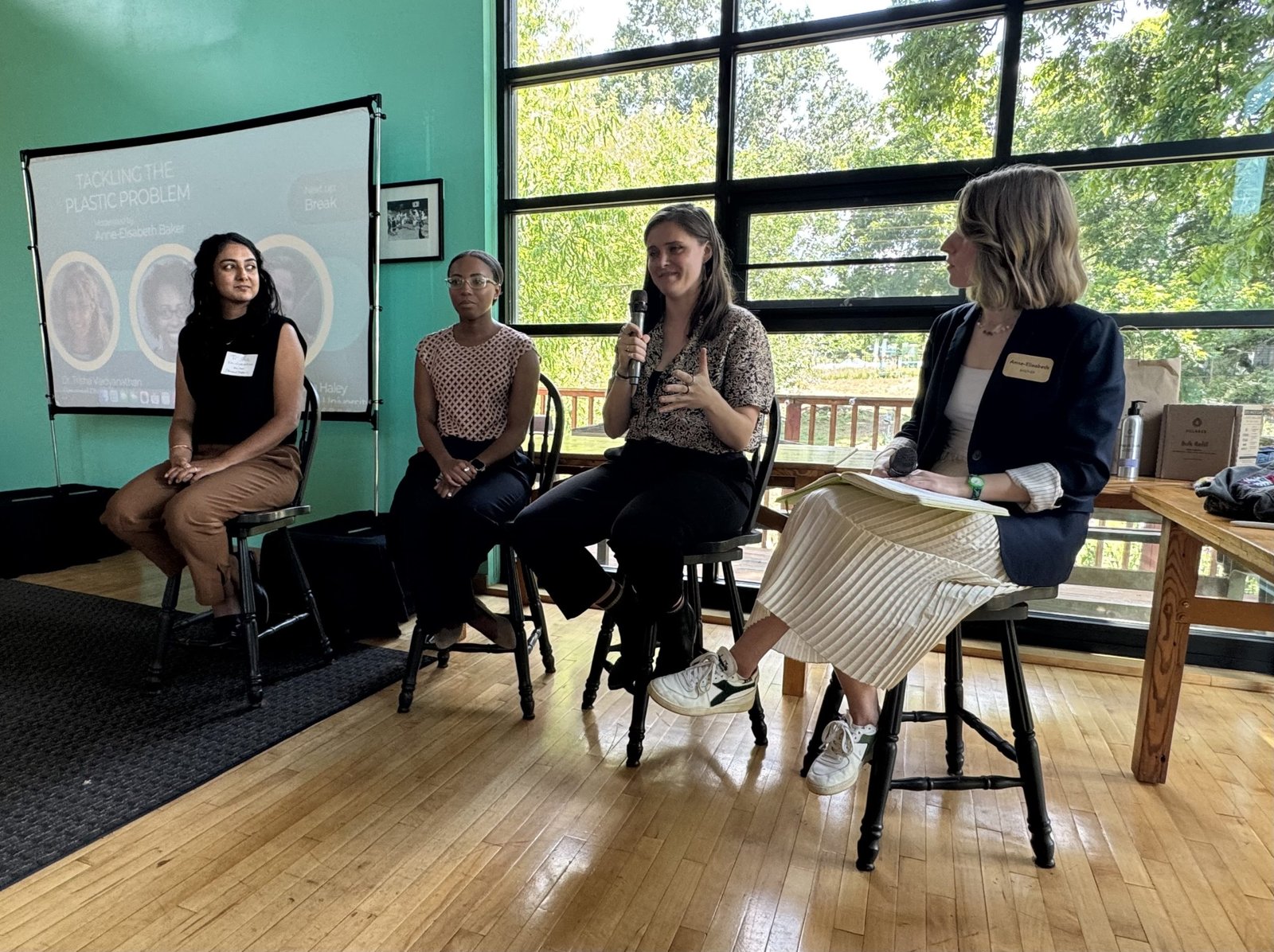
That’s partly why the June 12 summit in Durham was themed around circularity. One goal is to investigate the potential health hazards posed by plastic waste, possible policy remedies, and what a circular economy looks like in practice.
How to close the loop?
Proponents of the circular economy seek to disrupt the “take, make, dispose” mentality and instead opt for an approach that designs products and packaging that can be reused, repaired, and recycled.
This framework extends beyond plastics to include electronics, textiles and appliances, and increasingly overlaps with the right to repair movement. This connection was explored in a previous session of the Summit, which examined consumers’ increasing efforts to repair broken devices, mend old clothes, and transform them into something new rather than throw them away.
For proponents of thinking about plastic waste, circularity provides a framework for rethinking not only how plastic is managed at the end of its life, but also how it is made in the first place.
 Creek Week and the trash report have given environmentalists a new opportunity to press for long-term regulatory solutions to a problem that has plagued American society for more than half a century — and some argue has become an accepted part of modern life.
One policy tool gaining traction in this effort is Extended Producer Responsibility. The idea is to shift the financial burden of waste management from municipalities and taxpayers to the companies that created the packaging in the first place.
Durham City Councilman Matt Kopack, who specializes in advising businesses and nonprofits on sustainability issues, provided a clear explanation at the June 12 summit.
“By valuing raw materials and having producers pay by weight and by composition, we’re making this invisible visible,” Kopac said in his opening remarks at the third annual Circularity Summit, hosted by local nonprofit Circular Triangle. “Money paid by producers is recovered and used to reinvest in the recycling system, making it easier to collect materials and make them available for next life.”
It’s not that far-fetched an idea. Many states now have some form of extended producer responsibility law, such as plastic packaging laws.
Kopac added that expanded producer responsibility also creates economic incentives for companies to avoid using packaging materials that are not in good health or have no path to the end of their viable useful life. He noted that this approach has already been applied to textiles and electronics.
However, legislative solutions have not yet been successful in North Carolina.
House Bill 882, titled “Getting Away from Plastics and Forever Chemicals,” establishes an expanded producer responsibility program for packaging materials, banning toxic substances from packaging, including PFAS and phthalates, and banning the intentional addition of PFAS to food containers. The bill, introduced by Rep. Prissy Harrison (D-Guilford) in April 2025, was referred to the House Rules Committee, where consideration has stalled. An earlier version of the bill died in the same committee in 2023.
The last time North Carolina passed a law making producers responsible for waste was in 2007, when it passed a bill to regulate discarded computer equipment.
Where circularity gets complicated
Taylor Price, senior global sustainability manager at Aptar Group and member of the Durham Environmental Affairs Committee, provided a manufacturer’s perspective on what circularity looks like from within a plastics company.
Aptar makes the kinds of plastic parts that are rarely mentioned in discussions about plastic waste, but are ubiquitous in things like lotion pumps, sports caps, lipstick packaging, and asthma inhalers. Plastics make up about 95% of raw materials, and the company has a direct stake in how those plastics are designed, used and recovered, she said.
“We take plastic seriously as the number one raw material, so we take seriously designing better products, which means making better products,” Price said.
Apter began focusing on the circular economy around 2018, Price said, and circularity is now one of the company’s three main sustainability pillars, shaping everything from its zero-waste manufacturing program to the design of recyclable products and partnerships aimed at incorporating recycled content.
But she was candid about the complexity of the challenge. Price cited the stopper and valve of a Heinz ketchup bottle, which is placed upside down in a refrigerator, as an example of the complexity of the problem. She pointed out that Aptar only makes closures and valves. The bottle is from another supplier. another label. Tomatoes, sugar and salt from further others.
“I think a lot of people don’t realize how many partners are involved in making a single package,” she says. She noted that moving the entire supply chain towards circularity will require manufacturers to collaborate, in some cases with direct competitors.
“To really make that system easier to use and build a better system, we really have to work together. We have to work with pretty much our peers and we have to work with our competitors, so to speak.”
step by step
Dr. Madison Haley, a North Carolina State University candidate and member of the North Carolina Plastic Waste Reduction Coalition, advances through policies that literally make plastic waste valuable.
Haley cited bottle deposit bills as one of the most proven tools available. In the 10 states with such laws, consumers pay a small deposit when purchasing a bottled beverage, which is refunded when they return the container.
“It’s not a fee or a tax. It’s refundable,” Haley said. “You’ll want to pick up trash because it has value for money.”
 Plastic debris collects in Crabtree Creek in Raleigh. As part of the NOAA-funded study, researchers are installing sensors inside plastic bottles to track how trash moves through city waterways and how fast it moves downstream.
The results speak for themselves, she said. States with bottle bills have reduced beverage container waste by about 80 percent and dramatically improved the quality of recycled materials. Recycled plastic bales from states with bottle bills sell for nearly three times the market price of plastic bales from states like North Carolina.
In North Carolina, bottle bills have been introduced in each of the past three legislative sessions without becoming law. But Haley sees repeated deployments as a sign of growing momentum, rather than a failure.
“It’s not necessarily going to become law next year,” she said. “But we’re seeing momentum and there’s a kind of awareness campaign going on around it.”
He cited extended producer responsibility laws as another front that is coming under increasing pressure, even if progress in North Carolina has been slow.
“You have to start somewhere,” she said. “It starts locally, it starts at the state level, and that’s the big thing.”
Underlying the policy drive and industry efforts is a shared belief among proponents that reducing plastic waste means addressing it at the source, rather than simply managing it after the fact.
The local-to-state-to-federal pipeline is exactly what gives Price reason for optimism. Drawing on her experience navigating corporate sustainability across global markets, she noted that, as history suggests, the tipping point may be closer than we think.
When anywhere between seven to 25 states introduce similar measures, federal action is usually followed, he said.
“Local policy can end up becoming national policy, and ultimately national policy,” Price said.
thisarticleteeth,North Carolina Health NewsFirst published inCreative Commons Attribution-NoDerivatives 4.0 International License.
