


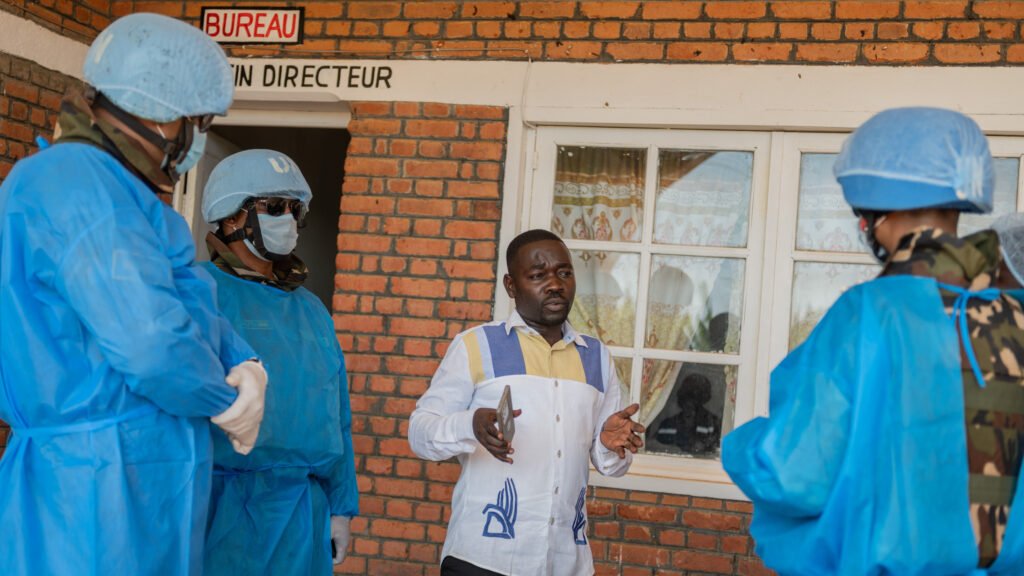
MONGWAR, Congo — Dr. Richard Rokudu, medical director of Mongwar General Hospital, receives little compensation for his work on the front lines of one of Congo’s deadliest Ebola virus outbreaks.
Rokdu and several of his colleagues work all day long at the hospital, treating the influx of patients. Notifications of suspected infections are received even late at night.
“I don’t receive any allowance (and) what happened to others could happen to me,” Rokdu told The Associated Press. “Despite all the infection prevention and control measures we have taken, we don’t know what will happen.”
Health authorities believe the outbreak, which spread quietly and undetected for weeks and stunned eastern Congo, began in the busy mining region of Mombwar, Ituri province.
Mining conditions that encourage the spread of viruses
Mongbuwal has emerged as the epicenter of the rare Bundibugyo type. The town attracts many workers who work in the large gold mines, which are filled with muddy pools, narrow pits, and caverns. They live in low-income areas such as crowded camps and have little access to proper health protocols.

I led the U.S. CDC response to the 2014 Ebola outbreak. Emerging outbreaks require massive, immediate and sensitive action
In these situations, the possibility that the disease is contagious increases and is spread by close contact with bodily fluids of the sick or dead, such as sweat, blood, feces, and vomit.
There is also widespread skepticism about the disease, making the task of treatment even more difficult for Rokdu and his colleagues, and some health care workers and first responders have died from the disease.
“It’s one thing to hear statistics being reported far away, but what’s happening on the ground is a huge deal,” Rokdu said. “People are sacrificing their rest and comfort for this purpose. They should be recognized as having a right to compensation. These workers should receive regular salaries.”
The Congolese government did not respond to requests for comment from The Associated Press.
Minimum resources available
Congolese authorities released new statistics on Sunday, saying that as of Friday, 488 people had been confirmed infected, including 86 deaths. On Thursday, the central African country recorded 71 new infections per day, which authorities said was a sign of “active community transmission.”
Neighboring Uganda has so far confirmed 19 cases and two deaths.
Because there is no approved vaccine or treatment for Bundibugyo, health workers in Congo are targeting Bundibugyo’s symptoms. At least five people have recovered from Ebola since Congo’s Ministry of Health officially confirmed the outbreak on May 15, the government has announced.

If Americans risk their lives overseas to fight Ebola, they have the right to return home.
World Health Organization Director-General Tedros Adhanom Ghebreyesus said the disease has had a “huge head start”. Hospitals in the region were unable to test for the right type of Ebola, which had begun to spread weeks before confirmation.
Health workers are battling the disease with minimal resources as government agencies scramble to deliver aid to the region. Masks, gloves, boots, and medical supplies were all in short supply initially.
“There is a collapse of the health system,” said Heather Kerr, country director of the International Rescue Committee for the Congo. “There is no investment in the health system and this has been going on for years.”
Tough environment for medical workers
“The first week, I didn’t even have time to go home and eat. The second week was the same. I only had one meal a day, which was breakfast in the evening,” said Alice Bamuhinga, a nurse at Mombuwal Hospital.
Despite widespread skepticism and disregard for health protocols, many in town are beginning to wake up to the serious reality of the outbreak.

CDC: Ebola outbreak in Central Africa could reach 20,000 cases without strong countermeasures
Athelo Jeanne, 52 years old, had five children. Two people died from the disease within two weeks. Jeanne said that when her daughter became ill, her family thought she had malaria and her neighbors advised her to avoid going to the hospital, saying, “If you go to the hospital, you will die right away.”
Her daughter died three weeks after being shuttled between the hospital and home, followed by her son a few days later. Then Jeanne became ill.
“I saw about 20 people die,” Jeanne said. “I watched them be taken to the morgue, but God allowed me to get out of here alive. I’m grateful to the doctors.”
UN health agency proposes plan
“Containing Ebola depends on political commitment, sustained funding, and community trust and engagement,” Tedros said on Friday, launching a $518 million plan to fight the outbreak.
Efforts to contain the disease have been hampered by attacks by Islamic extremists as well as conflict between the government and the Rwandan-backed rebel group M23.
For medical workers on the front lines of Congo’s Ebola outbreak, their job is becoming increasingly difficult as the disease spreads faster than current treatment capabilities.
“Despite the alerts we received and the presence of teams on the scene, we have no means to reach the scene,” Rokdu said. “As a result, we are generating alerts that cannot be investigated.”
— Justin Kabumba and Ope Adetayo
Ope Adetayo reported from Lagos, Nigeria.
