


Starting next week, Nebraskans receiving Medicaid will be at risk of losing their health insurance unless the state can prove they work, volunteer or attend school 80 hours a month. Come January, millions of other low-income Americans will face the same cliff.
Some working-age people are exempt, such as those with young children or those deemed “medically frail,” but new rules about who can opt out have caused confusion. For patients with complex medical conditions, looming requirements can create new barriers to health.
Work requirements introduced months earlier in Nebraska this spring caused 31-year-old Crystal Schroer serious concerns. They suffer from a number of chronic illnesses, including depression, ADHD, and panic attacks that became so severe during the coronavirus pandemic that Schroer could barely go grocery shopping alone.
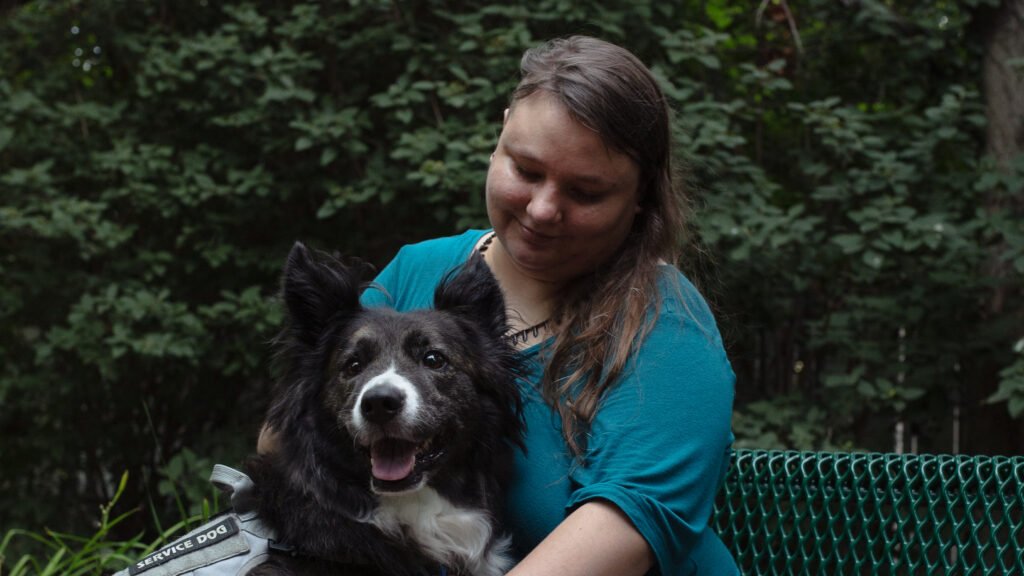
Things changed when she adopted Tarot, a 50-pound Australian Shepherd border collie trained in the technique of “sensory grounding.” But even as dogs reopened the world, Schroer struggled to find steady work in rural Kearney, Neb.
“There’s not much that I think she would feel safe about,” they said.
The state will review enrollee status within days and cut off coverage for those who don’t meet the new rules.


STAT Plus: President Trump’s Medicaid work requirement poses an unwanted surprise for some states and patients
The change is scheduled to take effect in many other states on Jan. 1, with Arkansas, Montana and Iowa also planning to launch programs before that deadline.
The work requirement was created to help pay for President Trump’s tax cut law passed a year ago. Republicans say it would encourage people to find work, even though many adults eligible for Medicaid already have jobs or have other obligations, such as caring for dependents.
Democratic attorneys general challenged the rules in court, arguing that the rules issued by the Centers for Medicare and Medicaid Services in June differ from the guidance states had received in previous months. Their lawsuit will go before a district judge on Tuesday and could decide the future of medical frailty exemptions in more than 20 states.
Now, states, legal advocates and people with chronic illnesses are scrambling to figure out what health conditions allow patients to avoid the requirement and how people should prove the severity of their illness.
Jennifer Hananoki, senior counsel at the law firm Holland & Knight, told STAT that states wanted to be able to automatically consider people with serious or complex medical conditions to be medically frail. “Patients with terminal cancer, patients with advanced end-stage renal disease who are in a dialysis facility three days a week, those types of scenarios.”
Instead, recipients would have to prove they are too sick to work 20 hours a week. The ‘impairments’ caused by their illness need to be well documented. Registrants can self-certify for the first year, but from 2028 onwards medical frailty exemptions must be supported by health data, according to the rules.
Experts fear that the plethora of unanswered questions surrounding medical frailty could lead to more vulnerable people being excluded from the program. More than 7 million people will lose insurance over the next few years, according to preliminary estimates from the Congressional Budget Office.
Researchers said creating a system to vet medical frailty applications within six months will be a major challenge for states. The CMS policy could also create new bureaucratic hurdles for vulnerable populations already struggling to manage their health care, and could put patients at risk of missing out on important treatments, the researchers said.
“We have an already overburdened health care system, providers who don’t have enough time, and patients who are facing terrible challenges. … There are no words to describe how bad this is,” said Ada Hamosh, a clinical geneticist who works with rare disease patients and teaches in the Johns Hopkins University Department of Medical Genetics. (She was speaking only for herself.)
Increased paperwork and self-management
People with chronic illnesses will say, “It’s hard to be sick.” Many people are bogged down by the amount of paperwork, counters, insurance claims, and follow-up required to get a diagnosis and appropriate treatment.
It took Schroer four years and several experts to develop an effective care plan. Medicaid covers all of this, including one ADHD medication, which costs $400 a month. “This year, we finally found a combination that works,” they said, noting that their panic attacks went from having them every other day to once a month.

The Catch-22 for Disabled Workers Hidden in Medicaid’s New Work Requirements
Nebraska has a nearly 300-page index of diagnoses that can qualify you as medically frail. Schroer’s disease is one of them. But CMS said in June that people with “complex or serious medical conditions” must show how their illness affects their daily activities, such as eating, bathing and walking. States can also change the list of conditions under the rules, and if the conditions are too lenient, they risk a federal investigation.
Information such as diagnosis codes, clinical experience data, prescriptions, and hospitalizations can all be used to support a claim of someone’s medical frailty. But given data limitations, the ultimate burden will likely fall on Medicaid patients and their doctors, researchers told STAT.
If doctors were required to fill out medical frailty waiver forms every year or every six months, as the CMS rule suggests, “the system would break down,” said Benjamin Sommers, a primary care provider and professor of medicine at Harvard University. “That can’t be helped.”
Who is sick enough?
The new rules raise uncomfortable questions about who the government considers to be sick enough to receive health benefits. Since Medicaid expansion, the main requirement to participate in the program has been low income. Medical frailty is even more troubling.
Conditions that the government would “not normally expect” to create barriers to work or community participation include well-controlled HIV/AIDS, asthma, hypertension, anemia, systemic pain, prediabetes, type 1 or type 2 diabetes, obesity, psoriasis, headaches, and ADHD, according to the rule.
But doctors and patients know that many illnesses and disorders can be well controlled one week and then feel worse the next. Some things can change overnight, such as asthma worsening due to poor air quality such as wildfires, or autoimmune diseases worsening on hot days.
“Storms can make arthritis symptoms worse,” says Lorraine Boissonneau, who wrote a book called “Body Weather” about how chronic disease and weather are closely linked.
“Sometimes you can’t take a shower, and sometimes you can. Sometimes you can work, and sometimes you can’t. That was the case for me, even when I had a bad flare,” she said. Boissonneau has psoriatic arthritis, celiac disease, endometriosis, Graves’ disease, and Hashimoto’s disease. She has her husband’s insurance, but says she probably would have gotten Medicaid if she were single.
Many others are still on a “diagnostic journey” trying to find the right specialist to figure out what’s wrong. Clinicians told STAT that some people, including 1 in 10 Americans with rare diseases, may never get a clear ICD code. What will happen to them under the new Medicaid rules? Their health insurance may be at risk now that many patients cannot afford such a break.
States may choose to adopt short-term “hardship waivers” that allow Medicaid patients to take time off from work while hospitalized or seeking care outside the community. However, states can choose not to grant such exemptions.
“[Our]biggest concern right now is that the system is so difficult to navigate that eligible patients with serious and complex conditions could lose their health coverage,” said Carolyn Sheridan, deputy director of national policy at the National Organization for Rare Diseases.
States would need to establish a system for people to apply for medical frailty exemptions even if they are not on the list of acceptable diagnoses, but it is unclear how that process would work or how flexible it would be.
 Crystal Schroer and Tarot walk through Yanni Heritage Park in Kearney, Nebraska. Schroer was confused about whether they met the criteria for “medical frailty” and whether they could avoid the Medicaid work requirement that Nebraska enacted in May.Alison Hess of STAT
negative track record
Previous state efforts to introduce work requirements for Medicaid coverage, such as in Arkansas, forced exempt people off the rolls, sometimes all together.
Researchers and advocates fear the same thing could happen nationwide in the new year.
A recent study of low-income adults on Medicaid found that about half were at risk of having their coverage canceled despite serious health problems. Researchers found that people at risk of losing insurance were more likely to self-report poor health, including mental health.
“The narrower the criteria and definition, the more concerned we are that we risk disenrolling people who absolutely should stay on Medicaid,” said study co-author Darshari Vyas, a respiratory and critical care researcher at Massachusetts General and Beth Israel Deaconess Medical Center. “These are people with high health needs.”
Federal officials take a much different view, describing the requirements as more of a bootstrapper that should be raised.
The interim final rule says work and community service can help people with severe chronic health conditions “escape isolation and dependence, build confidence, achieve self-sufficiency and prosperity, and improve health.”
The more people who join the workforce and leave Medicaid, the smaller the line becomes, helping the Trump administration seek to minimize federal spending.
In some ways, Schroer’s story is consistent with the administration’s vision. They were offered full-time jobs doing administrative work at the university just days before Nebraska announced it would begin kicking people off Medicaid who don’t meet work standards. Still, it took more than a year of searching for Schroer before he found a gig. They said the government’s view was wrong.
“People I know in the disability community want to have a job or do something that will at least give them some income,” they said. “We want to go to the movies. We want to be able to buy action figures, Starbucks, small snacks, etc. without having to worry about it.”
The data suggests that work requirements are not an effective way to get people jobs. At the state level, “it won’t increase jobs and will lead to rapid and massive loss of coverage,” Vyas told STAT.

Half of states file lawsuits over Medicaid work requirements
Part of the problem is that many people who need to comply with Medicaid work requirements may not know it. Sarah Maresh, director of Appleseed Nebraska’s health care access program, said she has heard stories of people calling state caseworkers with basic questions and getting incorrect information. The wait time at the call center was reportedly an hour and a half.
Some Nebraskans don’t even know if they qualify for Medicaid expansion.
“There’s no way to look it up in the portal. You can’t look at your Medicaid card and know that,” Maresh said. “I’ve already heard from a lot of people that they’re really confused about this.”
After Arkansas imposed the requirement in 2018, one-third of affected residents said they didn’t know about the new policy. One survey found that more than half of people who had heard about the change had no idea it applied to them. A year later, a court blocked the policy, but these pitfalls have proven difficult for other states to overcome.
New Hampshire attempted to implement its own work requirements in 2019, but paused implementation after realizing that many people eligible for Medicaid would lose coverage. A federal judge later blocked the program.
“Perhaps more important than the outreach, we realized how much states can do on their own with the data they already have,” said Somers, a Boston physician and health economist.
STAT’s chronic health coverage is supported by a grant from. bloomberg philanthropy. our financial supporter It has no role in any of our journalism decisions.
