


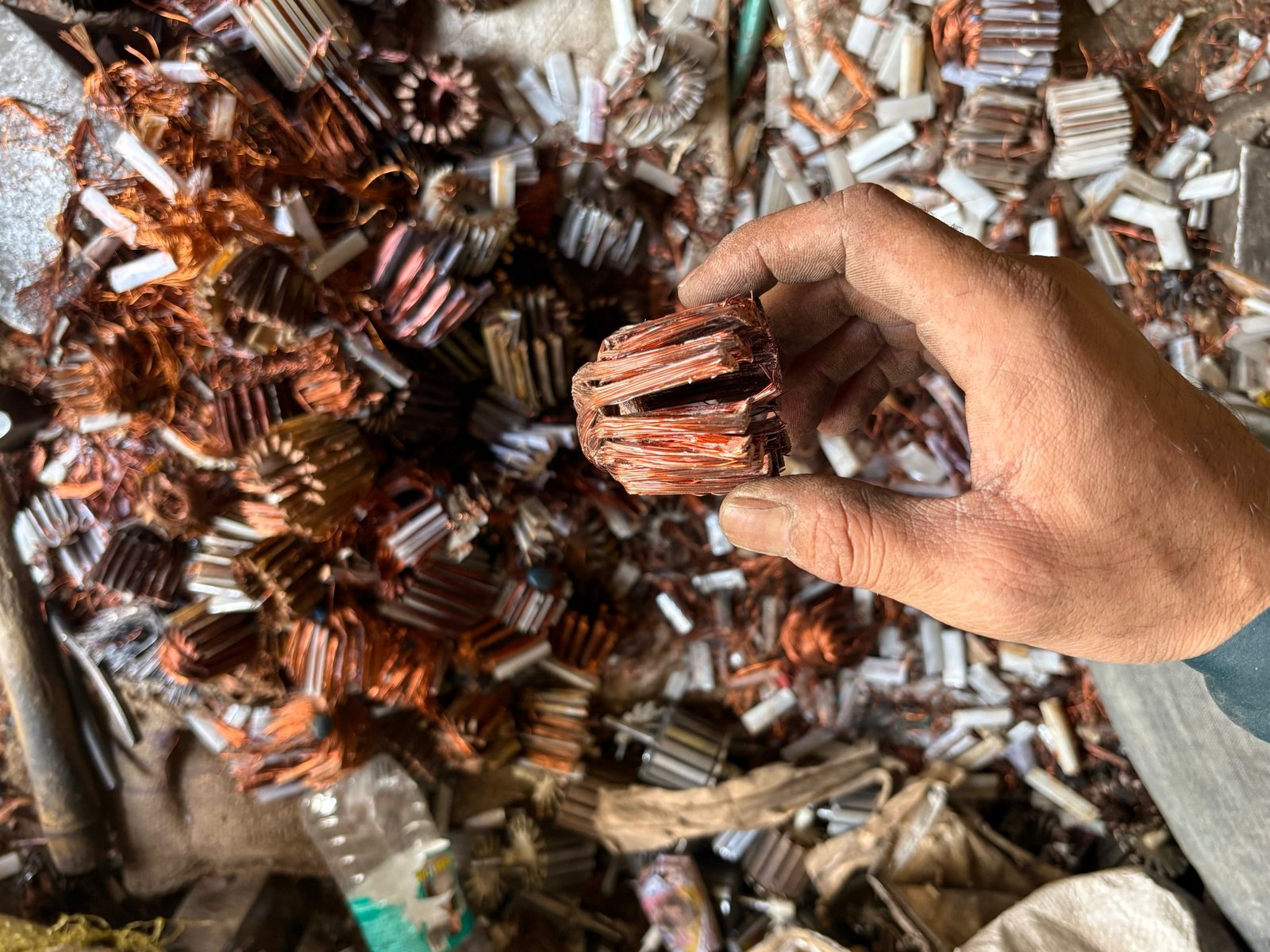
new delhi, india – Mateen Malik sits in a cramped workshop in New Delhi’s Mustafabad neighborhood, carefully separating copper wire from a pile of discarded electronic equipment.
All around him lie broken coolers, tangled cables, bits of metal, and old computers and laptops stacked against the blackened walls of his workshop.
Recommended stories
list of 4 itemsend of list
With quick movements of his bare hands, Malik peels away the plastic coating on the wire, exposing the copper inside. He often uses a blowtorch to dismantle electronic equipment, a process that releases highly toxic chemicals into the air and poses serious health risks.
“Sometimes the extraction is difficult and I don’t have any protective equipment. I don’t have gloves or a mask. I often get burns on my hands. This is a routine part of our work. There are also chemical residues there,” Malik told Al Jazeera. “But I depend on this job.”
Malik, who is in his early 20s, works as an untrained e-waste sorter in Mustafabad, one of India’s informal waste hubs. Its narrow, dusty alleyways are dominated by the constant sound of hammers and the smell of burning plastic and metal.
 View of a street in Mustafabad with an e-waste recycling unit (Raihana Maqbool/Al Jazeera)
The average worker here earns about $1 for dismantling cell phones and double that for dismantling televisions, for a total of about $8 a day for 12 grueling hours of work without gloves, masks or protective equipment.
The hidden costs of such work are therefore much greater, including chronic disease, environmental pollution, and generational exposure to toxic substances.
“Dangerous work”
India is the world’s third largest e-waste generator after China and the US, and the amount of recycled waste is increasing by nearly 23% every year.
In March this year, Union Minister of State for Environment, Forests and Climate Change Kirti Vardhan Singh told Parliament that India would generate over 1.4 million tonnes of e-waste in 2025-26, of which around 979,000 tonnes would be recycled.
New Delhi alone accounts for almost 10 percent of India’s total e-waste generation, generating an estimated 230,000 tonnes annually, according to a report submitted by India’s Central Pollution Control Board to the National Green Tribunal.
Behind these discarded electronics is a vast network of scrap dealers, repair shops, and backyard demolition companies, often working with little awareness of the harmful risks they face.
As India’s digital consumption expands and e-waste continues to grow, the burden of managing that waste falls primarily on workers like Malik, who are rarely protected from the risks that surround them on a daily basis.
Inside another small workshop, a thin plume of black smoke rose as Muhammad Faizan burned insulated wires to extract copper.
Visible parts of the walls inside the workshop are black from continued burning. The smell of melting plastic fills the air as a migrant worker from Uttar Pradesh’s Bulandshahr district works in a cramped space with three other men.
“This is a dangerous job. I sit in the same place from 9am to 8pm every day. I often cut my hands when dismantling electronic equipment. And when I burn plastic to get the metal out, I end up inhaling the fumes,” he told Al Jazeera.
“We get paid by the amount of metal we extract, so it depends on how many kilograms we can separate each day.”
 A worker shows his dirty hands while sorting waste. He says his job exposes him to smoke, which frequently causes cuts and infections (Raihana Maqbool/Al Jazeera)
Nearby, a group of female employees huddle in another store, using their bare hands to separate traces of copper, silver and even gold from electronic chips and discarded hard drives.
With piles of electronics occupying small spaces and little room to move around, the heat trapped indoors is suffocated.
Shakira, a 48-year-old migrant worker from West Bengal, told Al Jazeera: “The working conditions are tough, the space is small, and the few fans barely get a break in this heat.” “We frequently get cuts and infections on our hands.”
Sometimes, he says, he ends up not completing his share of the work and takes it home. “We also get paid less than men, but at least we make some money,” she says.
Al Jazeera contacted India’s Ministry of Environment, Forests and Climate Change and the Delhi Pollution Control Board regarding worker safety and enforcement of related rules, but did not receive a response.
family members are also affected
Bharati Chaturvedi, founder and director of environmental research advocacy group Chintan, says one of the defining features of India’s informal e-waste economy is the overlap between home and work.
“Very often, the workers live on the upper floors and the demolition work takes place on the ground floor or on the roof,” she told Al Jazeera.
“The first thing that strikes people is the proximity of these items, many of which are broken and discarded with lead dust and other toxins. They can catch fire,” she says.
“Workers often use blowtorches during demolition, which releases even more toxic substances into the air.”
The impact extends far beyond the workers themselves. Families, including children, are frequently exposed because they live in the same spaces where e-waste is disposed of.
“The effects of extreme toxins are especially felt on children. There is a lack of responsibility to improve conditions for workers,” Chaturvedi said, explaining the various health risks associated with informal recycling, including cuts, infections, lead exposure, toxic dust and hazardous chemicals.
“Exposure to lead makes iron absorption very difficult. People can be left anemic and weakened. The same goes for women and children, because they work and live in the same spaces,” she says.
 Muhammad Faizan takes part in a workshop in Mustafabad, New Delhi (Raihana Maqbool/Al Jazeera)
According to the World Health Organization (WHO), informal recycling activities can release toxic substances such as lead, mercury, cadmium, and dioxins into the environment. The WHO has linked exposure to such pollutants to neurodevelopmental disorders, reduced lung function and respiratory diseases, especially in children living near recycling sites.
A survey last year of informal e-waste workers in Delhi’s Seelampur district found that they faced significant occupational health risks while having limited awareness of the dangers associated with handling e-waste. Despite the risks, only about 10% of workers regularly use personal protective equipment (PPE), citing cost and discomfort as the main barriers.
India has laws and regulations regulating e-waste management, but informal recyclers, in contrast to licensed workshops, manage to flout them. According to government data, there are only 322 licensed electronics recyclers in India, but researchers estimate that nearly 95% of discarded electronics in the country are still processed in the informal sector.
Rehman, who asked to be identified only by his last name, owns a small workshop in Mustafabad where he employs six workers. He said profit margins in the recycling business are razor-thin, making it difficult for small businesses like his to provide protective gear and other workplace equipment.
“We can’t afford the infrastructure and facilities that the big recycling companies have. Here we pay our workers based on the amount of waste we process. If we raise costs, how can the business survive?” he told Al Jazeera.
A 2019 report by environmental NGO Toxics Link identified at least 15 unofficial e-waste hotspots across New Delhi where occupational safety and environmental protection measures are not followed, exposing workers and neighborhoods to harmful pollutants.
Call for reform and inclusivity
Chaturvedi said the government should focus on integrating informal workers into the formal economy, rather than creating policies to exclude them.
“The way I see it is you have to formalize people. You can’t keep people informal,” she says.
An earlier version of India’s e-waste policy allowed cooperative societies, self-help groups and associations to obtain aggregation and demolition licenses. Those provisions no longer exist, she said.
“If you don’t include people, you can’t make them comply. And if you don’t include them, you can’t help them improve their working conditions,” Chaturvedi said, stressing the need for affordable workspaces, policy support and training programs.
Satish Sinha, associate director at Toxics Link, said that despite being excluded from the e-waste economy, informal workers in India continue to play a central role in the e-waste economy.
“By law, informal workers are not expected to handle or dispose of this waste. However, the law is not enforced as such. The informal sector still plays an important role. They collect, aggregate, transport, and, to a large extent, dismantle e-waste. Some recover metals from e-waste,” he told Al Jazeera.
Sinha said irregular workers should be included in the system, but many activities require tighter controls.
“I think they can certainly engage in collection. They can transport the material according to certain guidelines and requirements, and they can trade it. I’m not suggesting that they dismantle e-waste or recover metals from it. Those processes should be carried out under strictly controlled conditions that are environmentally safe and sound,” he said.
Every evening in Mustafabad, the sound of banging and tearing electronic equipment echoes behind closed doors as workers sort out parts that may end up back in the supply chain.
“We have no other jobs. We depend on this. It gives us income and helps us survive in a city like New Delhi,” says Shakira.
