


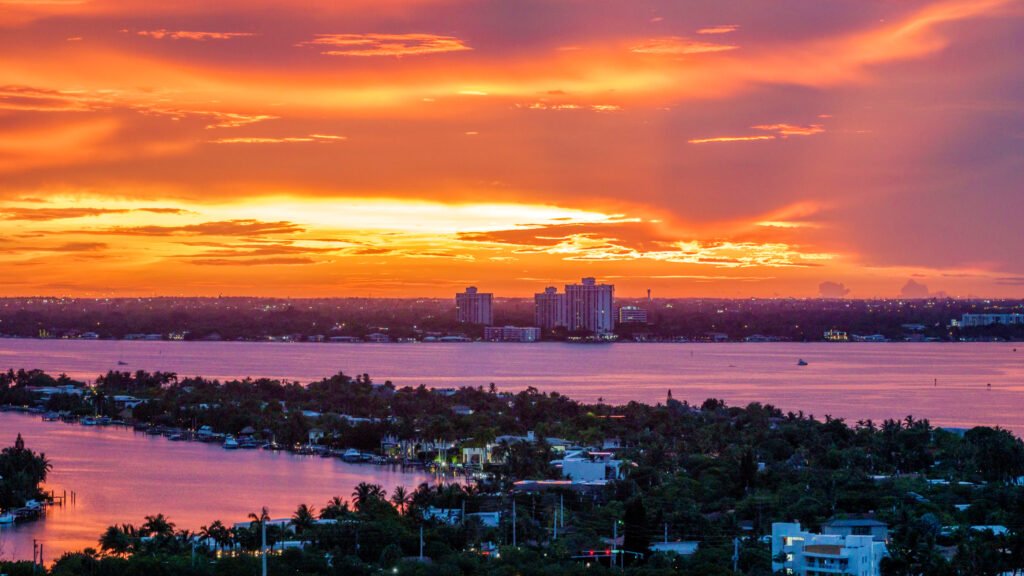
In the shadow of the Miami skyline, in water churned daily by boats and jet skis, the endangered juvenile giant hammerhead spends its first two years of life. A few miles away from downtown, researchers recently pulled a 12-foot-long endangered sawfish from the same shallow water. The species has been disappearing in alarming numbers across South Florida waters since 2024, something scientists suspect was caused by record ocean heat.
The bay is filled with creatures that most of the city has never registered. It is home to more than 30 threatened and endangered species and more than 100 species important to commercial and recreational fisheries. But when researchers surveyed more than 1,000 Miami-Dade residents, water quality was visibly declining, and most rated the bay as “moderately healthy,” even though a government assessment warned the estuary was reaching a “tipping point.”
It is also changing in ways that almost no one can see.
Over the past two decades, the Bay has become warmer, saltier and more acidic, according to a new University of Miami study that analyzed 20 years of monthly water quality measurements. This change is real, but gradual. The changes are too slow to be seen directly, even by divers, anglers, and scientists who spend their lives on the water. “The bay has been salty ever since I’ve been here,” said Anna Zangronis, a Florida Sea Grant employee who has worked at the bay since 2017, explaining that the changes have been so gradual that they go unnoticed.
Data captures what the eyes miss. The study authors say the bay has been steadily sliding away from its estuary and closer to the open ocean, a change that has become virtually irreversible due to rising sea levels.
Fish in the bay are already showing changes. Joseph Serafi, a NOAA research fisheries biologist who has tracked Biscayne Bay’s fish communities for 20 years, has observed fish catches change as the water becomes saltier. He said species such as snook, sea trout and mullet, which live where freshwater and saltwater mix, are in decline, but fish that can tolerate a wide range of salinity, such as snapper and grunt, are surviving. This is a characteristic of the bay being tilted away from its past estuary. As brackish waters disappear, so do the organisms created for them.
Meanwhile, over the 20 years analyzed by scientists, median water temperatures rose by 0.5 degrees Celsius across the Bay, and nearly doubled (0.8 degrees Celsius) in North Bay, the most urbanized and poorly flushed area.
But Serafi’s biggest concern isn’t that average prices are rising slowly. It masks the more dangerous trends, the sharper and more frequent extremes. Serafi said a cold wave, a heat wave, a series of high salinity levels, and a sudden drop in oxygen do the real damage, with a warmer baseline and higher salinity making each spike more severe.
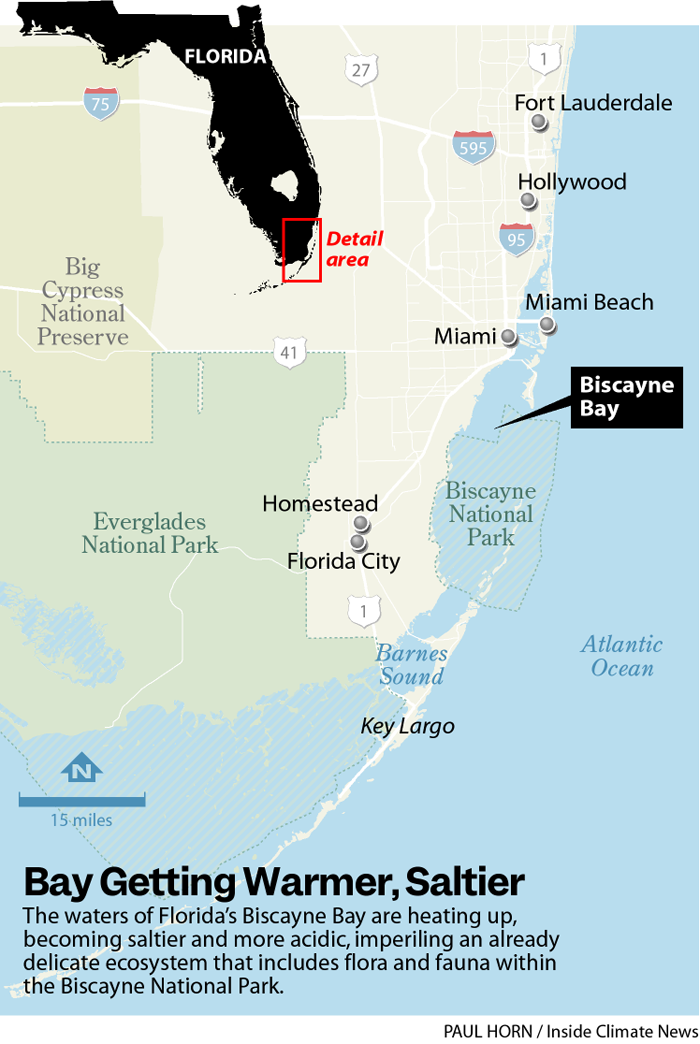
The summer of 2023 showed us what that looks like. A marine heatwave has caused water temperatures off the coast of South Florida to rise to levels never before recorded, with shallow Manatee Bay hitting 101 degrees Fahrenheit, potentially the hottest ocean water ever measured. Coral reefs in the area were bleached from end to end. Warm water contains very little oxygen. The same goes for salt water. If both rise at the same time and the seagrass dies, the fish can suffocate. This is the mechanism behind the extinction previously observed in Manatee Bay.
This pattern partly goes back to how South Florida moves water. A century of canals has given way to sheet streams, slow, shallow membranes of freshwater that once stretched across the miles wide of the Everglades, rather than rushing canals. It once seeped into Biscayne Bay along a wide brackish coast in sudden pulsating releases that caused the salinity to fluctuate up and down. Restoring calmer, more consistent flows is one of the central goals of the multibillion-dollar Everglades restoration effort.
For hammerhead sharks, danger comes through food. Juvenile hammerheads rely almost entirely on the bay for the first two years, eating a narrow diet of small stingrays and other benthic animals, crab eaters, molluscs, and shelled creatures, which are most vulnerable to acidifying waters.
This story is funded by readers like you.
Our nonprofit newsroom provides free advertising for our award-winning climate coverage. We rely on donations from readers like you to continue our work. Donate now to support our work.
donate now
“Acidification can have physiological effects on both the sharks themselves and important prey species for sharks,” said Katherine MacDonald, director of the Shark Research and Conservation Program at the University of Miami, where the shark research team documented the farm. As the base of the food pyramid shrinks, everything above it must also shrink, she explained. “By definition, the shark population must shrink accordingly, because there is no energy in the system to support them.”
MacDonald’s larger fear is more obvious. Bay hammerhead sharks return to the same waters to give birth. If these waters become unsuitable, entire genetic lineages can disappear along with them. “I sincerely hope that the first nurseries that are reported to disappear due to climate change do not end,” she said.
What’s happening in Biscayne Bay isn’t unique, but it’s also not universal. A groundbreaking 2020 study tracked 166 estuaries along Australia’s coast and found that they were changing faster than global climate models predicted, and that they were too small and shallow to be captured by the models’ coarse grids.
“These coastal habitats are often very shallow,” says lead author Elliot Scanes from the University of Technology Sydney. He explained that shallow waters heat up faster than larger, deeper environments. “They are like puddles in the sun.”
However, the direction depends on geography. Australia’s small estuaries are renewing their waters as rainfall increases, but Biscayne Bay, which is wider and increasingly fed by the sea, is trending in the opposite direction.
“As sea levels rise, there will be more saltwater intrusion,” Scanes said. “We can predict that they will probably turn into just big ocean bays.”
This invasion is the change that the study’s lead author fears most, and it is one that extends beyond the water’s edge. For oceanographer Josefina Olascoaga, a concern that keeps coming up is fresh drinking water. The same salt creeping into the Gulf is pushing into the Biscayne Aquifer, a porous limestone rock that supplies fresh water to much of South Florida.
This is the most significant of all changes, and the most difficult to discern. Some wells along the coast have already been abandoned due to salt intrusion. Cities from Hallandale Beach to Hialeah have been drilling inland to stay ahead.
The bay has been showing changes in its surface over 20 years. Underground, the same salt is moving towards the water that Miami drinks.
About this story
As you may have noticed, this article, like all news we publish, is free to read. That’s because Inside Climate News is a 501c3 nonprofit organization. We don’t charge subscription fees, keep our news behind paywalls, or fill our website with ads. We provide climate and environmental news free to you and anyone who wants it.
That’s not all. We also share our news for free with dozens of other news organizations across the country. Many of them cannot afford to do their own environmental journalism. We’ve established bureaus across the country to report on local news, partner with local newsrooms and co-publish stories to ensure this important work is shared as widely as possible.
The two of us started ICN in 2007. Six years later, we won the Pulitzer Prize for national reporting and now run the nation’s oldest and largest dedicated climate newsroom. We tell the story in its entirety. We hold polluters accountable. We expose environmental injustice. We debunk misinformation. We explore solutions and inspire action.
Donations from readers like you fund all aspects of our work. If you haven’t already, will you support our ongoing work, our coverage of the biggest crises facing our planet, and help us reach more readers in more places?
Please make a tax-deductible donation. Each one makes a difference.
thank you,

kate waxman
fellow
Kate Waxman is a Florida-based Outrider Fellow for Inside Climate News, where she covers climate injustice across the state. She earned a master’s degree in journalism from Columbia Journalism School and a bachelor’s degree in environmental science from Barnard College, with reporting focused on coral reefs, climate science, and communities closest to water.
