


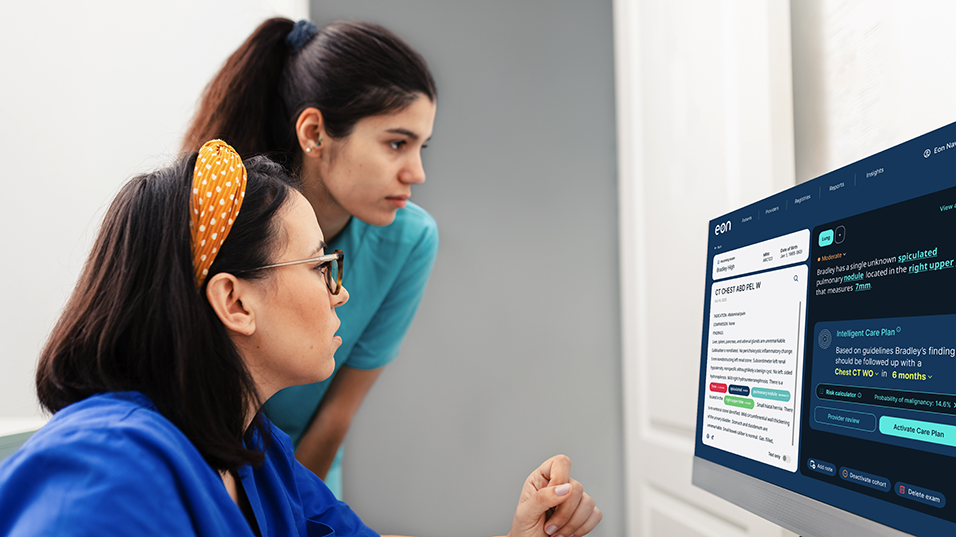
To realize the potential of AI in incidental finding management, trust must be built directly into the system itself
Across the healthcare industry, conversations about artificial intelligence are rapidly moving from possibility to urgency. Imaging volumes are increasing. Clinical documentation is becoming increasingly complex. There are no signs that restrictions on staffing will be eased. AI systems that can interpret narrative clinical texts are increasingly being looked at as part of the solution.
However, there are real risks to introducing generalized AI tools into clinical practice without strict oversight. There is a big difference between what an AI system appears to be able to do and what it is actually verified to be able to do, and it is unacceptable to confuse the two in a clinical setting. Governance boards, clinical leaders, and health system administrators are just beginning to consider that distinction.
Why most clinical AI workflows still require human validation
There are three main AI models in use today, each with distinct strengths and limitations.
Pattern-based natural language processing (NLP) works well for structured, high-frequency tasks, but becomes unreliable when clinical language becomes ambiguous or the context becomes hierarchical.
Large-scale language models (LLMs) enable flexible and contextual interpretation across a variety of clinical languages. In an analysis of more than 2,000 real-world radiology reports from more than 40 hospital systems, LLM achieved 81-85% accuracy without domain-specific adjustments. That means strong baseline performance. However, because LLM is probabilistic, its output varies and requires continuous validation to ensure that it remains reliable across different document styles and over time.
Computational linguistics (CL) operates on a deterministic, rule-based logic, where every decision follows a traceable path of reasoning. That transparency is a true clinical asset, allowing all conclusions to be explained, reviewed and audited. The CL model in the same study demonstrated higher accuracy and consistency within the specific clinical use cases evaluated.
However, even models that function independently require validation before care can safely proceed, creating a large operational burden. So how can you ensure that your AI output is actionable without human review?
Operational cost of verification burden
To understand why that question is important, you need to understand what happens if you don’t address it.
All outputs generated by AI that clinicians need to validate before acting contribute to the so-called validation burden, or the cumulative human effort required to confirm findings before acting. Incidental findings and screening programs include validating extracted data, assembling the clinical situation, determining appropriate next steps based on guidelines, and activating a care plan.
In individual cases, the effort is modest. Across hundreds of thousands of radiology reports within the health system, this problem is rapidly worsening and has become one of the most significant operational constraints facing early detection programs. If every discovery requires validation, the promise of automation actually becomes a burden on oversight.
Building trust in your IT infrastructure
To address this challenge, we propose an “architecture of trust” framework that embeds verification directly into the infrastructure itself, rather than treating verification as a downstream manual step.
This approach works through intentional independence. Two fundamentally different but complementary AI systems, a deterministic CL engine and a probabilistic LLM, independently analyze the same clinical report without accessing each other’s conclusions. Then their outputs are compared. If both systems independently reach the same conclusion and the agreement meets predefined performance thresholds, the results are computer-verified and downstream workflows such as guideline-based recommendations, care team notifications, and longitudinal follow-up updates automatically proceed.
If the system does not match, or if the match falls below the required threshold, the case is automatically sent for human review. Its routing is objective, consistent, fully auditable, and requires no judgment at the point of inference.
The performance impact is significant. Once the CL model and LLM individually agreed, the error rate within that subset fell below 1% and approached zero across several model configurations. Independent consensus serves as a measurable signal of trustworthiness.
why is this important
Computational validation provides a framework for applying automation more safely and consistently within clinical workflows. Establish clear, pre-defined criteria for when automation is justified, generate traceable reasoning paths for every decision, and ensure that human review is applied objectively according to pre-set safety and accuracy thresholds. This is essential in clinical practice.
Foundation for what comes next
Healthcare AI is no longer a future consideration, but a challenge for active adoption. The organizations that address it most effectively are those that move beyond evaluating AI solely on benchmark performance.
The Architecture of Trust provides a framework based on the principle that clinical AI should demonstrate trustworthiness, not claim it. Deterministic models provide the transparency and traceability needed for governance. Probabilistic models provide the linguistic flexibility required for real-world clinical documentation. Computational validation is applied at the moment of inference rather than retrospectively, creating conditions in which automation is safe and scalable.
What this framework ultimately enables is a more measurable, auditable, and scalable approach to clinical deployment of AI.
Read the white paper to learn more.Reduce the burden of verification with safe and reliable automation. ”
