


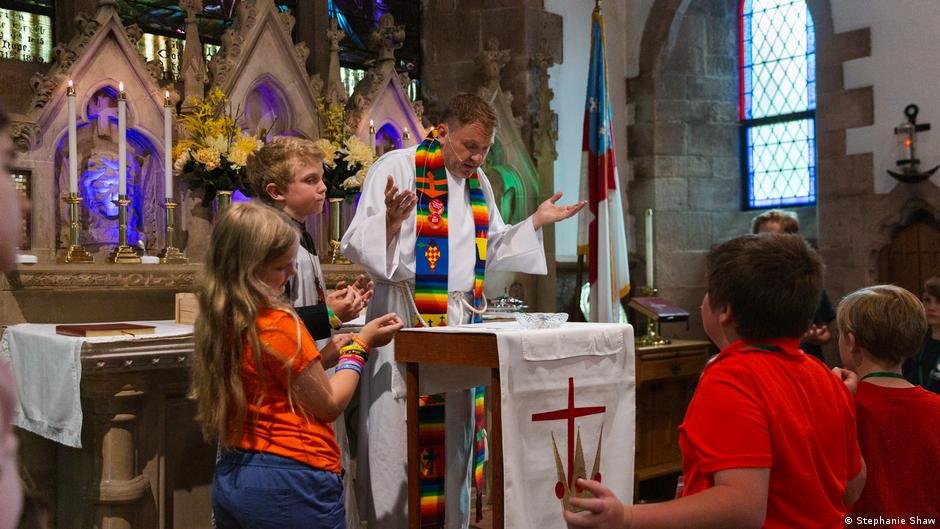
The number of Christians in the United States has stabilized after years of decline. But only a few of the people who line up for church on Sunday morning hear about the state of the earth, which the Bible requires stewards to do.
A 2025 study found that nearly 90% of U.S. faith leaders across all major Christian denominations believe in at least some human-caused climate change, but only about half have discussed it with their congregations.
Stiliano Silopoulos, one of the study’s researchers and an assistant professor in the School of Sustainability at Arizona State University, said there are many factors that create the disconnect.
“Just because they care about this issue doesn’t mean they feel obligated to talk about it,” Silopoulos said, adding that pastors may feel unqualified to raise the issue. “Or maybe some people feel like that’s not their role. At least in the United States, climate change is a highly politicized issue.”
“The Second Coming of Capitalism”
Pastor Bradley Mattson of Hope Episcopal Church in Pennsylvania has not forgotten this. He believes America’s divided views on climate change are a reason to talk about the issue instead of staying silent.
“I think political forces in this country and other countries around the world may be working very hard to move away from human influence on our climate,” he said. “They’re proactive and saying, ‘We can’t do anything about this. We’re going to slash, we’re going to mow, we’re going to spray, we’re going to do whatever we want.'”
US turns its back on EVs
To view this video, please enable JavaScript and consider upgrading to a web browser that supports HTML5 video.
The United States is a good example of this under the current administration. From blocking the expansion of renewable energy to encouraging the extraction and use of polluting fossil fuels, US President Donald Trump has rolled back literally dozens of regulations put in place to protect his country and the rest of the world from environmental damage.
“We all have the potential to use too much power and we need to restrain ourselves from doing so,” Mattson said. “I think certain groups of people use power for unbridled consumption, and Jesus is not there.”
Mattson said some people have a “second coming capitalism” worldview, the idea that God is free to consume because “eventually God will come back and destroy the earth and make it new.”
He said the story stems from a misreading of the Book of Genesis, originally written in Hebrew, where the call to “bury and conquer the earth” was interpreted to mean exploitation, or “just till it.” He said this passage is actually a call to be good stewards.
The church, whose congregation is led by Pastor Bradley Matteson, is located on property that can be protected in a way that benefits more distant communities Image: Katie Brown
Mattson takes his role as administrator seriously. He has engaged the church in climate change advocacy, tree planting, and protection of the greater Chesapeake Bay watershed, which spans six states, including New York. For the most part, his followers agree.
However, this is not the case for all pastors who want to introduce earth care to their flocks.
Church climate backlash
One state away in Maryland, Brother Ken Taylor’s efforts to weave environmental and climate awareness into his sermons at St. Nicholas Lutheran Church in Huntingtown are generating mixed reactions.
“When we dedicate a series of Sundays and a climate education series, there’s a very small minority of people who say, ‘Why are we bringing so much politics into the pulpit?'” Taylor said.
Some have told Taylor outright that they are leaving the church because they feel the approach is too overtly environmentalist. And while he was initially caught off guard by the backlash, that didn’t stop him from promoting climate action.
Taylor’s congregation is also working to protect clean water, planting native species to prevent erosion and installing water coolers and trash cans to collect items that are difficult to recycle.
He said he understands that when faith leaders know enough to talk about the climate, it’s easy to feel out of place. Or you can face the challenge from the pews. This is where the idea of having a congregation comes into its own.
“We have to rely on the entire community of people who care about this issue to move things forward,” Taylor said. He added that he frequently invites people from his flock to speak to the congregation.
start small with respect
Mattson said in Pennsylvania that when he joined Hope Episcopal Church six years ago, he started by integrating care for the earth in small ways that members could respect, rather than pushing the entire climate change issue onto the congregation. An example of this is giving people freshly grown vegetables.
Mattson is also a carpenter and helps young believers build bat boxes and birdhouses. Image: Stephanie Shaw
“Then we created pollinators and then we created herb gardens,” Mattson said. “Then we started talking to some funding groups around environmental work and expanded to include land management and watershed protection.”
Mattson is grateful that the congregation has embraced him and his approach, including understanding that preaching is not the best approach when it comes to climate and the environment.
“We tend to approach our religious lives with an attitude of running towards the light rather than running away from the darkness,” he says. “I didn’t say don’t run your gasoline lawn mower if that’s all you have. I didn’t say it’s your fault just because you have a gasoline lawn mower. I said, ‘Think of the pollinators.’ You know, Jesus said, ‘Think of the lilies of the field. Think of them. Think of them.'”
Editor: Jennifer Collins
This article was adapted from the DW Living Planet podcast. To listen to the entire episode, click here.
Hawaii reduces emissions with historic climate change solution
To view this video, please enable JavaScript and consider upgrading to a web browser that supports HTML5 video.
