


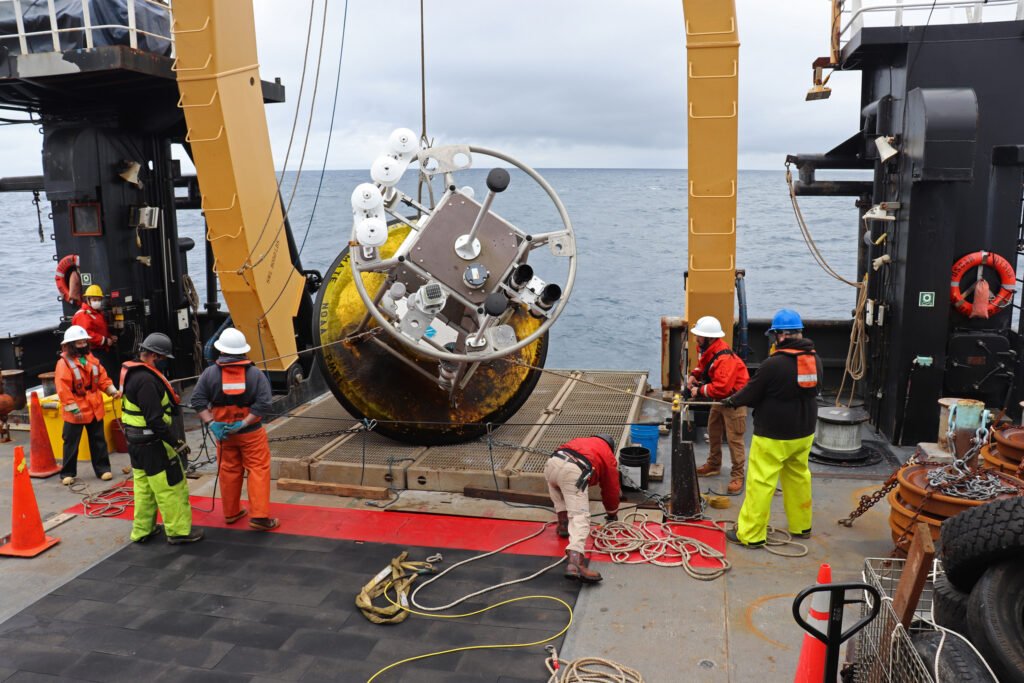
The upcoming loss of deep-sea monitoring systems is causing deep anxiety in Alaska, the nation’s largest fish-producing state, where temperatures are rising twice as fast as the global average.
In May, the National Science Foundation announced plans to eliminate the Ocean Observatory Initiative, a nearly $368 million network of scientific instruments that track ocean chemistry, wave movement, water temperature, salinity and many other metrics.
Real-time information from these ocean observatories helps scientists, fisheries managers, coastal hazard planners, and even military planning and future preparedness. Whether it’s calculating how much fish to harvest or when ocean heatwaves or giant wave activity will occur, data is used by numerous sources.
“This helps us know where we’re going and what’s coming our way,” said Jean Newton, a University of Washington associate professor of biological oceanography.
NSF’s decision to remove the observatory from the ocean’s surface is a wake-up call for Alaska’s fishing industry, which employs nearly 42,000 people and is home to a $5.3 billion commercial seafood industry, according to a recent report prepared by the McKinley Research Group for the Alaska Seafood Marketing Institute.
Michelle Stratton, executive director of the Alaska Marine Community Coalition, said the loss of Ocean Station Papa, a deep-sea observation system located about 14,000 feet deep in the Gulf of Alaska, means the state loses one of its only systems recording ocean changes in real time.
“We are in the midst of salmon collapses, crab collapses, and recurrent ocean heatwaves. This decision takes away the data we rely on to understand what is happening and how to manage these fisheries,” Stratton said.
As for why NSF is withdrawing scientific hardware, spokeswoman Cassandra Eichner said the decision is “in line with NSF’s broader strategy for a more agile approach that prioritizes support for evolving scientific priorities, emerging technologies, and smart lifecycle management within its portfolio of research infrastructure.”
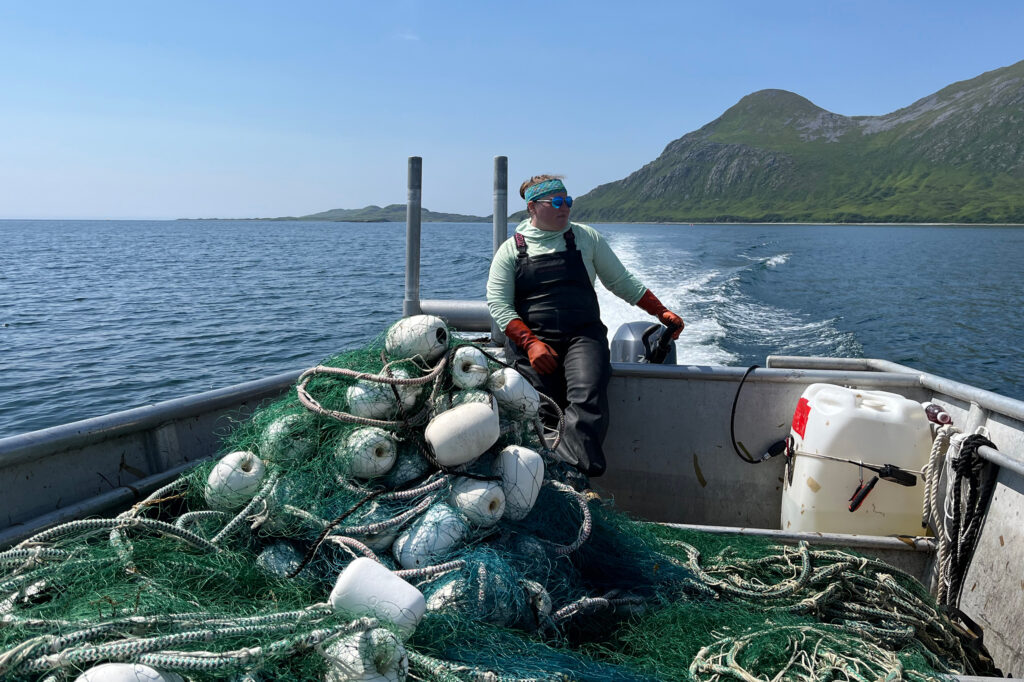 Michelle Stratton, a fisheries scientist and executive director of the Alaska Marine Community Coalition, moves equipment to fishing grounds off Kodiak Island. Credit: Hannah Heinbuch
Eichner said all data collected to date will remain accessible and NSF will continue to work on ocean science.
But critics argue that the decision to remove the ocean observatory network of about 900 deep-sea instruments spanning the Pacific and Atlantic Oceans is in line with Project 2025, a conservative governance blueprint created by the Heritage Foundation and enacted to some extent by the Trump administration.
Project 2025 positions government-sponsored ocean and atmospheric research, particularly at the National Oceanic and Atmospheric Administration and its various agencies, as a regular source of “climate alarm.”
Rick Thoman, a climate expert at the University of Alaska Fairbanks who worked for the National Weather Service for 30 years, said the ocean is one of the most unexplored, unmeasured and ultimately least understood regions on Earth.
Thoman said the goal of the Ocean Observation Initiative is to understand what’s happening not just on the surface, but in the deep, dark depths of the underwater world.
This story is funded by readers like you.
Our nonprofit newsroom provides free advertising for our award-winning climate coverage. We rely on donations from readers like you to continue our work. Donate now to support our work.
donate now
“Losing the information Ocean Station Papa provides about how the ocean is changing as the climate warms is like driving on a dark highway without your lights on,” said Carol Janzen, an oceanographer with the Alaska Ocean Observing System.
The last thing managers and scientists want is a loss of deep-sea monitoring data, Thoman said, as Alaska has experienced intense marine heatwaves in recent years that have decimated populations of species such as chinook salmon and snow crabs.
“The value of this network is that it provides oceanographic information from across the entire water column,” he added.
Rapidly warming Alaska has been battered by severe storms in recent years, including Typhoon Halon, which destroyed much of the western Alaska villages of Kipnuk and Kwigilingok last October. The mostly Yup’ik village is home to more than 1,000 people, many of whom fled to Anchorage and continue to live there until a decision is made on what to do next: rebuild or move to higher ground.
The state is also preparing for an El Niño event later this summer.
Ocean Station Papa’s sensors and other equipment help weather forecasters and emergency responders know in advance when superstorms like Furlong are coming.
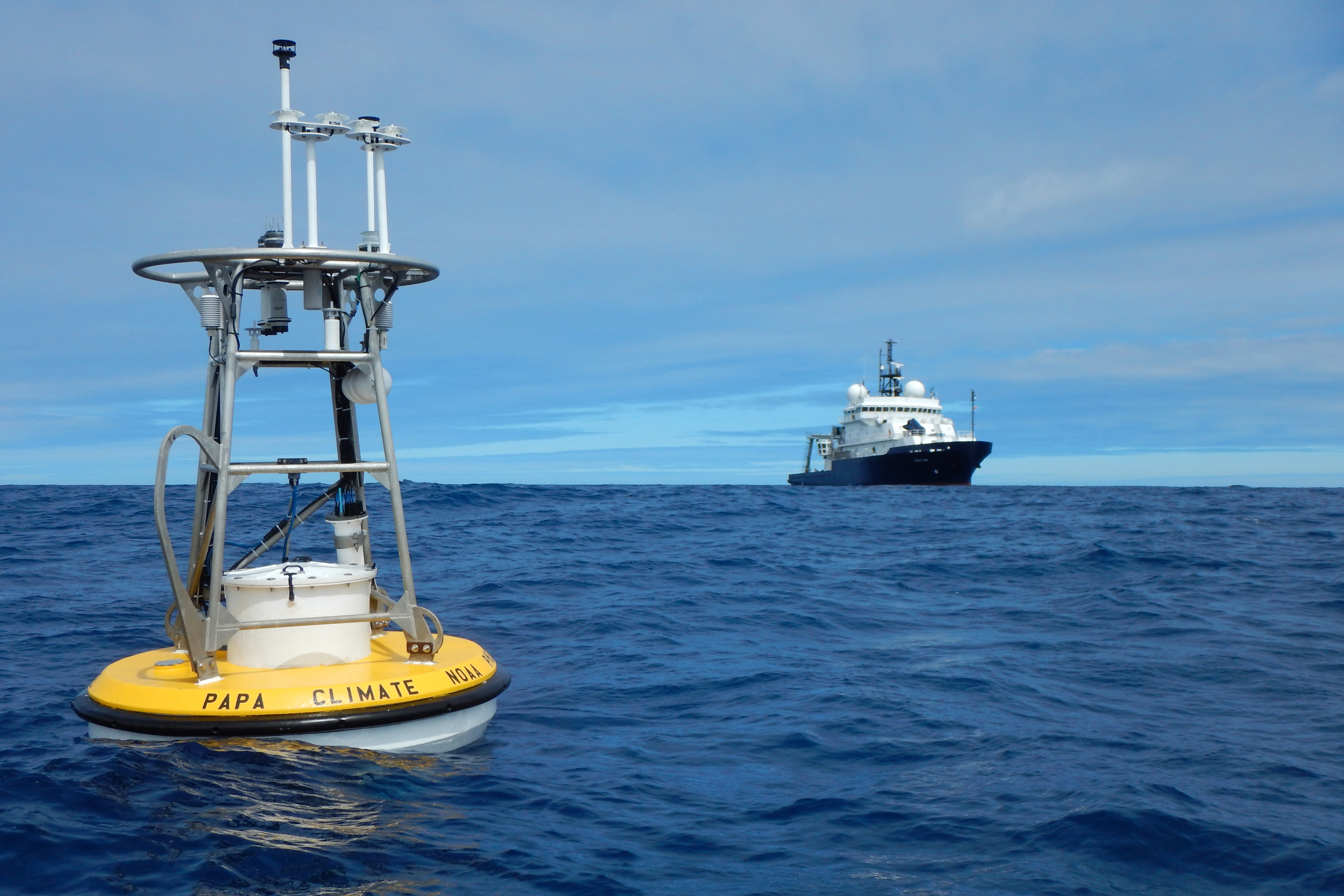 Ocean Station Papa Buoy floats in the waters of the Gulf of Alaska. Credit: NOAA
“We’re looking at ocean temperature, salinity, ocean currents, wave height and direction, and wind stress,” Stratton said. “These are all built into the models used by NOAA and universities to show how storms will intensify, how water levels along the coast will rise or fall, and when and where to expect the next major flooding event.”
The loss of Ocean Station Papa could make Alaska’s isolated, mostly indigenous coastal villages even more vulnerable.
“We’re seeing diseases that are directly related to food security, incomes, intergenerational knowledge, and community stability. So we’re not just talking about a biological crisis. It’s an economic one. It’s a cultural one. It’s a way of life,” Stratton added.
For Tim Bristol, executive director of the nonprofit Salmon State, a longtime fisheries advocate, pulling monitoring equipment out of the ocean seems counterintuitive.
“No matter where you are on a particular issue, you hear calls for more information, better data, more detailed analysis. It’s like, you know, a mad dash in the wrong direction,” Bristol said.
That may be true, said Thoman, a weather and climate expert at the University of Alaska Fairbanks. But even if the United States, which has long been a scientific leader, wants to bury its head over ocean changes and rising temperatures, that information will not disappear.
He believes other countries will step in to fill the data gap created by the loss of the ocean observatory initiative, as each country’s bases on the high seas provide valuable data to many countries.
“You know the Chinese could come tomorrow and knock down that buoy there if they wanted to,” Thoman said. “If anyone thinks that by stopping this the United States is going to stop monitoring or stop our understanding of this issue, that’s a big mistake. These are all international efforts.”
About this story
As you may have noticed, this article, like all news we publish, is free to read. That’s because Inside Climate News is a 501c3 nonprofit organization. We don’t charge subscription fees, keep our news behind paywalls, or fill our website with ads. We provide climate and environmental news free to you and anyone who wants it.
That’s not all. We also share our news for free with dozens of other news organizations across the country. Many of them cannot afford to do their own environmental journalism. We’ve established bureaus across the country to report on local news, partner with local newsrooms and co-publish stories to ensure this important work is shared as widely as possible.
The two of us started ICN in 2007. Six years later, we won the Pulitzer Prize for national reporting and now run the nation’s oldest and largest dedicated climate newsroom. We tell the story in its entirety. We hold polluters accountable. We expose environmental injustice. We debunk misinformation. We explore solutions and inspire action.
Donations from readers like you fund all aspects of our work. If you haven’t already, will you support our ongoing work, our coverage of the biggest crises facing our planet, and help us reach more readers in more places?
Please make a tax-deductible donation. Each one makes a difference.
thank you,
