


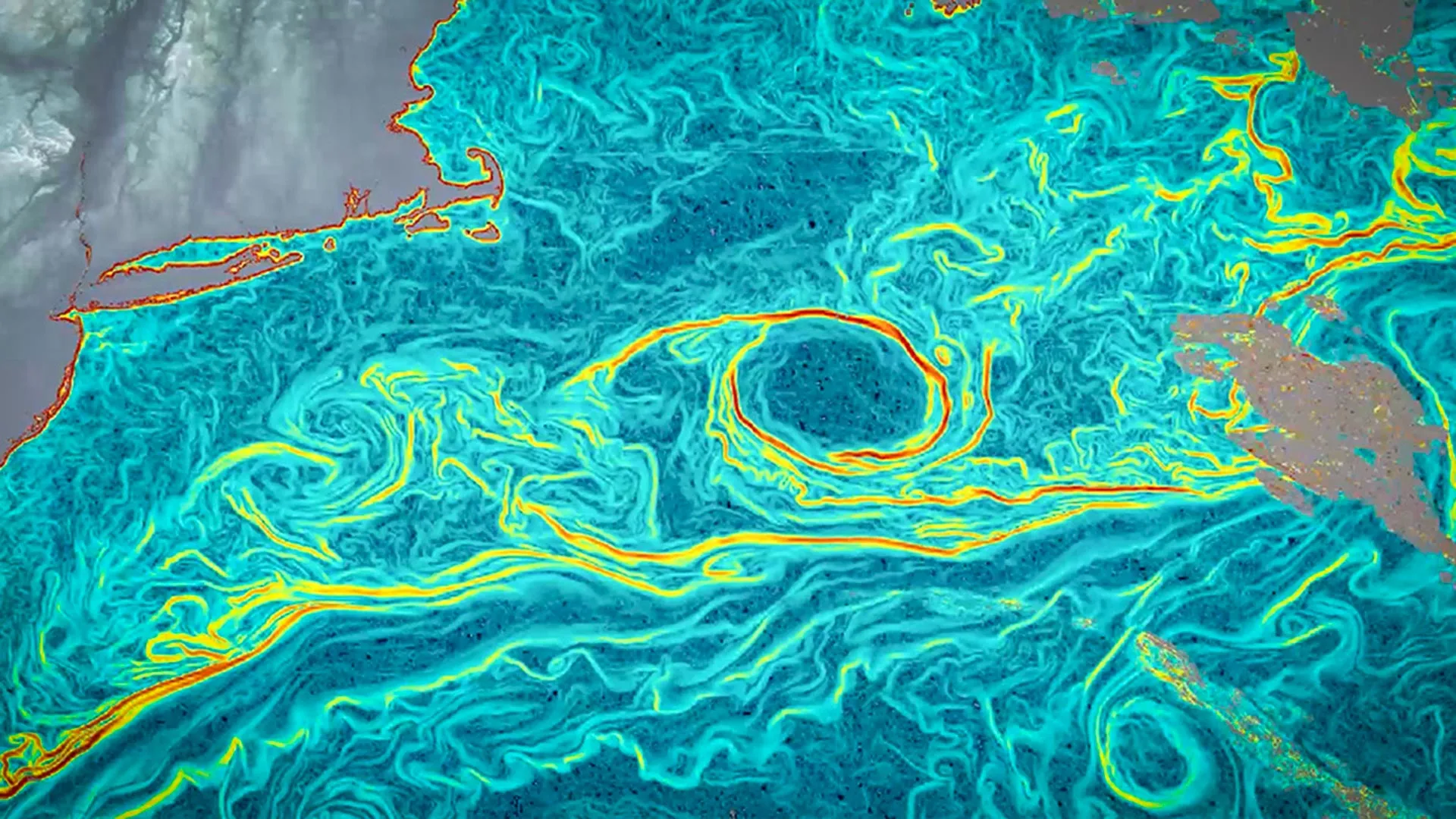
Scientists have introduced a new method to track ocean surface currents over vast areas in much more detail than before. The technology, known as GOFLOW (Geostationary Ocean Flow), uses deep learning to analyze thermal images captured by weather satellites already in orbit. Because this method relies on existing satellites, it represents a major advance in ocean monitoring without the need for new equipment in space.
The study was led by Luc Lenain of the Scripps Institution of Oceanography at the University of California, San Diego, and Kaushik Srinivasan, a Scripps alumnus now at the University of California, Los Angeles. Their discovery is natural earth science. Co-authors Roy Barkan of Tel Aviv University and Nick Pizzo of the University of Rhode Island also trained at Scripps. Funding was provided by the Office of Naval Research, NASA, and the European Research Council.
Why ocean currents are important for climate and life
Ocean currents are essential to how Earth functions. They move heat across the planet, move carbon between the atmosphere and the deep ocean, and cycle nutrients that support marine ecosystems. They also play an important role in real-world situations, such as search and rescue operations and tracking oil spills.
Despite its importance, it has been difficult to accurately measure current over large areas. Some satellites indirectly estimate ocean currents by observing changes in sea surface height, but they typically revisit the same area about once every 10 days, which is too slow to capture ocean currents that form and disappear within hours. Ships and coastal radars can detect sudden changes, but only in limited areas.
The missing link in ocean mixing
This limitation has left scientists with a large blind spot regarding the scale at which vertical mixing occurs. Vertical mixing occurs when surface water descends and deep water rises, and is caused by topography that changes rapidly over less than 10 kilometers (6 miles).
It’s important to understand this process. It transports nutrients from the deep sea to the surface, supporting marine life, and transporting carbon dioxide downwards, where it can be stored for long periods of time. Without detailed observations, much of this activity remains difficult to measure directly.
Turn satellite images into ocean current maps
The idea for GOFLOW began in 2023 when Lenain examined thermal images of the North Atlantic Ocean from the GOES-East satellite, which is typically used for weather monitoring. These images are taken every five minutes and show patterns of warm and cold water moving across clouds and ocean surfaces.
Lenain noticed that major ocean currents, such as the Gulf Stream, are visible in these temperature patterns. This observation led to the idea of translating those patterns into a new way of measuring ocean currents.
How AI tracks ocean currents
To make this possible, the research team trained a neural network to recognize how the temperature pattern of the sea surface changes and its shape changes under the influence of ocean currents. The system learned from detailed computer simulations of ocean circulation and correlated specific temperature patterns with known water velocities.
Once trained, the model analyzed sequences of satellite images and tracked how these patterns moved over time. This movement could potentially identify the underlying currents responsible for the changes.
“Weather satellites have been observing the ocean surface for years,” Lenain said. “The breakthrough was that we learned how to turn that time-lapse into an hourly tidal map by tracking how the temperature pattern curved, stretched, and moved over time.”
Testing accuracy against real-world data
The researchers evaluated GOFLOW by comparing its results to traditional satellite methods based on direct measurements and ocean topography collected by ships in the Gulf Stream region in 2023. The results were broadly consistent with both sources.
However, GOFLOW provides sharper details, especially for small, fast-moving features such as swirls and boundary layers. Previous methods often smoothed these features into a broad average. The increased resolution allowed the team to detect important statistical patterns of small, strong currents that cause vertical mixing. Until now, these patterns have mainly been seen in simulations rather than being directly observed.
“This opens up a wide range of exciting possibilities in physical oceanography that were previously only accessible through simulation,” Lenain said. “With GOFLOW, we can now use real observations to measure key features of these small, intense ocean currents, rather than relying almost entirely on simulations. This opens the door to testing long-standing ideas about how the ocean absorbs heat and carbon.”
No new satellites needed
GOFLOW uses data from existing geostationary satellites, so there is no need to launch new equipment into space. Over time, this method could be integrated into weather forecasting systems and climate models. Capturing rapidly changing ocean currents could improve predictions about air-sea interactions, marine debris movements, and ecosystem dynamics.
Challenges and future developments
Cloud cover is still limited because the thermal images that GOFLOW relies on are obstructed by clouds. The research team plans to combine additional satellite data sources to fill these gaps and achieve more consistent coverage.
Work is already underway to scale this approach globally. The team is also publishing data products and code that may help other scientists build on this approach and explore new applications.
