


One of the biggest unsolved challenges in modern physics is integrating two powerful theories that explain very different parts of reality. Quantum theory describes the behavior of extremely small particles with amazing precision. Einstein’s general theory of relativity, on the other hand, explains gravity and the motion of planets, stars, and galaxies. However, despite the successes, these two frameworks are still not fully aligned.
Physicists have proposed several possible ways to integrate them into a single theory. Ideas such as string theory, loop quantum gravity, canonical quantum gravity, and asymptotic safe gravity all attempt to fill the gap. Each approach has advantages and limitations. What researchers have lacked so far are clear, observable effects that can be measured experimentally to determine which theory best reflects how nature actually works. A new study from the Vienna University of Technology may be a step toward solving that problem.
In search of quantum gravity’s “slipper”
“It’s a bit like the Cinderella fairy tale,” says Benjamin Koch of the Institute for Theoretical Physics at the Vienna University of Technology. “There are several candidates, but only one of them can become the princess we are looking for. Only when the prince finds the slipper can we identify the real Cinderella. In quantum gravity, unfortunately, such a slipper has not yet been found. It is an observation that clearly tells us which theory is correct.”
To determine the correct “shoe size,” meaning a measurable way to test different theories, the researchers focused on a central concept in the theory of relativity called geodesics. “In fact, everything we know about general relativity depends on the interpretation of geodesics,” explains Benjamin Koch.
A geodesic curve represents the shortest path between two points. On a flat surface, that path is just a straight line. For curved surfaces, the situation becomes even more complex. For example, if you want to travel along the Earth’s surface from the North Pole to the South Pole, you would draw a semicircle. This represents the shortest route on the sphere.
Einstein’s theory connects space and time into a single four-dimensional structure called spacetime. Massive objects such as stars and planets curve this space-time. According to the theory of general relativity, the Earth orbits the sun because the sun’s mass bends space-time and shapes the path Earth follows in its orbit.
Creating a quantum version of the space-time path
The exact shape of these paths depends on something called a metric, which measures how strongly spacetime curves. “We can now apply the rules of quantum physics to this indicator,” says Benjamin Koch. “In quantum physics, particles have neither precisely defined positions nor precisely defined momentum. Instead, both are described by probability distributions. The more precisely we know one, the more fuzzy and uncertain the other becomes.”
Quantum theory replaces the precise properties of particles with a mathematical object known as a wave function. In a similar way, physicists can try to replace the classical metric of relativity with a quantum version. When this happens, the curvature of spacetime becomes completely undefined at all points. Instead, it becomes subject to quantum uncertainty.
This idea creates very difficult mathematical problems.
Benjamin Koch, in collaboration with PhD students Ali Liahinia and Ángel Rincon (Czech Republic), has successfully used a new method to quantize metrics for the specific but important case of a spherically symmetric gravitational field that remains constant over time.
Such models can describe systems such as the Sun’s gravitational field. The researchers then calculated how a small object would move in this field if the metric itself was treated as a quantum quantity.
“We then wanted to calculate how small objects behave in this gravitational field, using a quantum version of this metric,” Koch says. “In doing so, we realized that we have to be very careful, for example, whether it is permissible to replace the metric operator with its expectation value, a kind of quantum average of the space-time curvature. We were able to answer this question mathematically.”
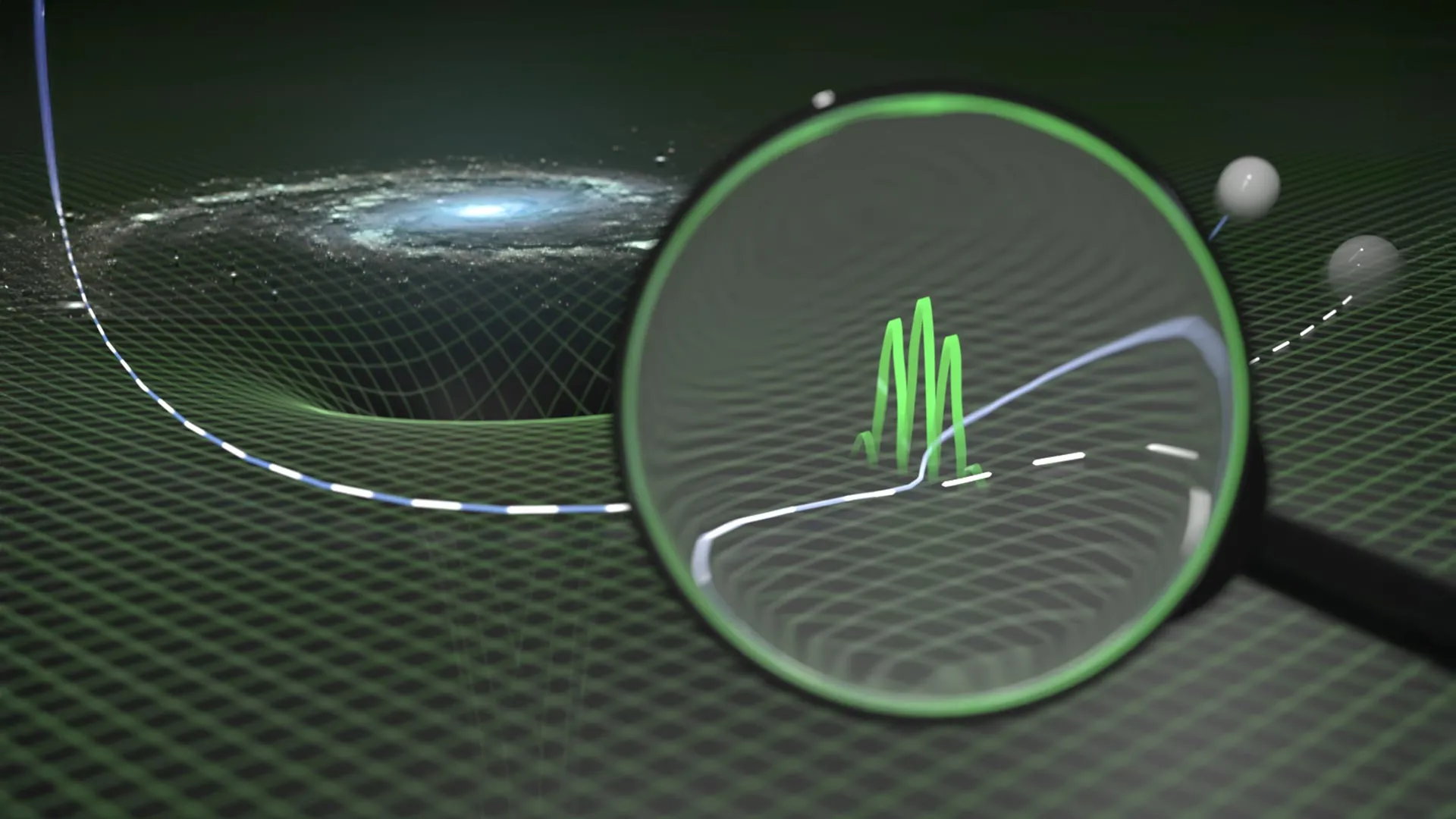
The research team derived a new equation called the q-desic equation, named after the classical geodesic curve. “This equation shows that in quantum spacetime, particles do not always move exactly along the shortest path between two points, as the classical geodetic equations predict.” By studying how a freely moving object (such as an apple falling toward Earth in space) moves through spacetime, scientists may be able to detect quantum features of spacetime itself.
Small differences and cosmic implications
How different are these quantum paths from the quantum paths predicted by classical relativity? The difference is very small if researchers only consider normal gravity. “In this case, we end up with a deviation of only about 10 to 35 meters, which is too small to be observed experimentally,” says Benjamin Koch.
However, Einstein’s equations also include another element known as the cosmological constant, often associated with “dark energy.” This component is responsible for the accelerating expansion of the universe at its largest scale. When the researchers incorporated a cosmological constant into the q-desic equation, the results changed dramatically.
“And when we did that, we encountered a surprise,” reports Benjamin Koch. “The q-desic is very different from the geodesic obtained by normal methods that do not use quantum physics.”
The predicted anomalies appear both at very short distances and on very large cosmic scales. It’s probably impossible to measure small scale differences. However, at a distance of approximately 1021 meters, the effects can be significant.
“In between, for example with respect to the Earth’s orbit around the sun, there is virtually no difference. But at very large cosmological scales, precisely where the main mysteries of general relativity remain unsolved, there are clear differences between the trajectories of particles predicted by the q-desic equation and those obtained from unquantized general relativity,” says Benjamin Koch.
Possible ways to test quantum gravity
The study, published in the journal Physical Review D, introduces a new mathematical framework for linking quantum theory and gravity. More importantly, it may provide an avenue for comparing theoretical predictions with actual observations.
“Initially, we did not expect that large-scale quantum corrections would cause such dramatic changes,” says Benjamin Koch. “Of course, this needs to be analyzed in more detail, but this gives us hope that further development of this approach will yield new, observationally well-testable insights into important cosmic phenomena, such as the still-unsolved mystery of the rotational speed of spiral galaxies.”
Returning to the Cinderella analogy, physicists may have finally identified a measurable clue that can help distinguish competing theories of quantum gravity. Slippers may have been found. The next step is to determine which theory really fits.
