


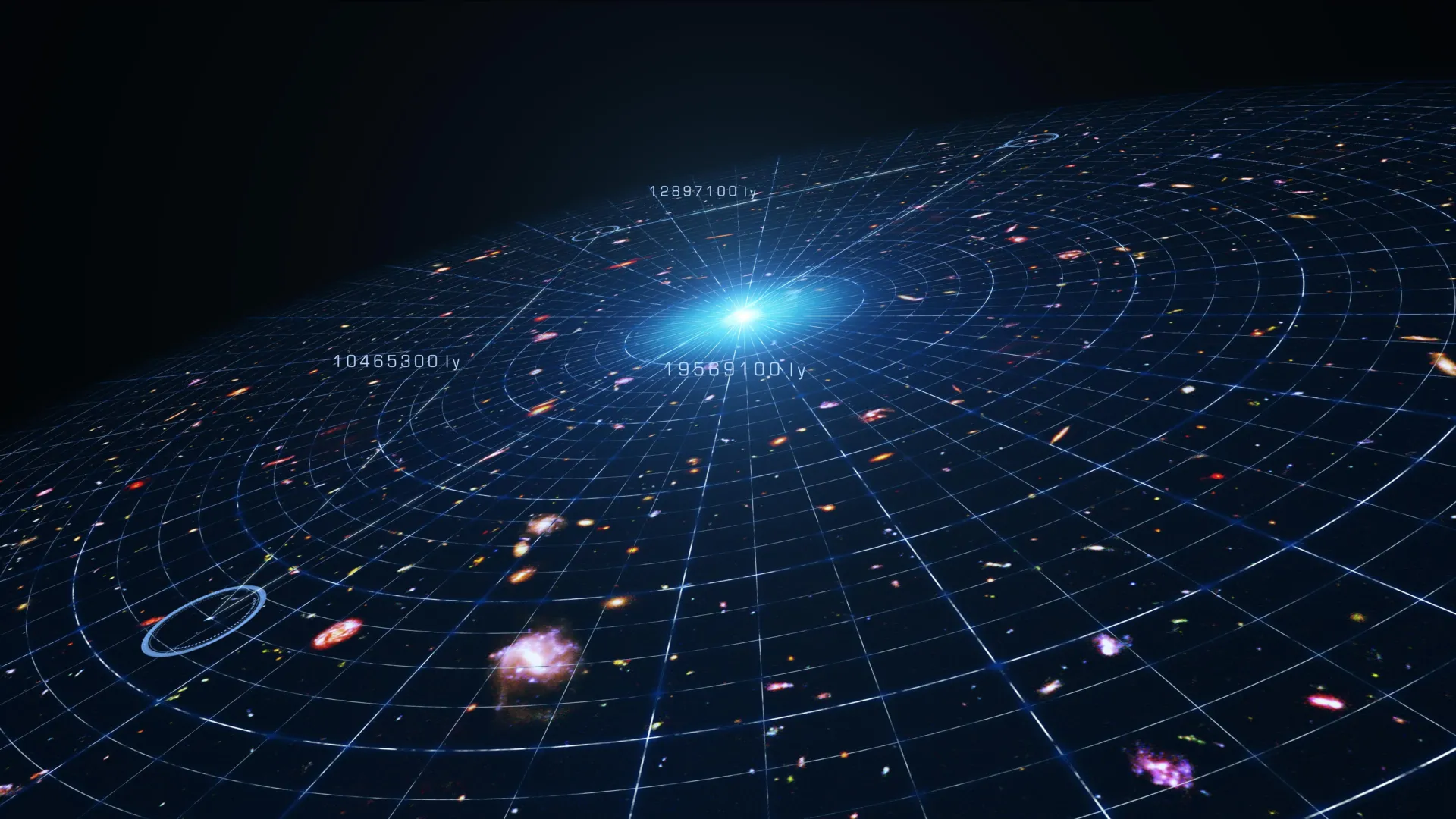
Science progresses by proposing ideas and trying to prove them wrong. This process becomes especially difficult when dealing with the universe at its largest scale. Dark energy and dark matter are among the most difficult concepts to test. Observations across vast regions of the universe clearly suggest that something influences gravity in a way that Einstein’s theory does not fully explain. But within our solar system, everything appears to be working as expected.
A new study by Slava Turishev, a physicist at NASA’s Jet Propulsion Laboratory, considers how researchers can address this discrepancy. His work suggests that being extremely precise and selective in how we design experiments to search for signs of dark energy and dark matter closer to home may be key.
‘Big disconnect’ between astrophysics and local physics
At the heart of the problem is a phenomenon scientists call the “Great Discontinuity.” The laws of physics seem to act differently depending on the scale at which they are observed. In regions with little matter (i.e., no gravity), effects related to dark energy and changes in gravity are more pronounced. In contrast, in dense environments filled with matter and strong gravitational forces, the same effect appears to disappear, at least based on current equipment.
Within the solar system, everything is consistent with traditional physics. The planet follows its predicted orbit. Measurements of spacetime around the Sun, including data from the spacecraft signal, match predictions exactly. All probes sent through the solar system behave as if only standard gravity were acting on them. There are no obvious signs that anything is wrong.
Powerful evidence from distant space
When we look far beyond our hometown, the picture changes dramatically. The universe appears to be expanding on a scale larger than that of galaxies. Although scientists continue to debate the exact rate of this expansion, there is strong evidence that something is affecting gravity and space-time in ways that are not fully captured by current theories.
At this time, dark energy is the best explanation for this behavior, although its true nature is still unknown.
Screening effects and hidden “Fifth Force”
One possible explanation involves a phenomenon known as “screening.” In this idea, the source of the discrepancy changes its behavior depending on its surrounding environment. As density increases, the effect becomes weaker or less detectable.
There are two main types of screening models. The first is called the “chameleon” model. In this scenario, a hypothetical fifth force in nature (other than gravity, electromagnetism, and the two nuclear forces) adjusts its strength based on the amount of matter nearby. In low-density regions, it becomes stronger and produces effects associated with dark energy. In dense areas, even if they are still present, they are weakened to the point where they cannot be detected by current equipment. It may only appear in the thin outer layer around an object like the Sun, but in principle it could be measured there as well.
Weinstein’s Selection and Oppressed Forces
Another explanation is the Vainshtein screening model. Here, the force itself does not change. Instead, the surrounding gravity effectively suppresses its influence, making it appear weaker. This model introduces the concept of Vainshtein Radius, which indicates the distance at which a force regains its normal strength.
For the Sun, this radius is estimated to span approximately 400 light years. This region contains many stars, meaning that this force will remain suppressed far beyond our solar system and even throughout much of the galaxy.
Why we need a new solar system mission
Both screening models can leave subtle traces in the large-scale observations collected by missions such as Euclid and the Dark Energy Spectrograph (DESI). However, these studies focus on distant galaxies and cannot directly reveal how such forces act within our solar system.
To test these ideas in the field, scientists need dedicated missions designed specifically for that purpose. More importantly, researchers need falsifiable theories that predict what such missions will detect.
The importance of testable predictions
Dr. Turishev emphasizes that without clear and testable predictions, additional experiments in the solar system are unlikely to yield new results. So far, observations have consistently confirmed general relativity. Continuing similar experiments without new theoretical guidance may not yield useful insights.
But if scientists can use data from large-scale cosmological surveys to formulate precise hypotheses that apply to our solar system, it will be possible to design targeted experiments to test them.
Looking to the future: Building better equipment
It may take time to develop instruments sensitive enough to detect such subtle effects. In the meantime, the mission will focus on incrementally improving measurement capabilities, and incremental progress will be key.
If current data yields well-defined, testable predictions, and experiments can be realistically constructed to test them, pursuing that opportunity can lead to major breakthroughs. Such discoveries have the potential to reshape our understanding of gravity, dark energy, and the fundamental workings of the universe.
