



In this interview, NewsMed speaks with Georgia Golfis, European Imaris team principal, about the launch of Imaris 11 and how its new workflow-driven approach is transforming image analysis through automation, reproducibility, and intelligent batch processing.
Could you please introduce yourself and your role at Imaris?
My name is Georgia Golfis and I’m part of the European Imaris team.
I work closely with users to support their image analysis needs and help them get the most out of their software. New versions of Imaris are typically presented by product manager Anna Paszulewicz, who oversees development from concept to launch. We have presented Imaris 11 on her behalf.
What is Imaris 11 and what is the main focus of this release?
Imaris 11 is built around the core goal of speeding up and simplifying image analysis while ensuring reproducibility.
The core innovation of this version is the introduction of workflows. These workflows are intuitive step-by-step protocols that automatically record all actions performed during image analysis. The goal is to eliminate repetitive manual documentation while improving consistency and reproducibility between experiments.
Why was workflow automation a priority in the development of Imaris 11?
This decision was driven by user feedback. Image analysis is often repetitive and time-consuming, and many users struggle to document complex protocols and share them with collaborators. Reproducibility is critical in scientific research, but manually recording parameters, filtering steps, and object creation settings is inefficient and error-prone.
We listened to our users’ daily challenges and designed a workflow that automatically captures every step of the analysis process. This allows protocols to be reliably reproduced and easily shared.
How can workflows improve the reproducibility of image analysis?
Workflows automatically document everything that happens during analysis. This includes object creation details, filtering decisions, masking, channel editing, statistics export, and even snapshots.
Instead of writing detailed notes, users now generate live workflow files that record the entire protocol. When someone imports that workflow, they can see exactly what was executed, in what order, and with what parameters. This dramatically improves the reproducibility and transparency of image analysis.
Can a workflow handle both automatic and manual analysis steps?
Yes, that is one of their strengths. If the workflow includes manual steps, such as drawing a region of interest, the batch process will pause and prompt the user for input before continuing.
This hybrid approach allows users to combine automation with the necessary expert-driven decision-making without sacrificing efficiency when processing multiple datasets.
How does Imaris 11 simplify batch processing?
Once you create a workflow and validate it on a control image, you can apply the workflow to multiple images with just two clicks. The same protocol can be performed across experimental groups, ensuring consistency.
Additionally, workflows can include automatic snapshot generation. After batch processing, users can perform quality control on all images without having to reopen each file individually. This can save a lot of time in large studies.
How does Imaris 11 support side-by-side comparison of experimental groups?
A plotting interface allows you to easily compare datasets. After applying the workflow to multiple images, you can analyze the quantification results side by side.
Users can compare experimental groups with one click, streamlining the process of identifying biological differences between conditions. This integrated approach increases both efficiency and analytical clarity.
What changes have been made to the user interface in Imaris 11?
One notable update is that the tools have been separated into two columns: Visualization and Workflow.
The (Visualization) column displays the objects currently in the scene and provides access to rendering tools. The “Workflow” column contains quantification tools and records each analysis step. This clear separation improves ease of use and helps users track the progress of image analysis protocols.
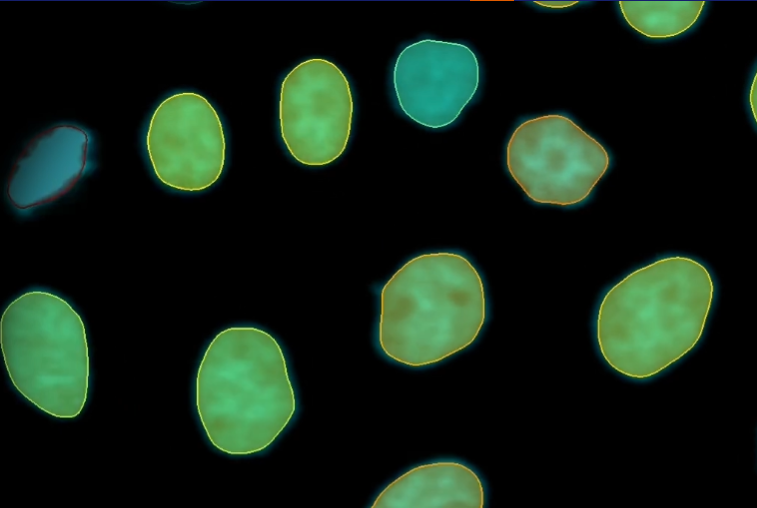
Image credit: Oxford Instruments
Can you give us a practical example of a webinar?
In the webinar, we analyzed cancer cells that grew in the form of micropatterns. This experiment included multiple fluorescence channels including nuclear, cytoskeleton, protein expression, and lysosomes.
We developed a workflow that uses machine learning to detect cells and quantify lysosomes within each cell. The objective was to measure the number, size, and density of lysosomes in control and treated samples. Once a workflow is validated, it is automatically applied to all experimental groups, ensuring consistent analysis.
How does Imaris 11 support learning and onboarding new users?
This release introduces a self-learning demo image that can be downloaded from the Imaris website. Each dataset contains raw images, analyzed versions, and associated workflow files.
Users can open the analyzed data, explore the workflow, and apply it to the raw dataset. This allows for systematic self-study and helps new users understand both workflow concepts and Imaris 11’s broader image analysis capabilities.
How does Imaris 11 facilitate collaboration between researchers?
Workflows are lightweight files that can be shared via email. This makes it easy to distribute validated image analysis protocols across laboratories and institutions.
Researchers can import a workflow, inspect all steps and parameters, and apply it directly to their data. This ensures consistency between collaborative studies and reduces ambiguity in methodological reporting.
What is the broader impact of Imaris 11 on scientific research?
Imaris 11 addresses two important needs in modern science: efficiency and reproducibility. Reduce human error and save valuable time by automating documentation, enabling batch processing, and simplifying protocol sharing.
Ultimately, both experts and non-experts will be able to perform reliable, standardized image analysis, accelerating discovery while maintaining scientific rigor.
About Georgia Golf 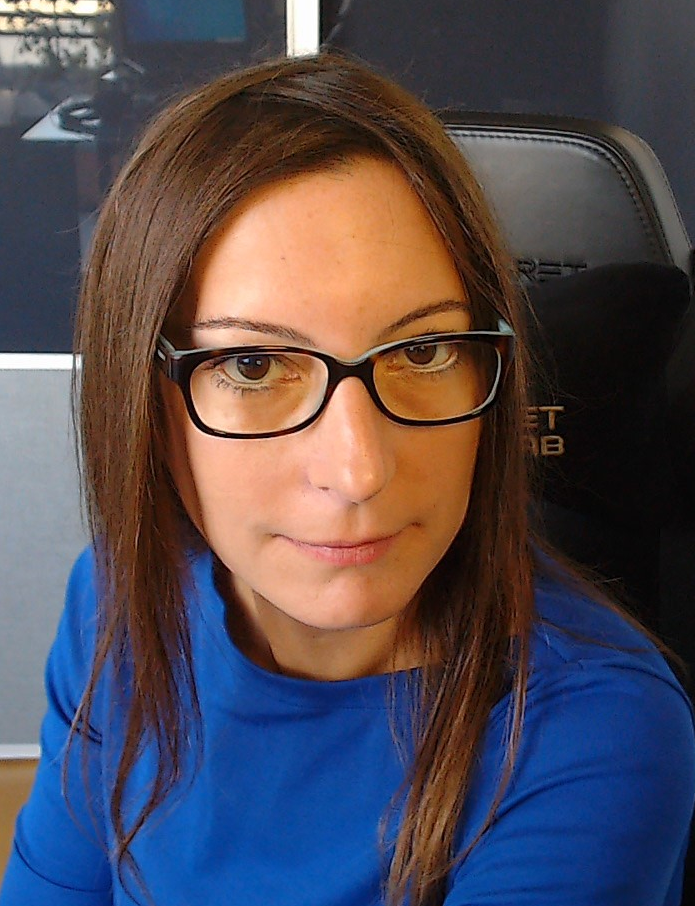
Georgia Golfis is a member of the European Imaris team, supporting researchers with advanced microscopy image analysis and quantification. With a background in life sciences and extensive experience in imaging technology, she works closely with scientists in academia and industry to optimize experimental workflows and analytical reproducibility. Georgia’s expertise spans fluorescence microscopy, 3D and 4D imaging, and quantitative image analysis. As part of the Imaris team, she contributes to user training, application support, and the introduction of new software features designed to streamline research workflows. We also work with multidisciplinary teams to transform complex image data into meaningful biological insights, enabling researchers to fully leverage automated, machine learning-driven tools. Through her work, Georgia plays a key role in communicating product innovations such as Imaris 11, helping the scientific community adopt more reproducible and efficient image analysis strategies.
About Oxford Instruments
Oxford Instruments is a leading provider of high-tech tools and systems for research and industry, focused on accelerating breakthroughs that create a brighter future for the world. With a global presence, we strive for innovation and excellence, providing cutting-edge solutions that enable researchers and industry professionals to achieve breakthroughs in their fields. Our advanced technology delivers many benefits through unparalleled precision and reliability, ensuring users get accurate and reproducible results. Oxford Instruments’ innovative solutions accelerate research, increase productivity, and achieve innovation in a variety of fields including materials analysis, life sciences, semiconductors, physics, chemistry, and food science. We’re proud to be a trusted partner for those looking to push the boundaries of scientific and industrial progress, providing the tools and support they need to realize their visions.
Atomic force microscope: These advanced instruments are utilized for high-resolution imaging and precise measurement of surface properties at the nanoscale level. These provide detailed topographic information and allow precise measurements of features such as height, roughness, and mechanical properties.
Optical microscopy: Our solutions include comprehensive advanced imaging systems that utilize visible light to examine samples at the microscale. Equipped with high-quality lenses, cameras, and illumination systems, these optical microscopes provide detailed images with excellent clarity and resolution. These have applications in fields such as biology, materials science, and forensic medicine.
Plasma Etching and Deposition: Innovative etching and deposition techniques, atomic layer etching and atomic layer deposition, and ion beam etching and deposition solutions are used to manufacture advanced semiconductor devices with high yields, efficiency, and reliability. Our services and product range includes research and development systems to fully clusterable, robust and high-uptime production systems designed for high-volume production in key markets such as quantum, power devices, augmented reality and datacom.
Electron microscopy analysis: Our high-performance tools are tailored for material characterization, particle analysis, and sample manipulation at the nanometer scale. Techniques such as backscattered electron and
Optical imaging and spectroscopy: Our optical imaging solutions consist of a series of advanced technologies and systems that use light to capture and analyze images. From state-of-the-art optical microscopes to spectroscopic systems and imaging software, these solutions deliver high-quality images and data for applications such as materials characterization, biological research, and semiconductor analysis.
Nanoindentation: Our high-resolution MEMS-based nanoindenters are designed to measure mechanical properties of materials such as hardness, modulus, stiffness, and creep behavior. These instruments offer excellent manufacturing tolerances, increasing sensitivity, resolution, and reproducibility beyond the limits of traditional technology.
nuclear magnetic resonance: We offer a variety of benchtop nuclear magnetic resonance (NMR) instruments for research, industrial quality assurance/control, and rock core analysis. These instruments offer advanced capabilities for chemical analysis, material characterization, and more.
Raman microscopy: Our advanced imaging systems are tailored for high-resolution microscopy and analysis, providing cutting-edge technology and precision optics for detailed insight into samples at the micro- and nanoscale. Trusted by researchers and scientists in fields such as materials science, life sciences, and nanotechnology, these systems are available in a variety of models for a variety of applications.
X-ray technology: Our technology encompasses a wide range of advanced systems and solutions for materials analysis and characterization. With its cutting-edge capabilities and high sensitivity, Oxford Instruments X-ray technology is widely used in a variety of industries and research academic institutions for applications such as materials identification, quality control, and research in fields such as geology, metallurgy, and semiconductor manufacturing.
