


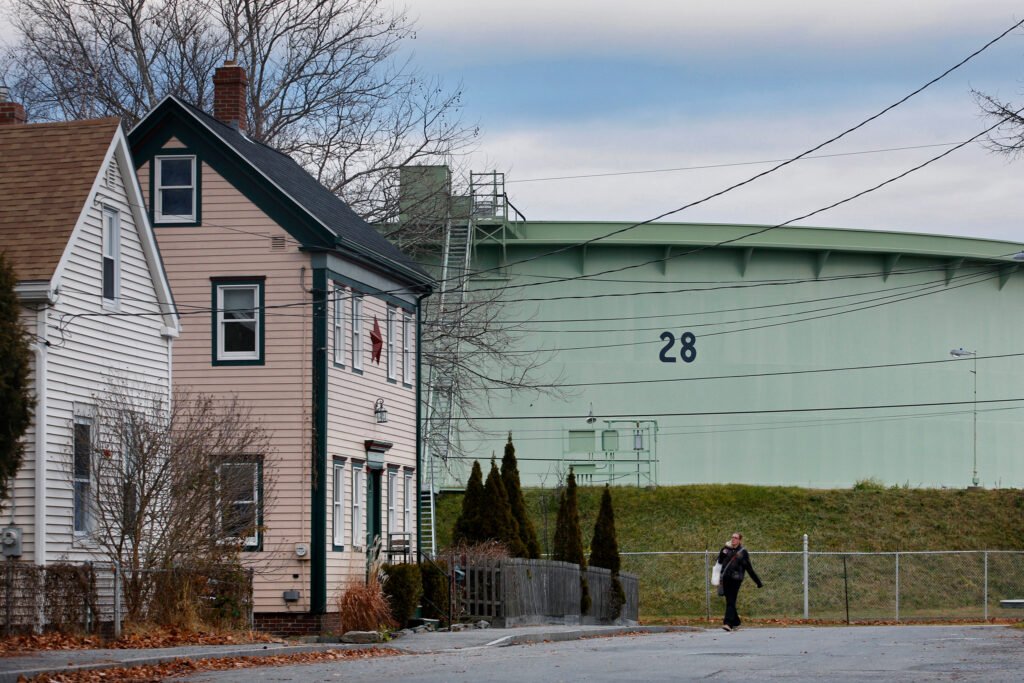
South Portland — One of the most desirable locations in Maine, with a vibrant and diverse community, close to the beach, and close to downtown Portland. But for years, South Portland residents have wondered: Is the air safe to breathe with 120 giant oil storage tanks dotting the coast and clustered in several neighborhoods?
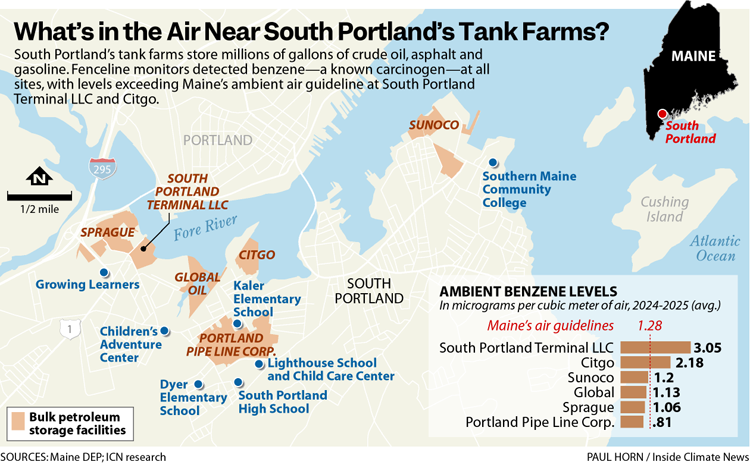
Thanks to a year of emissions monitoring along the fence line of a city tank farm, we have the first answer. At two of these locations in particular, results showed concentrations of benzene, a known carcinogen, far exceeding state standards.
“We’re about 300 feet from those tanks,” said Ted Reiner, whose home is surrounded by three tank farms in the city. Here he and his wife raised two daughters, now ages 38 and 28. Around Christmas, Reiner underwent surgery for bladder cancer. He is currently undergoing immunotherapy, but I can’t help but wonder if his environment is making his health worse.
“We don’t know what the cumulative impact is,” he says. “I’ll think about it.”
Reiner lives closest to the Citgo South Portland Terminal on the part of South Portland known as Turner Island. Tanks there mainly store gasoline, but other tanks in the city store various petroleum products such as kerosene and asphalt. He and his family are among more than 12,600 people who live within a mile of a tank farm, according to EPA data.
The CITGO terminal is one of only two tank farms in the city whose emissions exceed state limits, according to data collected by the Maine Department of Environmental Protection. Average benzene levels were measured at 2.18 micrograms per cubic meter, well above Maine’s allowable limit of 1.28 micrograms per cubic meter.
The highest level in the city, 3.05 micrograms, was measured at South Portland Terminal LLC, owned by Buckeye Partners. Unlike Citgo’s tanks, there are no people living nearby. Meanwhile, measurements at a tank farm owned by Sunoco Inc. were slightly below state guidelines.
Long-term inhalation of benzene can damage bone marrow and blood-forming cells, suppress the immune system, and increase the risk of leukemia. According to the World Health Organization, “there is no safe level of exposure.”
Each number reported by the state is an average of two consecutive weeks of samples. Citgo’s final numbers for this year are the average of all of these two-week samples. Examining one year’s worth of data masks higher emission levels. But levels have skyrocketed, and in one two-week period in particular, the average benzene level recorded near the Citgo facility was 11.8 micrograms per cubic meter, nearly 10 times the state limit.

These short-lived “burst releases” can be dangerous in and of themselves.
Exposure to high levels of benzene for 1 to 14 days can cause headaches and breathing problems in sensitive people such as children, the elderly, or people with existing health conditions. The risk level for short-term exposure to benzene is 30 micrograms per cubic meter. What the state’s data doesn’t reveal is whether benzene levels can get high enough to cause such a reaction.
Citgo spokesman Rich Johnson said the company takes South Portland residents’ concerns seriously and continues to work with state regulators. “We believe it is important that any study of air monitoring results supports accurate and representative conclusions about air quality at the regional level,” Johnson said.
Buckeye Partners did not respond to multiple emails seeking comment.
Although oil companies and oil terminal owners use a variety of techniques to eliminate emissions, they still occur. In most cases, chemicals escape through tank vents, equipment leaks, and rack loading operations.
Anna O’Sullivan, a 42-year-old artist and therapist, thinks about all of this. She is concerned about her 7-year-old son, Henry, who is playing in the garden. “Is he just absorbing things from the air?” she wonders.
This story is funded by readers like you.
Our nonprofit newsroom provides free advertising for our award-winning climate coverage. We rely on donations from readers like you to continue our work. Donate now to support our work.
donate now
She is reluctant to eat anything grown in the soil there. She worries that staying put will mean poisoning them both.
But she’s also stuck. O’Sullivan bought the three-bedroom Cape, which was built in 1904 and has a large backyard, in 2017 for $190,000. This is an attractive but impossible discovery in today’s market.
“I can see the tanks from my house,” she said. It’s like, “I have to move. I can’t raise my kids in a place where the air is toxic.”
But at the same time, “I like my house. …It’s hard to move, and it’s hard to buy a house.”
Science supports these feelings.
The measurements are high enough to “deserve serious attention,” said Drew Michanowicz, a senior scientist at the Institute for Healthy Energy Physicians, Scientists, and Engineers, an independent scientific research organization that brings science to energy policy.
Across South Portland, most people don’t live right next to tanks, reducing the risk of infection. This is because the emissions spread quickly. However, some people live quite close together, especially around Citgo facilities.
Jackie Jerry lived near the Citgo tank until last fall, when a house fire forced her to move. “Did you ever think we were safe? Probably not,” she said. “But did many people have a choice about where you lived? No.”
South Portlanders first became concerned about the tanks in 2019, after the EPA announced a consent decree for two companies that own tanks here, Global Partners LLC and Sprague Energy, to resolve the dispute without admitting guilt. In both cases, heated oil Storage tanks containing asphalt and concentrated fuel oil were emitting chemicals including so-called volatile organic compounds, or benzene, in violation of state permits. This problem is specific to tanks containing asphalt and No. 6 fuel oil, and while previously thought to be emissions-free, this is not the case with the Citgo tank.
As a result of the consent decree, the operator installed a system to capture the emissions, which appears to have been effective. In the most recent tests, emission levels around both tank farms were below Maine standards.
The consent decree also helped bring the tank to the attention of lawmakers. Newly passed legislation in 2021 requires all oil tank farms in the state to begin fenceline monitoring for chemicals, including benzene. Its monitoring began in August 2024, and the first results were announced late last year.
Residents here have long taken the fight against industrial emissions into their own hands, including a high-profile and successful fight in 2018 to stop oil from Canada’s tar sands from entering the city by pipeline.
In that spirit, Tom Mikulka, a retired chemist who lives in South Portland, in biochemistry from Cornell University, decided to analyze the state’s results so residents could begin to make sense of them.
“I don’t want to sleep knowing that benzene levels are high near my home,” Mikulka said. This refers to the houses that are built just a few meters from the fence line monitors installed along Citgo’s property. “While there is some dispersion, I don’t think the data would be much different just a few feet away.”
The state’s findings confirmed his long-held concerns. Mikulka first started testing emissions in her neighborhood in 2020, when she used coronavirus relief checks to buy air monitoring equipment. He hung one of the monitors on Reiner’s property near the swing where his grandchildren like to play.
Six years later, with official data in hand, Mikulka hopes it will be harder for regulators to ignore the findings.
That is also Jackie Jerry’s hope.
“Now that we have these answers, who is going to stand up and say, ‘Let’s solve this problem?'” she said. “Is it a city problem? Is it an oil company problem? Where is the problem?”
About this story
As you may have noticed, this article, like all news we publish, is free to read. That’s because Inside Climate News is a 501c3 nonprofit organization. We don’t charge subscription fees, keep our news behind paywalls, or fill our website with ads. We provide climate and environmental news free to you and anyone who wants it.
That’s not all. We also share our news for free with dozens of other news organizations across the country. Many of them cannot afford to do their own environmental journalism. We’ve established bureaus across the country to report on local news, partner with local newsrooms and co-publish stories to ensure this important work is shared as widely as possible.
The two of us started ICN in 2007. Six years later, we won the Pulitzer Prize for national reporting and now run the nation’s oldest and largest dedicated climate newsroom. We tell the story in its entirety. We hold polluters accountable. We expose environmental injustice. We debunk misinformation. We explore solutions and inspire action.
Donations from readers like you fund all aspects of our work. If you haven’t already, will you support our ongoing work, our coverage of the biggest crises facing our planet, and help us reach more readers in more places?
Please make a tax-deductible donation. Each one makes a difference.
thank you,

ryan krugman
Posted by
Ryan Krugman is a recent graduate of Columbia University’s Climate School with a focus on climate change reporting and communication. He also holds a bachelor’s degree from St. Lawrence University, where he studied environmental science and sociology. A former Inside Climate News fellow, he currently reports on climate and environmental issues in New England and Georgia.
