


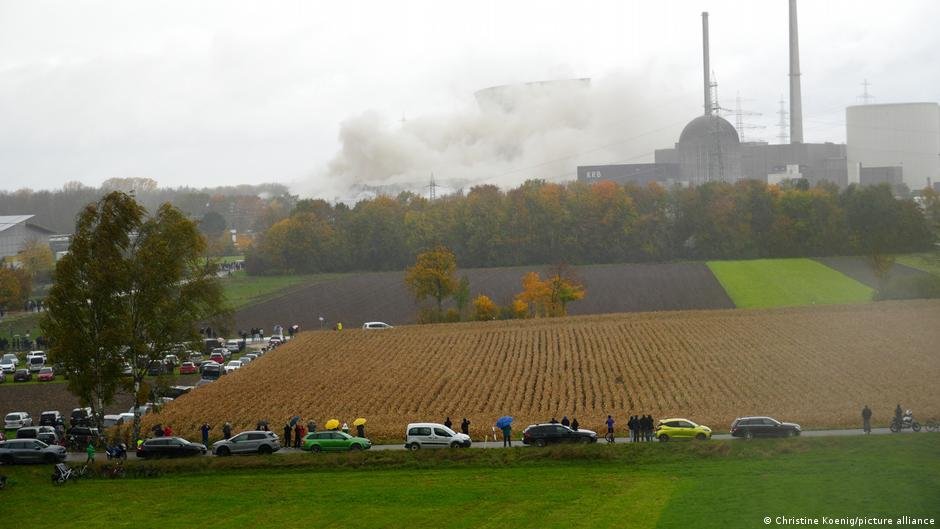
At a nuclear summit near Paris earlier this week, European Commission President Ursula von der Leyen said the transition away from nuclear energy, which some EU countries are undertaking, was a “strategic mistake”. Nuclear power is a “reliable, affordable and low-emissions source of electricity,” she said. She announced new EU funding for nuclear power plants.
Von der Leyen’s words echoed in Germany, which switched off its last nuclear reactor in 2023.
Like her daughter, von der Leyen’s father Ernst Albrecht, a member of Germany’s centre-right Christian Democratic Union (CDU), served as head of Lower Saxony’s state government in the 1970s and was an enthusiastic supporter of nuclear energy.
However, attempts to establish a final disposal site for highly radioactive nuclear waste in the eastern part of the state failed. The village of Gorleben, which had been identified as the site where the vault would be built, became a symbol of the struggle of hundreds of thousands of people against nuclear energy. No repository was built.
Was Germany’s nuclear withdrawal a mistake?
To view this video, please enable JavaScript and consider upgrading to a web browser that supports HTML5 video.
After 2023, Germany’s nuclear power plants will be decommissioned
Ms. von der Leyen’s calls for a return to nuclear energy have been met with mixed reviews at best in Berlin.
Since 1961, a total of 37 nuclear reactors in Germany provided up to 30% of the country’s electricity. The country began phasing out nuclear power 15 years ago following Japan’s Fukushima disaster on March 11, 2011. Germany’s last nuclear power plant was shut down in 2023. Spain and Austria also announced that they had permanently halted nuclear power generation.
Since then, there have been repeated debates in Germany about whether a return to nuclear power is wise, given fluctuations in the production of renewable energy such as solar and wind energy, and in light of oil and gas import shortages, especially in times of international crises such as the Ukraine war, the US-Israel war against Iran, and the subsequent escalation across the Middle East.
Chancellor Friedrich Merz, himself a member of the CDU, said on Tuesday that previous federal governments had decided to phase out nuclear energy and it was impossible to reverse that decision. “It’s unfortunate, but that’s the way it is. We’re focused on energy policy right now,” he said.
The CDU-allied Bavarian Christian Social Union supports nuclear power, but Merz also knows that reducing nuclear energy would require a majority in the lower house of Germany’s parliament. To make up for this number, votes from the far-right party Alternative for Germany (AfD) are needed. Merz said he would not cooperate with the AfD.
SPD rejects new nuclear power plant
The centre-left Social Democratic Party (SPD), the conservative junior coalition partner, rejected Ms von der Leyen’s proposal to return to nuclear energy. SPD Environment Minister Carsten Schneider said nuclear energy already costs taxpayers billions of dollars. “If a risky technology is still dependent on state support a quarter of a century later, and better alternatives have existed for a long time, then there should be consequences,” Schneider said.
Schneider also rejected proposals to focus primarily on mobile nuclear reactors, so-called small modular reactors (SMRs), saying: “These small nuclear power plants have been under construction for decades, but they still have no breakthroughs and still struggle to secure subsidies.”
Markus Klebber, CEO of Germany’s largest electricity company RWE, recently rejected the idea of small nuclear reactors. “As it stands, it is not viable for private companies to invest in SMRs,” Klebber told news portal Politico. He said no supplier in the world could commit to construction time at fixed or negotiated costs. Kleber said companies will not fund small nuclear reactors.
Nuclear power plants: a billion dollar grave?
To view this video, please enable JavaScript and consider upgrading to a web browser that supports HTML5 video.
Nuclear alliance between France and 15 EU countries
Many EU countries are considering expanding nuclear power generation. France operates 57 nuclear reactors and has formed a group of 15 EU countries to advocate for new nuclear power plants. This group includes countries such as Sweden and Italy.
In Germany, the 1986 Chernobyl disaster prompted a rethink of nuclear energy. The Green Party was founded in West Germany in 1980 and led a major campaign against nuclear power. After forming a government with the SPD, they succeeded in pushing for a gradual withdrawal in 2000.
The plan was scrapped when the conservatives returned to government in a coalition with the neoliberal Free Democratic Party (FDP) and decided in 2010 to extend the operating life of Germany’s nuclear reactors.
But the tide has turned again. Following an earthquake and tsunami, a “supermeltdown” occurred at the Fukushima nuclear power plant in Japan in 2011. Chancellor Angela Merkel herself oversaw the return to an exit strategy. And that decision continues to this day.
This article was originally written in German.
While you’re here: Every Tuesday, DW editors round up what’s happening in German politics and society. You can sign up for our weekly email newsletter, Berlin Briefing, here.
