


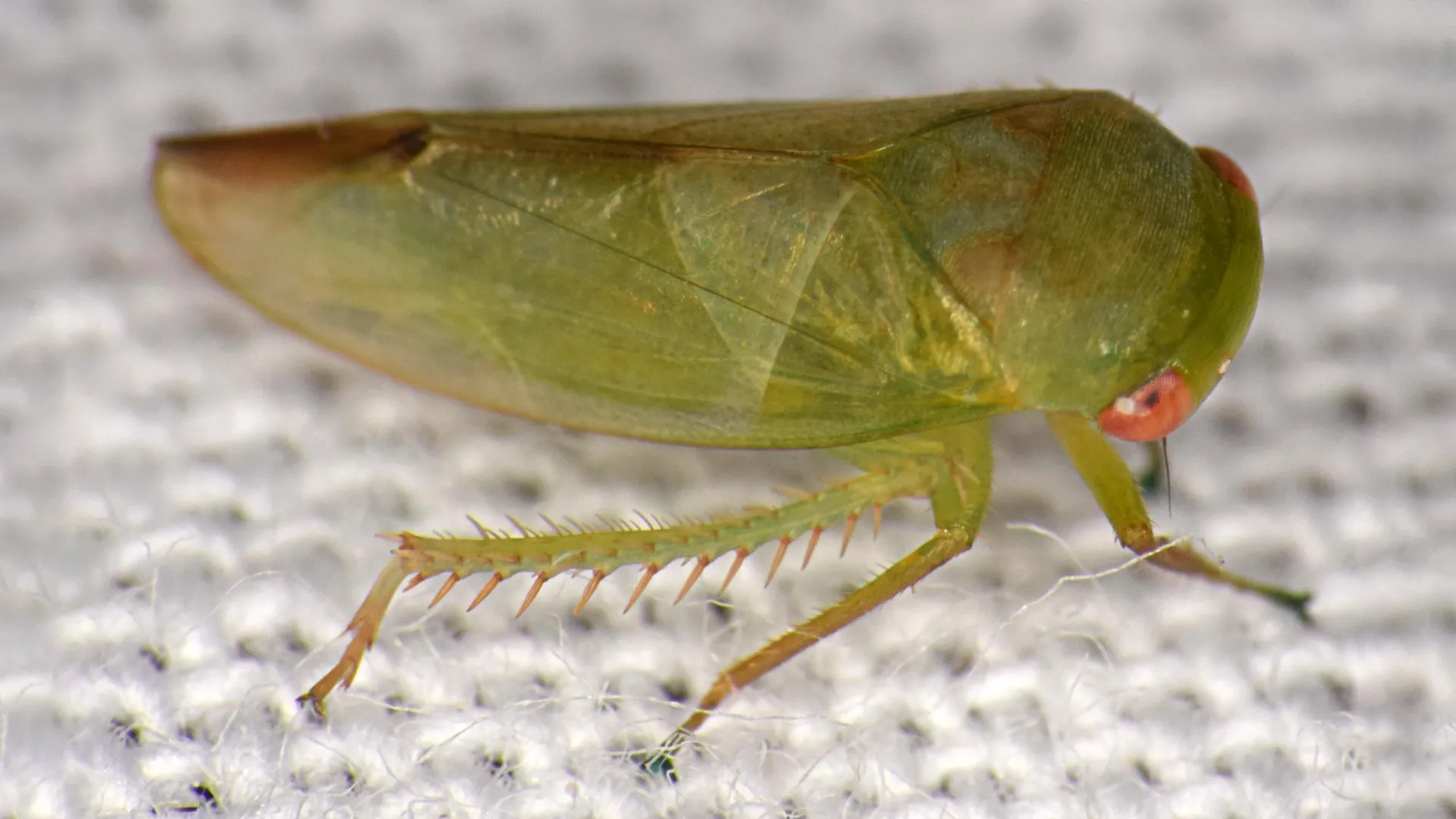
Scientists at Anglia Ruskin University (ARU) in Cambridge, UK, have identified seven previously unknown species of distinctive frog-like insects.
insects belong to the genus Batracomorphusa swarm of leafhoppers. Dr. Alvin Helden discovered this new species while conducting fieldwork in the rainforests of Uganda.
name Batracomorphus It comes from Greek and means “frog-shaped”. These leafhoppers are usually green in color and have large eyes. It moves by jumping on its long hind legs on the sides of its body, giving it a frog-like appearance.
Details of Dr. Helden’s discovery were published in the journal zoo animals. A discovery represents the first new thing Batracomorphus Species recorded in Africa since 1981.
Before this study, scientists had identified only 375 species. Batracomorphus They have been recorded all over the world, but only two have been recorded in the UK. All seven newly discovered species were collected using light traps in a rainforest area above 1,500 meters above sea level in Kibale National Park, Uganda.
How scientists identify new species of leafhopper
One of the most difficult parts of the research was proving that the insect was a species that had never been recorded before. Leafhoppers of this genus look almost identical in appearance and are therefore very difficult to visually identify.
To tell them apart, scientists must examine the insect’s reproductive structures. This is the only reliable way to distinguish between species.
Leafhoppers reproduce using what scientists call a “lock-and-key” system. In this process, the male genitalia act as a key, having a unique shape that only fits the corresponding female structure of the same species.
These intricate structures are made of the same durable materials as insect exoskeletons. This exact match ensures successful reproduction only between members of the same species and prevents hybridization.
Why leafhoppers are important to the ecosystem
Dr Helden, an entomologist and member of the Center for Ecology, Evolution and Environment Research at Anglia Ruskin University (ARU), said: “Leafhoppers are beautiful, adorable creatures. Some are pests and some are associated with crops such as maize and rice, but leafhoppers as a whole are a really under-appreciated group of herbivores.”
“They are an important food source for birds and other insects, and their presence is a sign of a healthy ecosystem.
“Discovering these new species requires a lot of painstaking field work in the rainforest, dealing with heat and humidity, but discovering species previously unknown to science is incredibly satisfying. All the hard work is worth it.”
“I named six of the leafhoppers in Greek, after their characteristics and where they were found. Batrachomorphus luteahas a very personal meaning. It is in honor of my mother, Ruth, who passed away in 2022.
“Ruth was a scientist and worked in a hospital laboratory. She bought me my first microscope, which I still have today, and encouraged my love of science from the beginning. So naming a species after her seems like the most fitting tribute I can give.”
