


About 15% of asteroids that pass close to Earth have a smaller companion star orbiting them. These paired objects are known as binary asteroid systems and are surprisingly common in our region of the solar system.
A research team led by the University of Maryland has discovered that these systems are much more active than scientists once thought. Rather than simply orbiting each other, the two bodies exchange rocks and dust through gentle, slow impacts that gradually reshape their surfaces over millions of years.
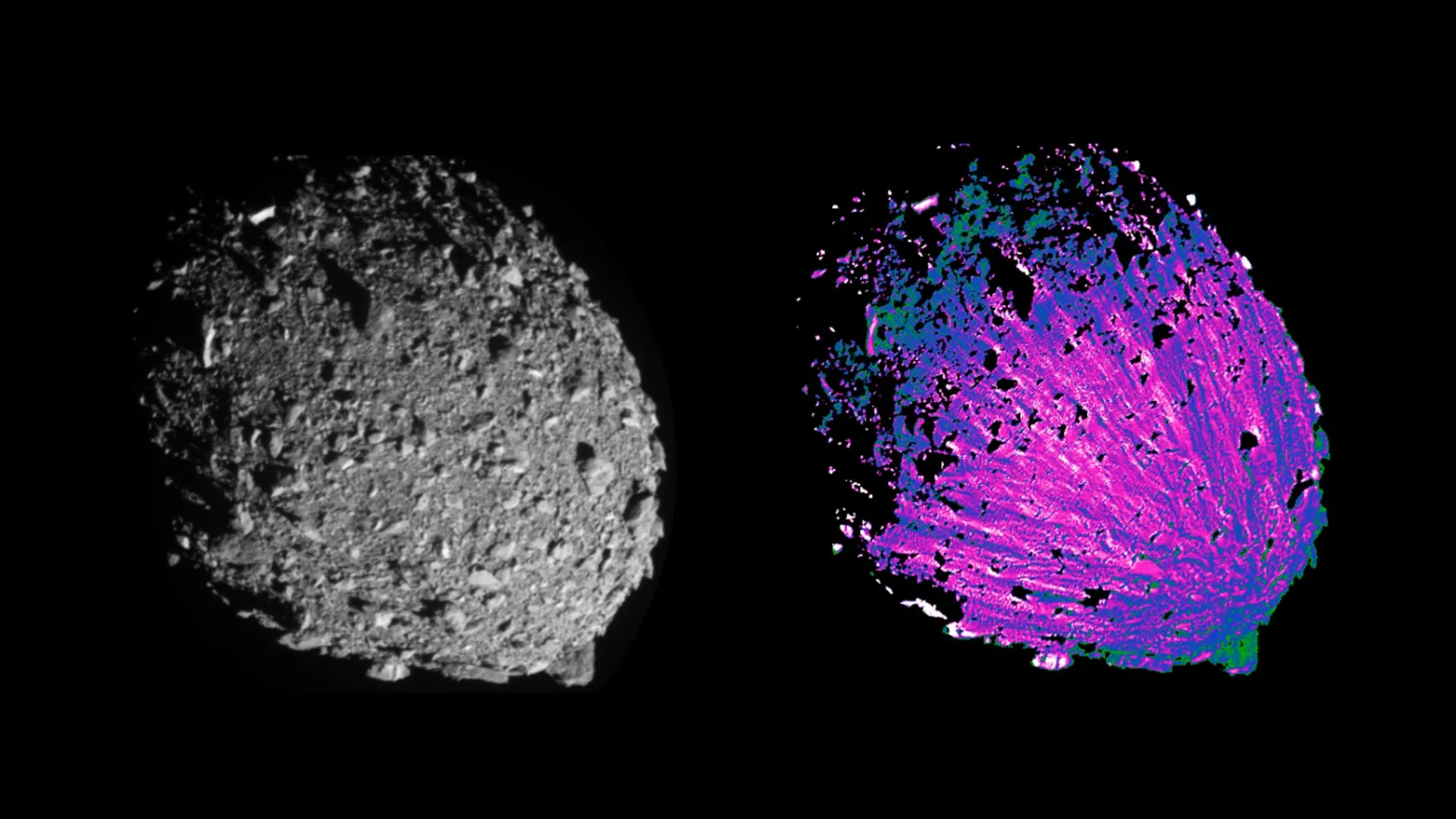
The discovery comes from a close analysis of images taken just before NASA’s Double Asteroid Redirect Test (DART) spacecraft intentionally collided with the asteroid moon Dimorphos in 2022. In these images, scientists noticed bright fan-shaped stripes on Dimorphos’ surface. These signatures provide the first direct visual evidence that material can be transferred naturally from one asteroid to another. Results published on March 6, 2026. Planetary Science Journal This could help scientists better understand asteroids that could someday threaten Earth.
“At first we thought there might be something wrong with the camera, and then we thought there might be something wrong with the image processing,” said Jessica Sunshine, lead author of the paper and an adjunct professor in UMD’s Department of Astronomy and Department of Geology, Environmental and Planetary Sciences. “But after we sorted things out, we realized that the pattern we were seeing was very consistent with a low-velocity impact that would throw a ‘cosmic snowball.’ We now have the first direct evidence of recent mass transport in a binary asteroid system. ”
Evidence of YORP effect on asteroids
This observation also provides the first visual confirmation of a process known as the Yarkovsky-O’Keefe-Radijevsky-Paddak (YORP) effect. In this phenomenon, sunlight gradually accelerates the rotation of a small asteroid. As rotation increases, loose material can fly off the surface and form small moons.
Sunshine explained that this likely happened in the Didymos system, which includes the larger asteroid Didymos and its smaller moon Dimorphos. The imprint left by the so-called “cosmic snowball” on Dimorphos suggests that debris flew off of Didymos and then landed on its companions.
Detecting Hidden Stripes in DART Images
Finding this evidence required months of careful analysis. The stripes were not visible in the original images returned from the DART spacecraft. UMD astronomy research scientist Tony Farnham and former postdoctoral researcher Juan Rizos have developed a special technique to remove shadows cast by rocks and lighting artifacts from photographs. Once these visual effects were fixed, subtle streaks left by the “cosmic snowball” began to appear.
“We ended up seeing a beam of light engulfing Dimorphos, something no one had ever seen before,” Farnham said. “I couldn’t believe it at first because it was so subtle and unique.”
Spacecraft flight paths have become even more complex. Because DART approached Dimorphos almost directly, the illumination and viewing angle changed little during the encounter. This made it difficult to determine whether certain features were real or simply a result of lighting conditions.
To confirm that the stripes were real, the researchers traced them back to a specific source region near the edge of Dimorphos. Its position is offset from the point where the sun is directly overhead, indicating that the pattern is not caused solely by sunlight.
“As we refined the 3D model of the moon, the fan-shaped stripes became more distinct, not fainter,” Farnham said. “It confirmed that we were dealing with the real thing.”
Slowly moving asteroid fragments
Scientists had previously gathered indirect evidence suggesting that sunlight could increase the rotation speed of small asteroids until surface material was ejected. But a new model created by a team at the University of Maryland provides the first visual confirmation of this process. The model also determines where debris fired from Didymos ultimately reached Dimorphos.
Additional calculations led by UMD alumnus Harrison Agruza (MA’19, PhD’22, astronomy) found that the debris left Didymos at a velocity of just 30.7 centimeters per second. Its speed is slower than normal human walking speed.
“That would explain the distinctive fan-shaped footprint,” Sunshine said. “These slow impacts will not be spread out evenly, they will produce deposits rather than craters, and they will be centered at the equator, as predicted from modeling of the material separated from their initial impact.”
Reproducing a “space snowball” in the laboratory
To test those explanations, researchers led by former UMD postdoctoral fellow Esteban Wright conducted laboratory experiments at UMD’s Institute of Physical Sciences and Technology. In the test, the team dropped marbles into sand interspersed with painted gravel pieces representing Dimorphos rocks. A high-speed camera recorded the results.
Experiments showed that the rock blocked some particles, while others were able to pass through the gaps between them. This produced a ray-like pattern similar to the stripes observed in Dimorphos.
A computer simulation conducted at Lawrence Livermore National Laboratory reached the same conclusion. Whether the incoming object was a solid rock like marble or a loose dust clump, the rock on the asteroid’s surface shaped the incoming object into a distinctive fan-like pattern.
“The footage taken by the DART spacecraft just before the impact showed these traces on Dimorphos, evidence that there was a material exchange between it and Didymos,” Sunshine said. “Fun line deposits would have extended to the sides of the moon that we did not impact, so they may not have been destroyed by the impact.”
Hera’s mission may reveal more clues
The European Space Agency’s Hera mission is scheduled to arrive at Didymos in December 2026. The spacecraft could determine whether the stripes survived the DART impact. Sunshine and his colleagues also hope that Hera may be able to detect new light patterns created by the rock that was dislodged when DART hit Dimorphos.
“These new details revealed from this study are critical to understanding near-Earth asteroids and how they evolve,” Sunshine said. “We found it to be much more dynamic than previously believed, and this will help us improve our models and planetary defense measures.”
The paper “Evidence for recent mass transport within a binary asteroid system” was published on March 6, 2026. Planetary Science Journal.
This research was supported by NASA (contract number 80MSFC20D0004), the U.S. Department of Energy (contracts DE-AC52-07NA27344 and LLNL-JRNL2002294), and the French National Research Agency (project ANR-15-IDEX-01).
