


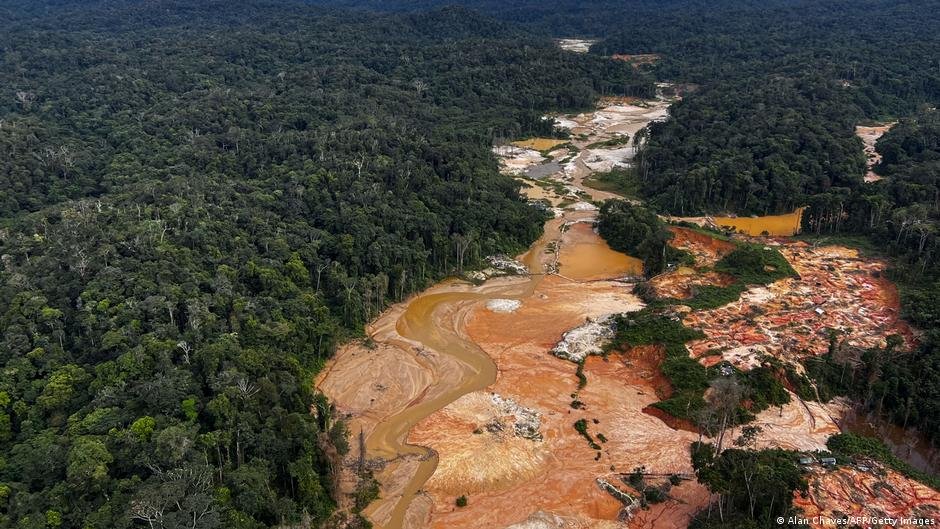
Deforestation, the collapse of fisheries, and the disappearance of pollinators rarely pose a national security threat. However, there is growing recognition that the loss of nature poses serious risks to political stability.
“Nature is the foundation of national security,” authors from the UK Department for Environment, Food and Rural Affairs (DEFRA) wrote in a recent assessment that draws a direct line between protecting vital ecosystems and securing a country’s future.
Biodiversity loss threatens water, food, clean air, and other vital resources on which human societies depend. And the risk is not only due to the decline of local nature. The report warns that six key ecological regions, including the Amazon rainforest, could collapse by mid-century, threatening the security of the UK and other countries.
That’s because the collapse of even remote critical ecosystems could upset delicate balances and “displace millions of people, change global weather patterns, increase global food and water scarcity, and foster geopolitical competition for remaining resources,” the report said.
Among the most pressing risks is food insecurity. More than a third of the world’s marine fish stocks are already overexploited, and more than three-quarters of the world’s food crops depend on pollinators that are disappearing due to intensive agriculture. As ecosystems weaken, supply shocks become more likely and politically unstable.
This vulnerability is acute as the UK imports 40% of its food and does not have enough farmland to support its people’s current diet. In the United States, 75% to 90% of domestic seafood is imported. In an increasingly unstable world, disruptions abroad can lead to price hikes and shortages at home.
“Protecting and restoring ecosystems improves food systems and the resilience of societies to shocks,” DEFRA writes.
Exchange stocks for stocks to invest in nature
The challenge of protecting nature and reducing security risks is both environmental and economic. For economically weak countries facing high debt burdens, short-term income from logging and resource extraction can be difficult to resist.
According to the United Nations Environment Programme, the world spends a total of US$7.3 trillion (€6.2 trillion) on activities that harm nature, 30 times more than it spends on conservation.
What is needed, environmentalists say, is a dramatic reversal in spending. Join the Nature Debt Swap, an increasingly popular financial tool aimed at freeing up new capital to protect critical ecosystems.
This idea dates back to the 1980s. Creditors and countries exchange debts in exchange for promises to protect nature. The country can have its debts restructured or canceled on the condition that some of its savings go toward conservation programs.
In the early days, creditors were either conservation NGOs or governments, and transactions were relatively small.
The first exchange took place in 1987 between Conservation International and Bolivia. The nonprofit organization bought some of Bolivia’s debt, allowing the country to spend more money to protect the Beni Biosphere Reserve in the Amazon River Basin.
How Berry’s Chocolate Supports Rainforest Conservation
To view this video, please enable JavaScript and consider upgrading to a web browser that supports HTML5 video.
Despite domestic concerns over indigenous land sovereignty and violations, the exchange strengthened protection of forest reserves and helped spark a wave of similar nature debt deals across Latin America.
Most recently, a swap in Belize in 2021 eased its ballooning debt burden and funneled millions of dollars in savings into fisheries management and marine conservation.
“If you protect certain areas of the ocean, they act as incubators for fish stocks in other areas,” said Gaia Larsen, who oversees climate finance for developing countries at the research nonprofit World Resources Institute.
With fish populations in decline worldwide, such protection could prove essential to keeping food on our plates. More than 3 billion people rely on seafood as their primary protein source.
A new era of private funding for nature conservation
The appeal for individual investors is bond-like returns. Legal & General, Britain’s largest asset manager, recently committed $1 billion to a new natural debt exchange, the company told DW in an emailed statement.
“We believe these transactions offer attractive risk-reward potential while supporting the communities and ecosystems that are fundamental to the resilience of the global economy,” said Jake Harper, senior investment manager.
Adam Tomasek, head of the Debt for Nature Coalition, a conservation NGO and charity, said a large investment by a major financial institution, for example, would send a positive signal to other financial institutions considering such an exchange.
“Their commitment will greatly enhance our ability to ensure these deals materialize early in the process,” Tomasek told DW.
Nature lovers fight for survival of Lusaka’s main forest
To view this video, please enable JavaScript and consider upgrading to a web browser that supports HTML5 video.
And debt-for-nature exchange is just one financial tool for addressing collective action problems for global biodiversity.
Brazil’s initiative, called the Tropical Forests Forever Facility, is similar to a debt swap and aims to channel investment from wealthy countries to countries that pledge to protect their rainforests.
“Foreign aid and overseas development assistance are really tied to national security, and I think there’s a growing recognition in some quarters of that,” Tomasek said.
Cascading threats related to nature loss
Beyond food security, protecting critical ecosystems can have a knock-on effect, slowing climate change, reducing pressures on migration, and strengthening fragile economies.
Forests and oceans act as large carbon sinks, absorbing greenhouse gases that accumulate in the atmosphere. Limiting warming can help prevent destabilizing droughts, crop failures, and extreme weather events.
The human cost of the loss of nature is staggering. According to the International Organization for Migration, by 2023 more than 90 million forcibly displaced people will be living in countries and territories affected by food insecurity.
Climate change and nature loss are accelerating displacement of people inside and outside borders Image: Hassan Ali Elmi/AFP/Getty Images
“We need a stable country with a strong economy and the ability to act as an effective player in the world,” Larsen said. “And so that we don’t end up in an emergency situation where we don’t need the aid or where the countries that provide this funding have to intervene anyway.”
The UK government has been upfront about what that emergency actually looks like, identifying a range of cascading risks from ecological collapse, including organized crime groups seeking to exploit scarce resources, political polarization and even military escalation.
“This is a smart investment for any government because it essentially buys the potential for risk that affects its national security and domestic policy,” Tomasek said.
Editor: Tamsin Walker, Jennifer Collins
