


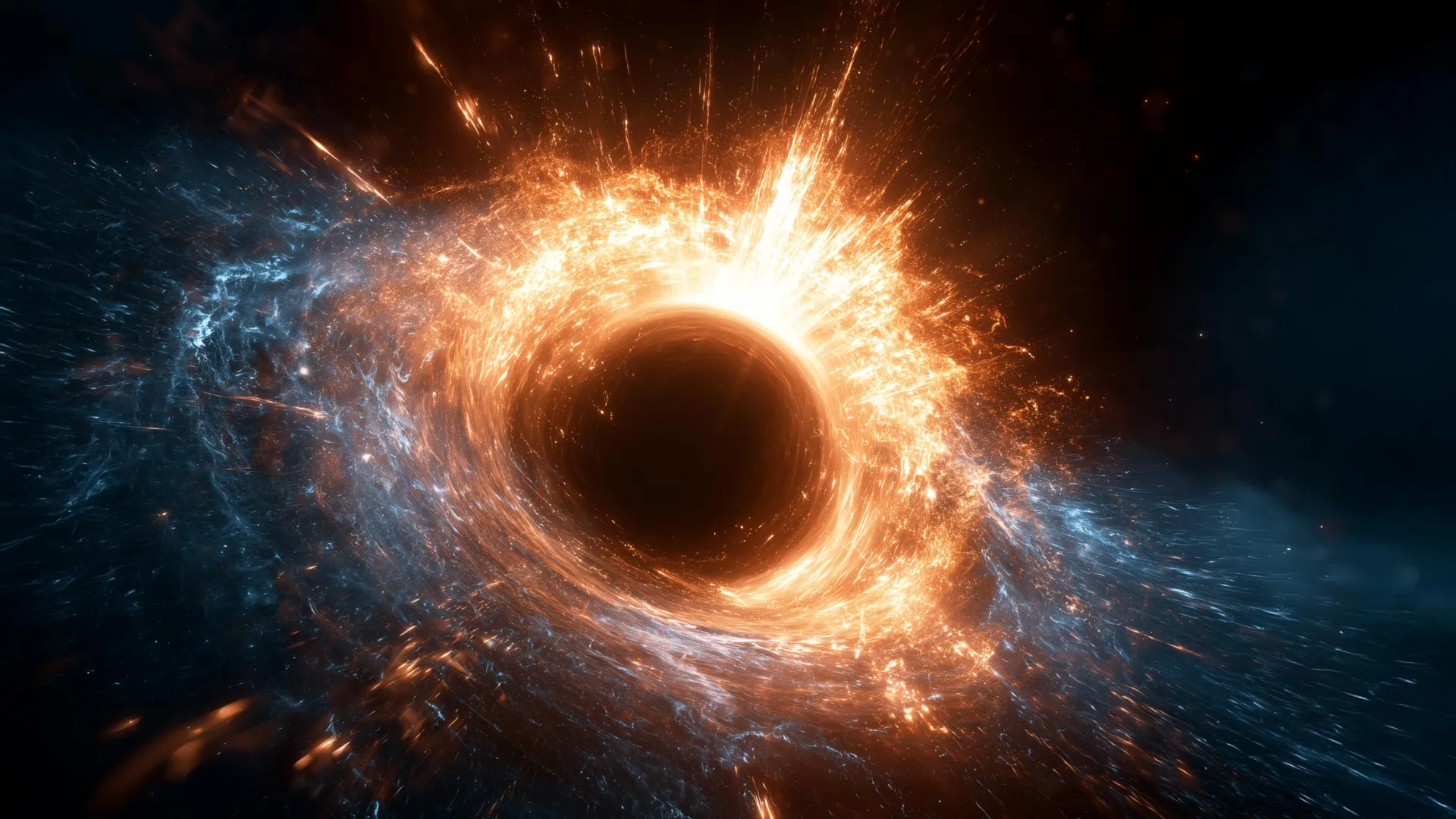
New observations from the James Webb Space Telescope (JWST) give astronomers the clearest picture yet of how supermassive black holes get the gas they need to grow.
These images reveal a long bundle of gas connecting the galaxy’s hot outer atmosphere to the rapidly rotating disk surrounding its central black hole. That disk acts as a final reservoir of matter before gas falls inside to fuel the black hole.
An international research team led by the University of Montreal conducted the observations and analyzed the results in cooperation with Michigan State University. Their findings were published in the July 14 issue of the journal. Astrophysics Journal Letterhelps solve a problem that has puzzled astronomers for decades.
“I can report that the JWST observations are providing us with thousands of new facts and measurements, and we have a lot to absorb,” said Megan Donahue, MSU University Distinguished Professor of Physics and Astronomy. “We’re all working together to solve astrophysical questions about how black holes get their fuel and how they interact with their host galaxies.”
Effects of supermassive black holes on galaxies
At the center of almost every large galaxy is a supermassive black hole (SMBH). These objects can be millions or billions of times more massive than the Sun.
Black holes themselves do not emit light. However, when a large amount of gas or dust falls towards it, the material heats up, creating an extremely bright and energetic region. Astronomers call this an active galactic nucleus (AGN).
Active black holes can act like powerful cosmic engines. It could fire giant jets that carry energy far beyond the center of the galaxy. These jets can heat the surrounding gas, slow the formation of new stars, and influence changes in the galaxy over billions of years.
That creates a long-standing mystery. As the jet heats up nearby gas, that gas should cool and be less likely to fall toward the black hole. In theory, a black hole should eventually cut off its own food supply.
However, many supermassive black holes continue to feed.
Possibility of black hole fuel cycle
The main explanation is that the system regulates itself.
Gas heated by black hole activity may eventually cool down again. When they lose energy, they can condense into elongated structures known as filaments. These streams of cooler gas could flow back toward the galaxy’s center and replenish the black hole’s fuel supply.
To investigate this process, the researchers used JWST to study NGC 4696, the Centaur Cluster’s largest central galaxy. This galaxy cluster is a dense collection of galaxies about 145 million light-years from Earth and is considered one of the best places to study how active galactic nuclei interact with their surroundings.
The research team observed NGC 4696 for nearly eight hours using JWST’s NIRSpec instrument. NIRSpec separates infrared light into its component wavelengths, allowing scientists to determine how gases move, what they’re made of, and how their properties change from region to region.
The resulting map tracked the movement of gas deep within the black hole’s sphere of influence. This is the region where the black hole’s gravity governs the movement of nearby matter.
JWST has resolved structures as small as about 30 light-years in diameter. Although that distance is extremely long by human standards, the level of detail inside the galaxy, which spans hundreds of thousands of light years, is astonishingly fine.
Inject gas into a rotating disk
Observations show that the S-shaped structure near the galaxy’s center is actually a rotating disk of gas surrounding a supermassive black hole.
This disk is nearly 800 light-years wide, and some of the material inside it is moving at speeds of up to 600 kilometers per second.
Most importantly, this disk appears to be physically connected to one of the galaxy’s large inward-flowing gas filaments. JWST data shows that gas moves along the filament and enters a rotating disk that feeds matter to the black hole.
This connection provides some of the strongest observational evidence to date that cold gas filaments can act as feeding channels for supermassive black holes.
Complete the black hole feedback loop
This discovery helps fill in missing steps in the larger cycle.
First, a jet fired by an active black hole injects energy into the surrounding galactic gas. Over time, some of that gas cools and becomes unstable, collapsing into thin filaments. Some of these structures are only a few hundred light-years wide, while others span thousands of light-years.
As the gas falls inward, magnetic forces may help reduce the rotation of the gas and guide it toward the center. The matter then collects into a rotating disk around the black hole.
The disk feeds energy into the black hole, which powers new jets, and those jets reheat the surrounding gas.
In this way, the black hole could help create the conditions that will eventually provide the next fuel supply.
Simulations support JWST observations
The researchers also used advanced computer simulations to test whether this explanation could reproduce the behavior seen in JWST.
The simulated gas moved and condensed in a manner very similar to the observed system. This agreement provides independent support for the idea that cooling gases, magnetic fields, and black hole jets work together in a self-regulating cycle.
“It’s really exciting to be a part of this project,” said Mark Voight, MSU professor of physics and astronomy. “Calculations made by our Michigan State University group predict that magnetic fields should help feed the universe’s largest black holes by pumping cold gas into them, and it’s amazing to see that happening in these JWST images.”
