


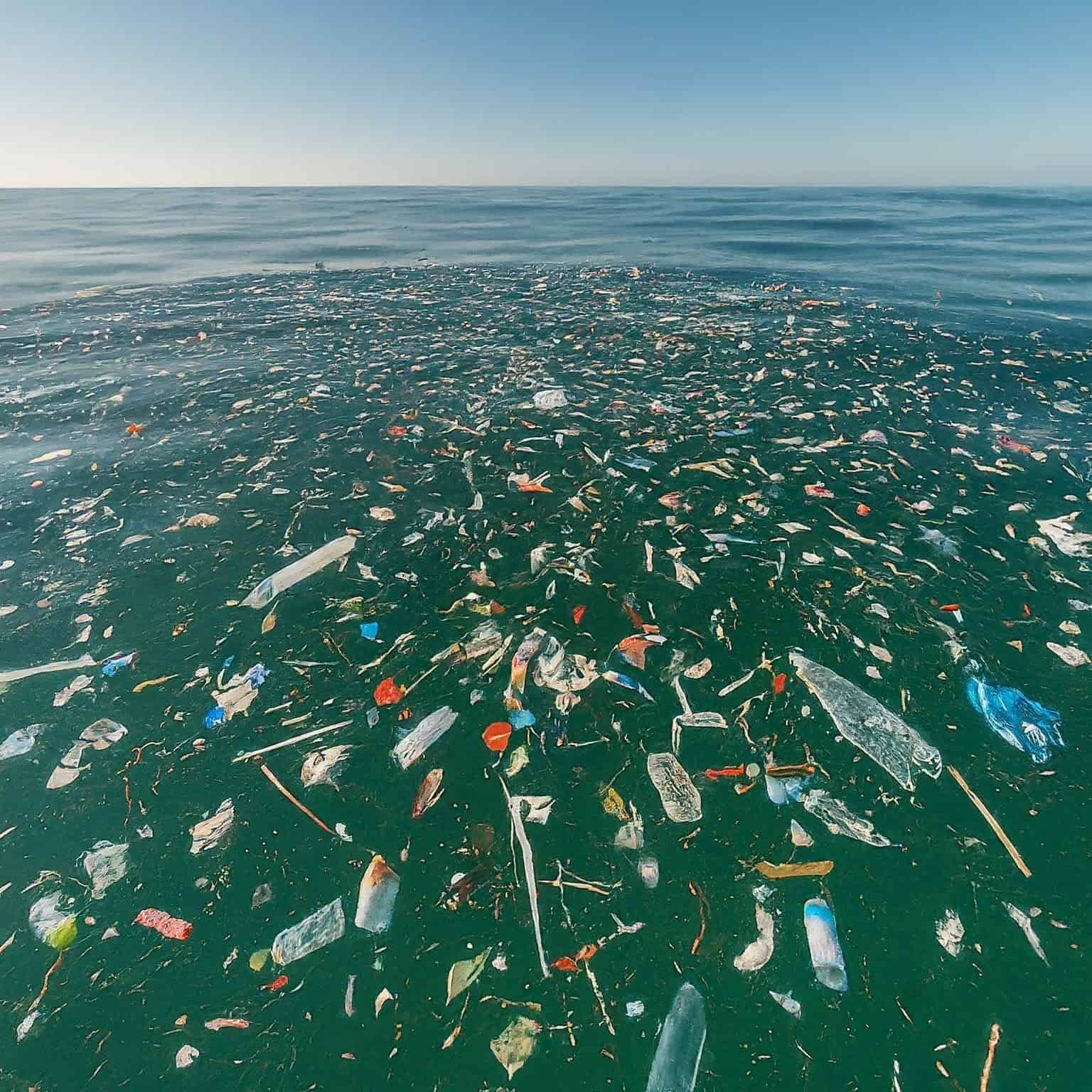
 Plastic debris in the ocean. Image credit: Wiki Commons.
In the middle of the North Pacific Ocean, thousands of miles from the nearest continent, sea anemones, hydroroids, crustaceans and other coastal animals live off discarded fishing nets, plastic boxes and bottles.
Plastic and marine life usually make a scary combination. But researchers have documented something more complicated here.
These animals breed and form communities with organisms that have evolved to live in the open ocean. The Great Pacific Garbage Patch has provided the durable surface needed for fortuitous ecosystems to take root beyond any coastline on Earth, according to a new study.
an unlikely house
Researchers examined 105 pieces of plastic collected between November 2018 and January 2019 from the eastern North Pacific Subtropical Gyre, within an area commonly known as the Great Pacific Garbage Patch.
Invertebrates were found in 103 of these objects. Pelagic species adapted to the open ocean inhabited 94.3% of the debris. Even more surprising, even coastal species appeared in 70.5%.
The Great Pacific Garbage Patch is not an island of solidified garbage. It is a vast diffuse accumulation zone of debris, nets, buoys, and other debris spread over a vast area. Ecologically, however, these scattered objects can behave like shifting archipelagos. Each durable piece provides a small patch of hard surface on which organisms can colonize. Ocean currents may also move animals and their offspring between nearby rafts, but researchers don’t yet know how often this happens.
Natural rafts are nothing new. Logs, seaweed, seeds, and pumice have carried marine life across a wide range of oceans for millions of years. However, most natural materials eventually rot, become waterlogged, or sink. Plastic can remain buoyant for years, even decades, giving passengers even more time to survive, grow, and reproduce.
The researchers found evidence of several coastal taxa breeding on the debris itself. Some crustaceans carried eggs and raised young. The goiter had reproductive structures. Sea anemones and crustaceans appeared in several size classes, including small juveniles consistent with recent reproduction.
×
thank you! One more thing…
Please check your inbox to confirm your subscription.
Many of the identified species were associated with the northwestern Pacific Ocean, including the coast of Japan. Their presence raises the possibility that they are descendants of organisms carried into the ocean after the 2011 Great East Japan Earthquake and tsunami.
The disaster sent millions of objects into the Pacific Ocean. Then docks, ships, and plastic debris crossed the ocean, transporting hundreds of live creatures from the coast of Japan to North America and Hawaii. Some survived at sea for at least six years.
distorted ecosystem
scientists use this term Neopelagic However, these words alone cannot adequately express how unnatural this foundation is.
Coastal animals that evolved to live on rocks, coral reefs, and coastlines are now thriving on bottles, fishing nets, and other trash thousands of miles from land. As a result, it differs from simple and natural types of habitat. Instead, we rely on humans to provide us with durable plastics. The balance between these groups remains uncertain. So are the effects on established marine food webs, nutrient cycling, and species dispersal.
Also, this doesn’t mean that plastic is somehow good for the ocean. The same material that provides a foothold for one organism can entangle other organisms, disrupting microplastics and transporting species across boundaries that once separated ecosystems. Even if a community is thriving, it can still be a sign of environmental damage.
The impact could ultimately reach far beyond the garbage patch. Plastic rafts can travel long distances, potentially transporting passengers to islands and continental shores. Species that once faced formidable barriers in the open ocean may now have a network of durable stepping stones to cross them.
Perhaps the strangest lesson is that nature does not wait for humans to decide what should be considered an ecosystem. As people filled the ocean with long-lived debris, organisms began to colonize it, breed there, and form new relationships around it. The result is an ecosystem that no species has evolved to live in, nor was it intentionally created by humans.
This research natural ecology and evolution In 2023.
