


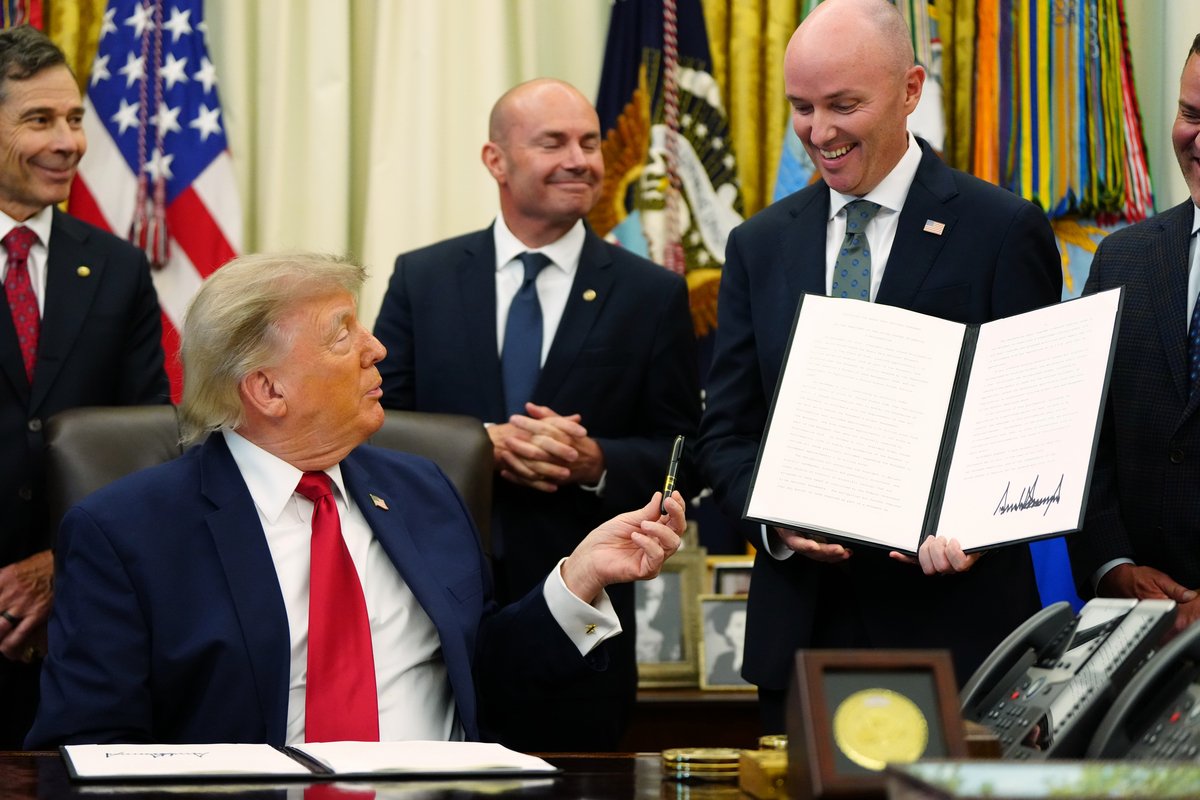
President Donald Trump signed an order Monday to reduce the size of two huge national monuments in Utah, a move likely to reignite conflict with conservationists and public lands advocates.
“Fairness has been restored,” Trump said at a signing ceremony in the Oval Office, watched by Utah’s congressional delegation and Republican Gov. Spencer Cox.
The move mirrors monument cuts made by President Trump during his first term in office and later reversed by former President Joe Biden. But the order signed Monday would cut even more land from protected monuments in the Utah desert.
In 2017, President Trump reduced the size of Bears Ears National Monument from approximately 1.35 million acres to 228,000 acres. Grand Staircase-Escalante National Monument has been reduced from 1.87 million acres to approximately 1 million acres.
Under Monday’s order, President Trump reduced the size of Bears Ears to about 121,000 acres and the Grand Staircase-Escalante site to about 182,000 acres.
President Trump’s statement cited several “flaws” in the designations made by previous presidents, all Democrats, to justify border changes. This included some “relatively common” cultural resources that the monument was designed to protect, such as prehistoric campsites, petroglyphs, and pictographs.
Cox said Monday that the monuments are too large and that their designation departs from the original intent of the Antiquities Act of 1906, which authorized the president to increase protections for federal lands.
But Democrats and environmental groups condemned the move on Monday. These monuments were also important to neighboring tribes, especially the Bears Ears site, which was partially managed by a tribal commission. The group was disbanded by President Trump’s order that tribal consultations be conducted as required by federal law.
Sen. Martin Heinrich (D.N.M.), ranking member of the Senate Energy and Natural Resources Committee, denounced what he called a “war on the West.”
“Time and time again, this administration has put the interests of billionaires and powerful industries ahead of America’s public lands and their owners,” Heinrich said in a statement.
Save Our Parks spokesperson Jason O’Neill said council needed to step in and stop “illegal efforts” to reduce monuments.
“Bears Ears and the Grand Staircase belong to the people of Utah and all Americans, not to a would-be king or his minions,” he said in a statement.
 Ruins of the “Fire House” in Mule Canyon near Blanding, Utah. President Donald Trump signed an order Monday to shrink Bears Ears National Monument, leaving these and other sites on about 121,000 acres. |Rick Bowmer/Associated Press
The Trump administration last year began reviewing at least six national monuments, focusing on the possibility of opening some lands to new mineral extraction.
In addition to the monument in Utah, monuments considered included the Grand Canyon’s Burge Nwabujo Ita Kukuveni Ancestral Footprints and the Ironwood Forest Monument in Arizona, the Organ Mountains and Desert Peaks Monument in New Mexico, and the Chuckwalla Monument in California.
On his first day in office last year, Interior Secretary Doug Burgum signed an executive order directing agencies to “review and, if necessary, remediate all cleared public lands consistent with existing law” as part of a push to “unlock” America’s energy production.
Former President Bill Clinton first created Grand Staircase-Escalante National Monument in 1996, and former President Barack Obama designated it Bears Ears National Monument in 2016.
President Trump’s initial move in his first term to shrink Utah’s monuments sparked multiple federal lawsuits. Environmentalists argued that only Congress has the power to scrape national monuments designated by the president.
But the Trump administration’s Justice Department issued an opinion last year concluding that presidents can change their predecessor’s nominations.
If President Trump’s recent moves lead to a new legal battle, which they likely will, the administration’s position could be well-received by Chief Justice John Roberts, who said in a four-page statement released as part of his 2021 decision that the antiquities law deserves new consideration. Roberts highlighted the part of the law that says monument designations should be “limited to the smallest areas compatible with the care and management of protected objects,” and suggested that some presidents have not followed that guidance.
Federal courts have traditionally given presidents wide latitude to set the size of monuments, a stance dating back to 1920, when former President Theodore Roosevelt’s 1908 attempt to challenge the then-designated Grand Canyon National Monument failed.
Scott Braden, executive director of the Southern Utah Conservancy, said Monday that the group will challenge the changes in court.
“These two landscapes should be protected for current and future generations of Utahns and Americans and should not be exposed to exploitation,” he said in a statement. “We are confident that President Trump’s reckless and illegal actions will be rejected and that the monument will be restored.”
In general, the public often expresses support for presidents to designate national monuments, often a legacy move carried out in the last year of a president’s term.

A National Park Conservation Association poll last year found that nearly three-quarters of Americans strongly or somewhat supported maintaining the land protections designated by the sitting president.
But Utah Republicans have long sought to deny the federal designation, saying it would seal off land that could be used for mining or other uses. More than 60 percent of Utah is administered by the federal government.
Utah Sen. John Curtis (R) said from the Oval Office that the state’s land is managed locally rather than by federal agencies.
“Utahans will tell you they love this land,” he says. “If this is about good stewardship, it should really be done in Utah by people who have proven themselves to be good stewards of this land over decades and decades and generations.”
Ridge Johnson, director of the Utah Office of Public Lands Policy Coordination, said in an interview Monday that Utah’s biggest concern is that the monument is too large, but it doesn’t have enough law enforcement officers or other resources to cover such an area of land.
He acknowledged that the company has mining interests in the Grand Staircase-Escalante area, which has coal, cobalt and copper reserves, among other things. While Cox has made increasing mining a key priority for his administration, Johnson said access to mining is not Utah’s main complaint.
He said there is a “misconception” that lifting the monument designation removes federal protection. Those lands will continue to be subject to the National Historic Preservation Act and other laws, he said.
President Trump’s proclamation also notes that much of the monument is managed by the Bureau of Land Management as wilderness or wilderness research areas.
Scott Waldman contributed to this report.
