


Written by Will Atwater
Important points:
- AI data center developers are turning their attention to rural North Carolina, sparking debate over health, environmental safety and rising energy costs.
- Local battles in places like Edgecombe County are now centered on whether to welcome new data centers or slow them down with bans or moratoriums.
- At the state level, two major bills would create new rules for large data centers and reduce important tax breaks for future solar projects.
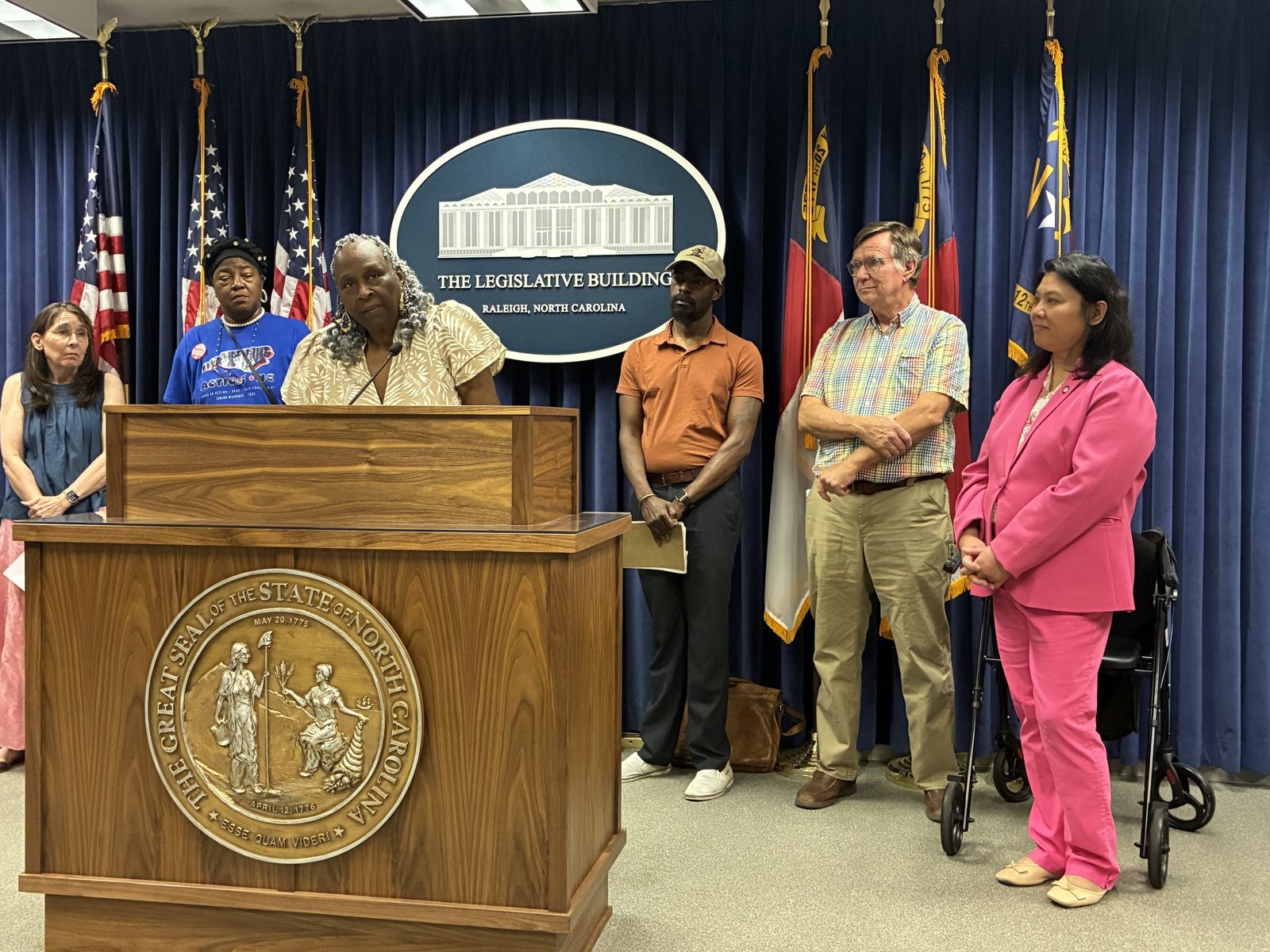
The debate over AI data centers is heating up across North Carolina. Local residents, county officials and state lawmakers are clashing over whether to block or embrace new projects and who should bear the risks and benefits.
That tension was on full display at the recent Edgecombe County Commissioners meeting.
“This is not about data centers,” Northeast County Commissioner Donald C. Boswell said. “When you have 50 people come here with 1,362 signatures and I think some of them aren’t even in this county, I didn’t count them, I didn’t look at them. There’s some very slippery slopes when you come here and start getting us into thinking, should we ban this or should we ban that?”
Boswell’s comments came after months of organizing by residents, including a petition signed by about 180 local residents and presented to commissioners at the Dec. 1 meeting opposing the sale of 122 acres of county-owned land in Kingsboro (enough land to accommodate more than 90 soccer fields) to Energy Storage Solutions. The land will house a 900-megawatt AI data center, large enough to power more than 700,000 homes.
“I’m a little tired of hearing that[data centers]are going to use all of our water, they’re going to consume all of our electricity, and it’s going to take everything they’ve been saying since day one to turn this committee around to the point of, ‘Either suspend it or ban it now,'” he said.
At the state level, the tension between data centers’ ability to provide tax dollars and residents’ concerns about environmental and health impacts continues through two bills currently before Congress.
One is Senate Bill 730, the so-called Ratepayer Protection Act, which would impose new rules on large data centers and tie the retirement of coal-fired power plants to the development of new nuclear power. This would extend the operation of coal-fired power plants and their associated emissions into the atmosphere, meaning that data centers would be powered by coal-fired power plants for extended periods of time.

Another House Bill 1213, in its current form, would end the 80 percent property tax credit for utility-scale solar projects that start on or after July 1, 2027. The measure could slow the development of solar power, a clean energy source that helps power power-hungry data centers.
Part of the appeal is simple economics. Rural counties in North Carolina offer relatively inexpensive land near Duke Energy power lines and water lines. A recent market analysis found that Digital Realty paid about $960,000 per acre for land near Charlotte, while Microsoft purchased rural land in North Carolina for just $19,000 per acre in more rural counties. In both locations, prices are well below the $2 million-plus per acre land costs reported in Virginia’s “data center array.”
Two bills at the center of debate
The Ratepayer Protection Act, introduced by Davidson County Republican Sen. Steve Jarvis, aims to establish guardrails for ratepayers. This will require large data centers (facilities with peak monthly demand of at least 100 megawatts) to cover the cost of grid expansion, transmission upgrades, and new generation needed to accommodate the load through long-term contracts and minimum rate requirements.
The bill would require these facilities to use water-saving cooling techniques, such as closed-loop or other systems that minimize water consumption. The bill also bans more wasteful evaporative cooling and open-loop cooling, aimed at protecting local water supplies and groundwater.
One of the most controversial aspects of the bill is a provision that would prohibit the Public Utilities Commission from approving the retirement of coal-fired power plants until new nuclear development is underway in the state. Coal-fired power plants will remain in operation longer until these nuclear power plants meet set regulatory milestones.
North Carolina has struggled to stay on track with its own carbon reduction goals. A 2022 analysis by the Environmental Defense Fund predicts that without stronger policies, the state will miss its 40% emissions reduction goal by 2025. Climate change advocates have warned that SB 730’s coal-free approach could push the state further off track toward its next goals of 50% reductions by 2030 and net-zero emissions by 2050.
Reacting to language in the Ratepayer Protection Act regarding extended use of coal-fired power plants, Kevin Wilson, co-chair of the Edgecombe County Neighborhood Data Center Accountability Group, said it is cause for concern.
Wilson said the bill’s language provides that Duke Energy “would not be required to close a coal-fired power plant until a nuclear power plant is constructed and a replacement is in service.” “Think about how much that costs. It takes at least 20 years to build a nuclear power plant. And think about all the pollution that gets released into the atmosphere from coal plants that operate that long.”
Another bill, House Bill 1213, was originally drafted to eliminate the availability of some sales and tax credits for large data centers, which Gov. Josh Stein’s office says costs North Carolina tens of millions of dollars a year. In its original form, the bill is no longer justified in line with the governor’s push for subsidy recovery. But in the version recently passed by the House, lawmakers removed language about data centers.
It also adds language that would end the property tax break for solar energy electrical systems installed after July 1, 2027, while continuing the tax break for existing projects and projects that start operating before that date, which could reduce the tax burden for developers and help landlords with lease payments.
The state already offers about $50 million in sales tax incentives to qualifying data centers. If all planned facilities are built, that number could rise to about $450 million a year, plus $2.3 billion with a one-time construction phase waiver, Stein staff said. Given the trillions of dollars currently flowing into AI and data center infrastructure, “the industry does not need economic incentives,” Stein’s staff said in a memo to the Energy Policy Task Force in April.
By contrast, legislative analysts estimate that North Carolina’s property tax breaks for solar projects cost local governments more than $40 million a year, a burden that some rural landowners argue could be critical in years of lower crop yields and higher costs.
Ken Gurganas, a longtime farmer with solar leases on land in eastern North Carolina, told lawmakers during the House Finance Committee on June 30 that while crop prices have only increased slightly, the costs of fertilizer, fuel, chemicals and equipment are rising. In that environment, he says, the checks he receives from solar companies are important operating income.
“Tomorrow, July 1st, my wife and I will receive an installment check from our solar company, and I promise you that the money will not go toward a trust fund or a vacation,” Gurganus said. “It goes directly into our account, where we pay the daily bills that occur on the farm.”
Low-wealth counties under pressure
He said counties across the state, especially low-income counties that “traditionally have the highest property tax rates,” are losing about $40 million a year.
“Edgecombe County is number one. We’re saving about $2.5 million a year, which is a big deal,” Hicks said. Her comments were echoed by Edgecombe County Commissioner Donald Boswell at the county’s July 6 meeting.
“Fifty-one percent of our county receives Medicaid,” Hicks said. “Our population has been aging since the last census. We need to put something in Kingsboro. We don’t need a data center, but are we going to rule that out?”
Prior to Gurganus’ comments, Joy Hicks, director of advocacy and policy for the North Carolina Board of County Commissioners, expressed support for House Bill 1213, saying it is a measure needed by cash-strapped counties.
Community activist Kevin Wilson is sympathetic to the economic challenges facing rural communities like Edgecombe.
“In this small town, the world rests on their shoulders, and if they do, they’ll be blamed, and if they don’t, they’ll be blamed,” he said. “So I understand that (officials) are desperate to find something (…) We’re basically tying their hands right now from a data center perspective. But they need to understand that there are other (industries) out there.”
As for the future of Edgecombe County, activists urged commissioners to adopt a permanent data center ban, but commissioners instead voted to hold a public hearing on the proposed 24-month data center moratorium, which will be discussed at their August meeting.
“Our county is becoming more active, and as we become more active, our residents become more active, and that’s really what’s happening to us,” Edgecombe County Commission Chairman Leonard Wiggins said.
“We have been sitting here for years and doing whatever we wanted without any questions from the people,” he added. “The public is starting to question what we’re doing, but that’s for another day.”
At the state level, neither General Assembly bill is final.
The Ratepayer Protection Act has already passed the Senate once, but after the House makes changes, it must go back to the Senate for approval and could eventually be amended again. Meanwhile, House Bill 1213 faces further debate in the Senate after passing the House.
thisarticleteeth,North Carolina Health NewsFirst published inCreative Commons Attribution-NoDerivatives 4.0 International License.
