


Mars wasn’t the cold, dry world we see today. Scientists believe that billions of years ago, the land was warmer, wetter and surrounded by a thicker atmosphere, creating conditions that supported simple microbial life. Still, proving that life once existed there remains one of the biggest challenges in planetary science.
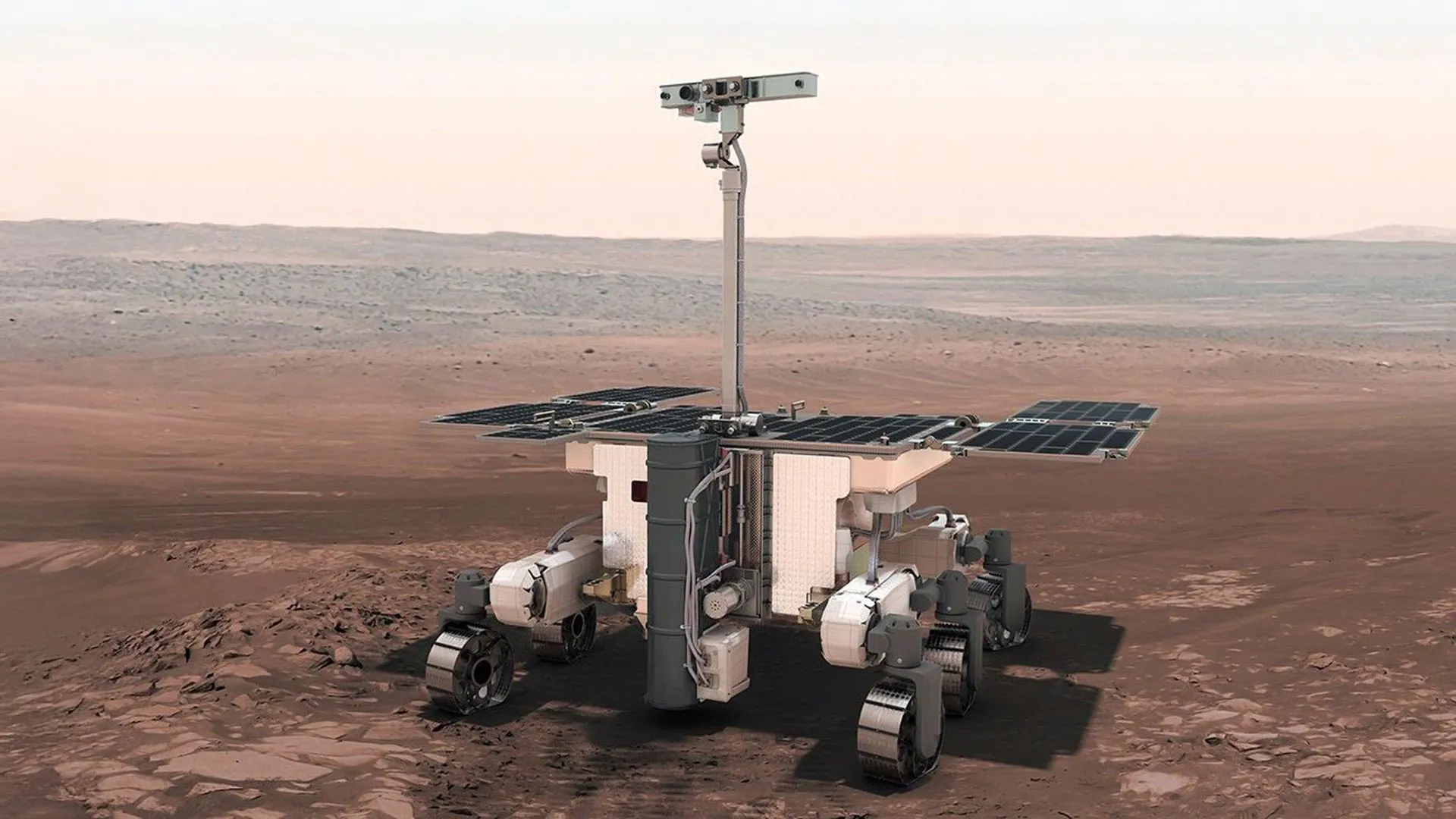
NASA rovers have already detected organic molecules in Martian rocks, but those compounds alone cannot confirm that life once existed. From 2030, the European Space Agency’s Rosalind Franklin rover is expected to join the search, equipped with specialized equipment designed to look for stronger chemical evidence. Now, researchers from the Max Planck Institute for Solar System Research (MPS), the University of Göttingen, and the Cote d’Azur University in Nice (France) have put one of the rover’s key detection methods to the test.
Searching for ancient Martian biosignatures
Finding convincing evidence for ancient Martian life means distinguishing between organic molecules made by living things and those made by normal chemistry. Researchers think two hydrocarbons, pristane (C19H40) and phytane (C20H42), may help answer that question.
These molecules come from living organisms and are also found in petroleum on Earth. They are unusually stable, so scientists believe they can survive for billions of years under the right conditions.
“If life once existed on Mars, molecules like pristane and phytan represent important molecular biosignatures that may have survived to this day,” said MPS scientist Guillaume Rouseneur, lead author of the new study.
Why mirror molecules are important
Pristane and phytan have another important feature that makes them attractive targets in the search for life. Like many organic compounds, they are chiral. That is, it exists in two mirror image forms called enantiomers. The two versions contain the same atoms, but they are arranged as mirror images of each other, like a person’s left and right hands.
“Chirality is a valuable tool in the search for past extraterrestrial life,” said co-author Uwe Mayerhenrich of the University of the Cote d’Azur.
Living organisms usually produce approximately only one mirror image of a chiral molecule. Scientists expect the same pattern to hold true for life elsewhere in the universe, since living systems replicate themselves. In contrast, molecules formed without the use of biology should contain approximately equal amounts of both mirror image forms.
Rosalind Franklin Rover Test
The Rosalind Franklin spacecraft will explore these nuances using the Mars Organic Molecular Analyzer (MOMA), an instrument developed and built under the direction of MPS. MOMA combines a gas chromatograph, mass spectrometer, small reactor, and excitation laser.
The rock sample is first heated in a furnace to release volatile compounds. These gases are analyzed and passed through specially coated capillary tubes. Mirror-image versions of the same molecule interact differently with the coating and therefore move through the tube at different speeds, allowing the instrument to separate them.
In the new study, the researchers used an identical replica of MOMA’s capillary tube. They were the first to successfully separate the chiral forms of both pristane and phytane, even though the molecules are extremely unreactive.
“The chiral separation of pristane and phytane requires high instrumental sensitivity and measurement precision, and we show that MOMA can achieve both,” explained co-author and MOMA team member Fatma Yesil Sahan of MPS.
Meteorite reveals unexpected developments
Instead of Martian rocks, the research team tested samples from the famous Murchison meteorite, which fell in Australia in 1969. Like many meteorites, this one contains a mixture of organic compounds. Some were present during the meteorite’s formation, while others appear to have been created by biological contamination after the meteorite struck. Researchers initially suspected that pristane and fitan belonged to this second category.
But the results told a different story.
This meteorite contained equal amounts of all mirror-image versions of Pristan and Phytan. The pattern is not consistent with biological material that may have been contaminated at the site where the meteorite was found.
Instead, the researchers concluded that the meteorite may have picked up the contaminants as it passed through Earth’s atmosphere, where it encountered aerosols produced by the combustion of fossil fuels.
Comparison with pristane and phytane found in oil shale supported that explanation. These sedimentary rocks contain petroleum precursors that have spent millions of years deep underground.
“Oil is formed over millions of years in deep rocks under the influence of heat and pressure,” said co-author Manuel Reinhardt of the University of Göttingen.
Over time, these conditions erase the natural imbalance between mirror-image forms of molecules, keeping them in equal proportions. This is very consistent with what the research team observed with the Murchison meteorite.
Preparation for exploration of life on Mars
Researchers say the study goes beyond validating MOMA in advance of a mission to Mars. It also raises new questions about how organic molecules found in meteorites become contaminated and what increasing levels of oil-related pollution in Earth’s atmosphere might mean for future research.
MOMA is part of ESA’s ExoMars mission to Mars, developed and constructed under the European Space Agency program and funded by the European Space Agency.
