


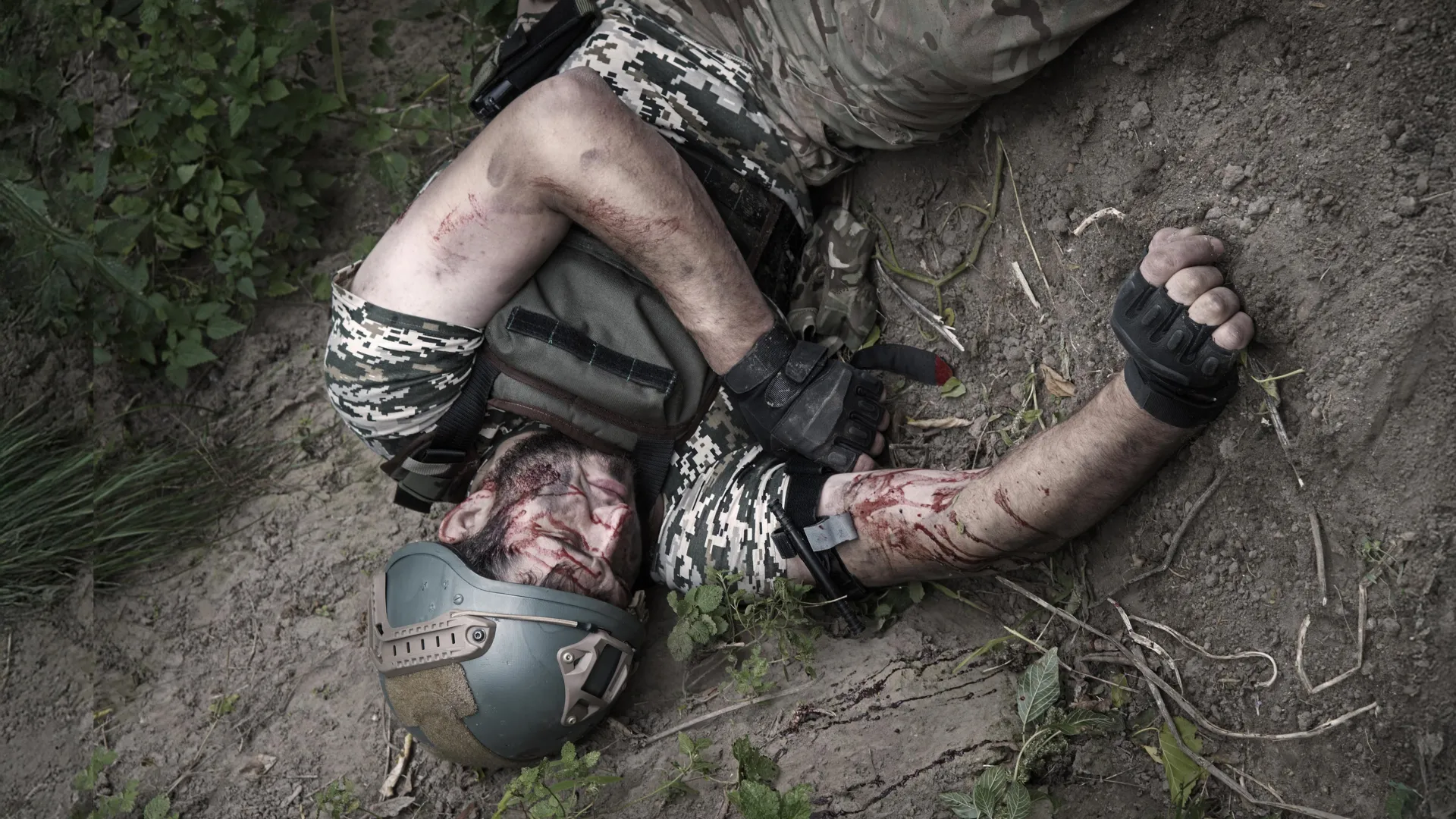
Excessive blood loss is the leading cause of death from combat injuries, making rapid hemorrhage control one of the greatest challenges in battlefield medicine. KAIST researchers, including Army Maj., have developed a next-generation spray powder that can stop severe bleeding in about a second. This innovation has the potential to significantly improve survival rates for injured soldiers, while also opening up a wide range of possibilities for civilian emergency medical care.
A research team led by Professor Steve Park of KAIST’s School of Materials Science and Engineering and Professor Sangyoung Jeong of the School of Biological Sciences has developed a powdered hemostatic agent that quickly transforms into a strong hydrogel barrier when sprayed onto a wound.
The technology was designed with real-world battlefield conditions in mind, as Army Majors directly participated in the project. The powder hardens almost instantly and is stable during storage, allowing for rapid deployment in harsh environments such as combat zones and disaster areas.
Powder designed for deep, complex scars
Traditional patch-type hemostasis products are widely used in the medical field, but their flat shape makes them difficult to apply to deep, uneven, or complex wounds. They are also sensitive to temperature and humidity, creating problems in storage and use in the field.
To overcome these limitations, researchers have developed a powder that can conform to wounds of various shapes and sizes. One product can be used on deep, large, and uneven scratches, making it more versatile than traditional alternatives.
Most existing hemostatic powders work primarily by absorbing blood and forming a physical barrier. Instead, the KAIST team designed the material to take advantage of natural ionic reactions that occur in blood.
How AGCL powder works
This new material, called “AGCL Powder,” is a combination of several naturally derived, biocompatible ingredients. These include alginate and gellan gum (which reacts with calcium to provide ultra-fast gelling and physical sealing), and chitosan (which binds blood components to enhance chemical and biological hemostasis).
When the powder comes into contact with blood, it reacts with cations such as calcium and turns into a gel in about 1 second, rapidly sealing the wound.
Also, due to its three-dimensional internal structure, the powder absorbs more than seven times its own weight (725%) in the blood. This allows blood flow to be quickly cut off in the event of massive high-pressure bleeding. According to the researchers, the material has an adhesive strength of more than 40kPa, which exceeds commercially available hemostatic agents and can withstand strong hand pressure.
Strong safety and healing effect
AGCL powder is made from all naturally derived ingredients. Laboratory tests have shown that the hemolysis rate is less than 3%, the cell viability is more than 99%, and the antibacterial efficacy is 99.9%, indicating that it is safe in contact with blood.
Animal studies have also demonstrated improved blood vessel and collagen regeneration, as well as faster wound healing.
In surgical liver injury experiments, the powder reduced both blood loss and the time required for hemostasis compared to commercially available hemostasis products. Liver function returned to normal within two weeks after surgery, and the researchers found no evidence of systemic toxicity.
Another important advantage is durability. The powder maintained its performance for two years under room temperature and high humidity conditions, allowing it to remain ready for use in harsh military and disaster environments.
Possibilities beyond the battlefield
Although the technology was originally developed for national defense, researchers believe it could have broader applications in emergency medicine. Potential applications include disaster response, healthcare in developing countries, and treatment in medically underserved areas.
This project is considered a typical spin-off example of defense research being translated into civilian use. In addition to emergency treatment on the battlefield, this technology could also be useful in controlling bleeding during internal surgery. (Spin-off refers to the expansion and transfer of defense science and technology to the private sector. Examples include computers, GPS, and microwave ovens.)
This research was recognized for both its scientific innovation and defense value, and received the KAIST Q-Day Chairman’s Award in 2025 and the Minister of Defense Award at the KAIST-KNDU National Defense Academic Conference in 2024.
Park Gyu-soon, a doctoral candidate (army major) who participated in the research, said, “The core of modern warfare is to minimize the loss of human life,” and “I started the research with a sense of mission to save as many soldiers as possible.” He added, “I hope that this technology will be used as a life-saving technology in the fields of national defense and civilian medicine.”
The research was led by KAIST doctoral student Kyu-sun Park and doctoral candidate Young-joo Song, under the guidance of Professors Steve Park and Sang-Yeon Jeong. Published online in the International Journal on October 28, 2025. Advanced functional materials (IF 19.0) specializes in chemistry and materials engineering.
This research was supported by the National Research Foundation of Korea (NRF).
