


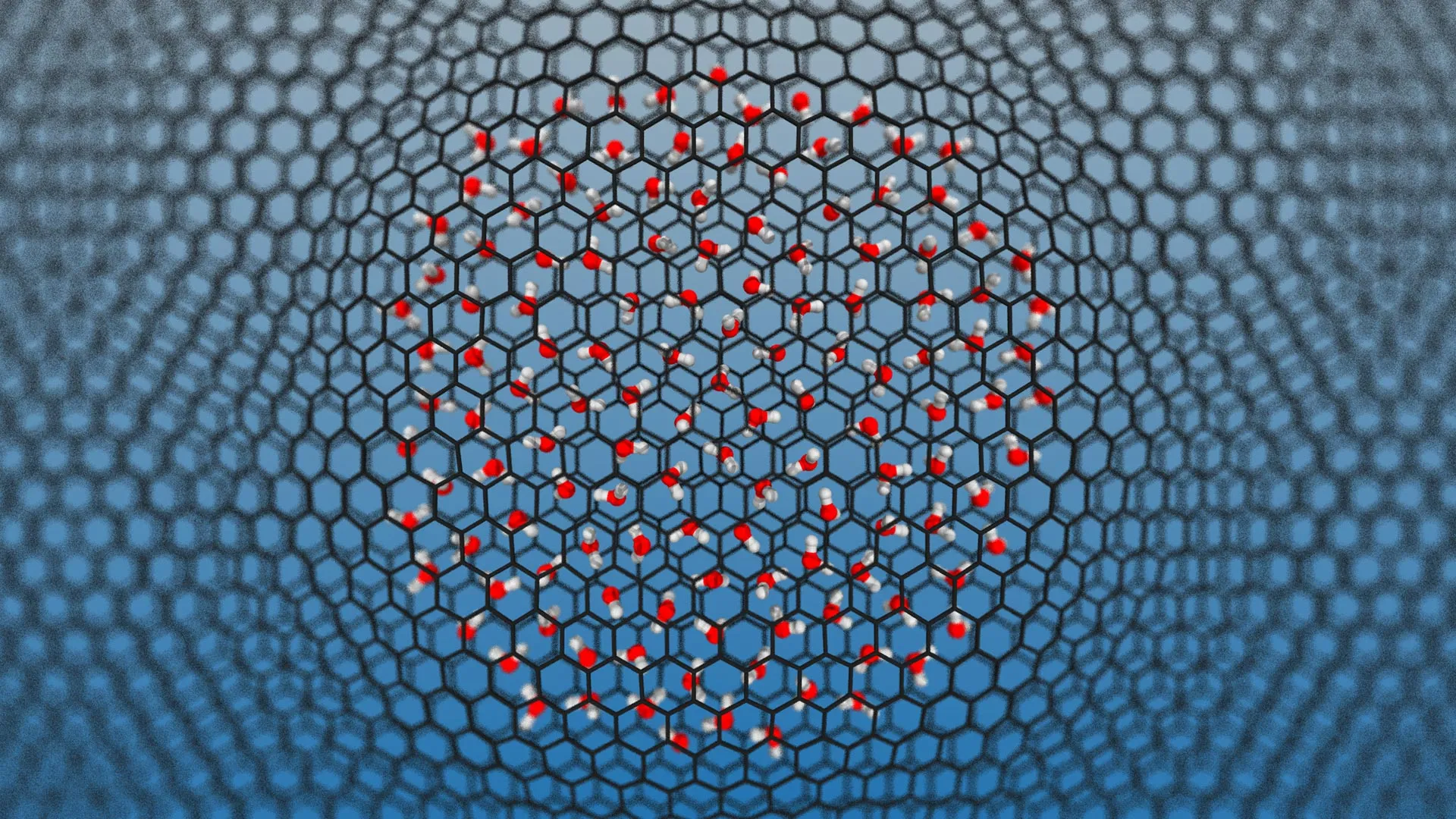
Water has been studied more than almost any other substance, and scientists have long debated a surprisingly simple problem. That is, what happens to the chemistry of water when it is squeezed into a space just a few molecules wide.
These tiny spaces exist throughout nature and technology, including nanoscale pores, membranes, and biological channels. A new study reveals that the answer is more nuanced than researchers once believed, helping to resolve years of contradictory results.
Why water splitting is important
One of the characteristic chemical properties of water is its ability to break down into two charged particles: H3O+ (hydronium ion) and OH- (hydroxide ion). This process determines pH, which measures how acidic or alkaline (basic) a solution is, and plays a central role in acid-base chemistry. It affects everything from the enzymes that keep cells functioning to the reactions that occur inside batteries.
Scientists wanted to determine whether confining water to a space just one billionth of a meter wide would change the likelihood of this fragmentation.
Their findings were; scientific progresssuggested that the apparent chemical reactivity of nanoconfined water strongly depends on factors such as density, pore size, wall flexibility, and surface chemistry.
“When we compared systems under comparable thermodynamic conditions, and specifically under the same chemical potential (a quantity that determines whether a reaction proceeds), the effect of confinement almost disappeared. In other words, confinement alone does not inherently change the reactivity of water. This explains why experiments over the past decade have yielded contradictory results,” said Xavier R. Advincula, lead author of the study.
“The discrepancies in the literature were primarily due to scientists unknowingly comparing systems at different effective pressures or densities.”
Machine learning reveals the gaps
To investigate this issue, the researchers relied on machine learning simulations that can study a much wider range of conditions than traditional computational methods while replicating quantum mechanical precision.
The researchers investigated water trapped between sheets of graphene and hexagonal boron nitride (hBN). Although both materials are only one atom thick and share a similar structure, their surface chemistry is very different.
The simulations also revealed that water droplets trapped between these materials experience very high internal pressures. Water trapped between graphene or hBN sheets can reach pressures of several gigapascals, similar to those found deep within the Earth, even in the absence of external forces.
Instead, pressure is generated naturally due to van der Waals attraction between atomically thin layers. Although the forces between individual atoms are weak, they become significantly stronger over the large surface area of a two-dimensional material, pulling the sheets together and compressing the water trapped between them.
Pressure, not confinement, drives water reactivity
The researchers found that these intense pressures significantly accelerated the splitting of water molecules.
However, when we compared trapped water and normal bulk water exposed to the same pressure, both behaved essentially the same way. This showed that the increase in reactivity was mainly brought about by the pressure itself rather than confinement alone.
Professor Angelos Michaelides, from the Yusuf Hameed Department of Chemistry at the University of Cambridge, said: “What surprised us most was how much of the apparent confinement effect could be explained by thermodynamics. Once pressure and chemical potential are properly taken into account, a large part of the complexity simply falls into place.”
Surface chemistry still plays an important role
Just forcing water into a small space does not make it inherently more reactive, but the surrounding materials can influence its chemical properties.
In a water droplet confined by hBN, hydroxide ions (OH-) formed around the edges chemically bond with surrounding materials. This stabilized the ions, lowering the energy required to split water and increasing the amount of dissociation.
The same effect was not observed in graphene because the chemically inert surface does not participate in the reaction.
This result shows that the materials surrounding trapped water can actively shape its chemical behavior.
“This study provides a new framework for understanding water chemistry at the nanoscale and helps reconcile a decade of seemingly contradictory research,” said Dr. Christophe Schran of the Cavendish Laboratory’s Condensed Matter Theory Group.
“More importantly, this work provides practical design principles for engineering nanoscale chemical environments. Rather than focusing solely on pore or channel size, we can tune the reactivity of water by choosing confinement materials whose surfaces interact with the dissociation products of water and by controlling the pressure generated within the confined space.”
Potential applications in energy technology
The discovery could have important implications for technologies that rely on trapped water, such as hydrogen fuel cells, batteries, ion-selective membranes, and catalytic systems.
Next, the researchers plan to study more realistic environments, including defects and edges commonly found in real materials. They also hope to compare their predictions with laboratory measurements using advanced spectroscopic and nanofluidic techniques.
At the same time, the team is screening a large family of two-dimensional materials and surface chemistries to identify combinations that can enhance or suppress water reactivity for specific technology applications.
