


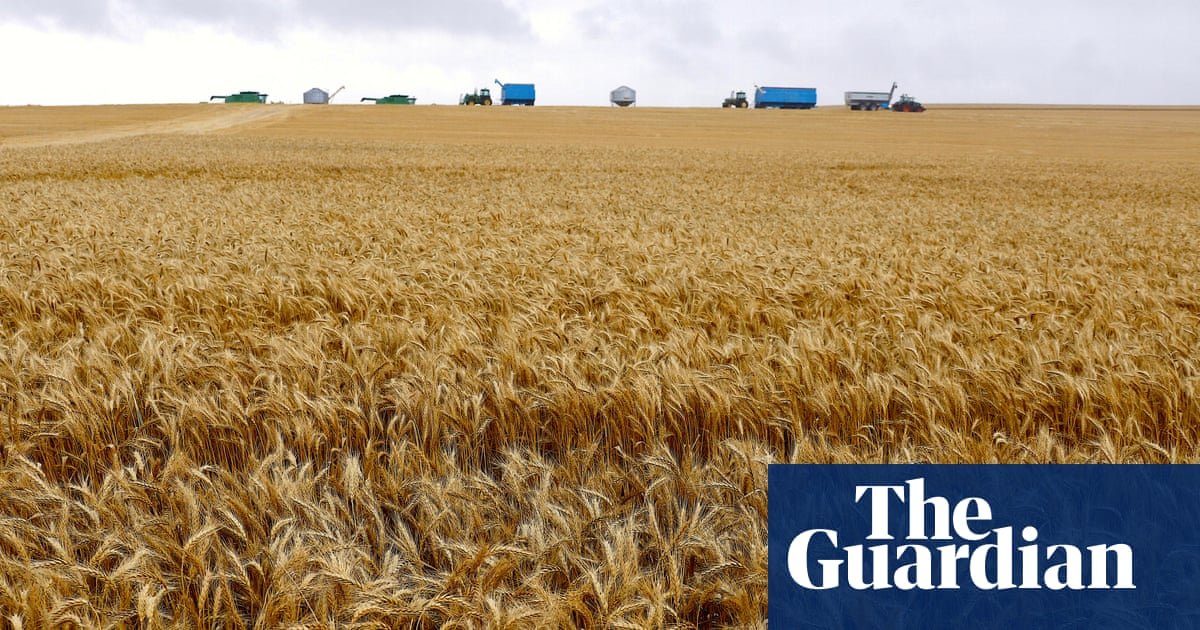
The herbicide paraquat, which is banned in more than 70 countries, will remain legal in Australia despite Parkinson’s disease groups, scientists and neurologists claiming there is a strong correlation between direct exposure and the development of Parkinson’s disease.
The Australian Pesticides and Veterinary Medicines Agency (APVMA) on Tuesday announced its final decision after decades of investigation into the highly toxic paraquat and related chemical diquat. Both are widely used in Australian agriculture.
Regulators will continue to allow its use, but with stricter conditions to reduce the risk of exposure to farm workers, birds and mammals.
Paraquat is used in large acre agriculture, especially grain, sugarcane, cotton, and horticulture.
Scott Hansen, chief executive of the APVMA, said the regulator wanted to find a clear answer as to the cause of Parkinson’s disease, but a review of hundreds of scientific papers and long-term data had not established a causal link between paraquat and the debilitating neurological disease.
Tuesday’s ruling was not surprising given what was noted in an earlier draft. The debate over paraquat and diquat, and Australia’s approach to pesticide regulation, is unlikely to end.
Sign up for Australian breaking news emails
About 70 countries have banned the highly toxic paraquat. The European Union and Britain banned the herbicide in 2007 after a lawsuit found that manufacturer Syngenta had not established the herbicide’s safety and that its initial evaluation was flawed.
The EU and many other countries apply a so-called precautionary approach when authorizing the use of chemicals. We require manufacturers to prove that their products are safe.
Australia uses a risk-based assessment, which requires establishing the actual risk.
However, establishing how much of a risk a herbicide poses is not easy, especially given that regulators rely on evidence from manufacturers at the registration stage.
Chemical giants concerned about link between herbicides and Parkinson’s disease
A Guardian investigation in 2022 revealed internal documents showing that Syngenta had concerns about paraquat’s chronic effects in the 1970s – despite the company’s public statements to the contrary.
Other countries have also approved the continued use of paraquat. The U.S. Environmental Protection Agency reviewed paraquat in 2021 and allowed its continued use under stronger controls. Some states, including Vermont, have unilaterally banned it amid concerns about its link to Parkinson’s disease. New Zealand has also authorized the use of paraquat.
Hansen said an extensive review of scientific research has failed to establish a causal link to Parkinson’s disease. But there was evidence of potential effects on farm workers from exposure, as well as effects on birds and mammals along the distribution route, he said Tuesday.
“Both chemicals continue to be available for use, with significant new restrictions on application amounts and permitted uses.
“To protect users from acute exposure, the new restrictions will phase out backpack nebulizers and require closed mixing and loading systems and enhanced personal protective equipment for all applications.
“Overall, the maximum application rate for paraquat and diquat will be 231 grams per hectare, compared to previously 1,150 grams per hectare.”
Higher application rates are allowed when using technological spot sprays, but are limited to 30% of the total area.
Parkinson’s disease researchers say Australia is out of step with the prevailing scientific evidence.
Melbourne neurologist Professor Wes Thevasathan told the ABC in early June that the “universal consensus” in his field was that exposure to paraquat was closely linked to the development of Parkinson’s disease. He said APVMA had failed to collaborate with researchers in this field.
“There are now multiple epidemiological and real-world exposure studies suggesting that paraquat increases the risk of Parkinson’s disease by approximately three times,” Tevasathan said.
“Do Australian lives have less value?”
Parkinson’s Australia CEO Olivia Nassaris said she was disappointed with the outcome of the review.
Skip Past Newsletter Promotions Free Newsletter | When You Need It
sign up for breaking news australia
Get the most important news breaking news

After newsletter promotion
“70 countries have banned the use of paraquat,” she said on Tuesday. “Do Australian lives have less value?”
Ms Nassaris said her organization would continue the fight to ban paraquat in Australia.
APVMA lost much of its expertise in 2013 when then Agriculture Minister Barnerby Joyce announced it would move from Canberra to his hometown of Armidale. Several important reports have concluded that this was a disaster for regulators.
The review of paraquat took almost 30 years, even though it was declared a “review” priority in 1994. The work plan for the review was finalized in 2015, with an interim report published in 2024.
Australia does not have a system in place to regularly review approved products, and chemicals are only reviewed if they attract international attention.
Paraquat is manufactured by Syngenta. Photo: Bloomberg/Getty Images
The paraquat decision could draw attention to whether the scale of regulation here is tipped in favor of large-scale agriculture.
Paraquat quickly kills leaves it touches, so it is used to control grass and weeds around crops and to remove leaves from crops such as cotton and potatoes before harvest.
Industry has fought to maintain the availability of herbicides, arguing that they are key to no-till farming and, in turn, essential for conserving soil moisture and preventing erosion.
“Science-based safeguards protect farmers and workers”
National Farmers’ Federation president Hamish McIntyre on Tuesday acknowledged “community concerns around paraquat”.
“It’s vitally important that the products farmers use are safe for both people and the environment,” he said, adding that Australian agriculture operates under strict controls.
“These are science-based safeguards designed to protect farmers, their workers and the environment.”
ACT independent senator David Pocock, who has taken up the cause of Parkinson’s patients, said on Tuesday: “This appears to be yet another example of vested interests winning over community interests.”
Syngenta Australia said: “As part of this decision a number of crop use cases have been removed from labels and Syngenta is assessing the impact on its product portfolio under these restricted conditions.”
The company said paraquat had played a “unique and important role in Australian agriculture”.
“Many farmers consider this an essential tool for conservation agriculture and integrated weed management.”
