


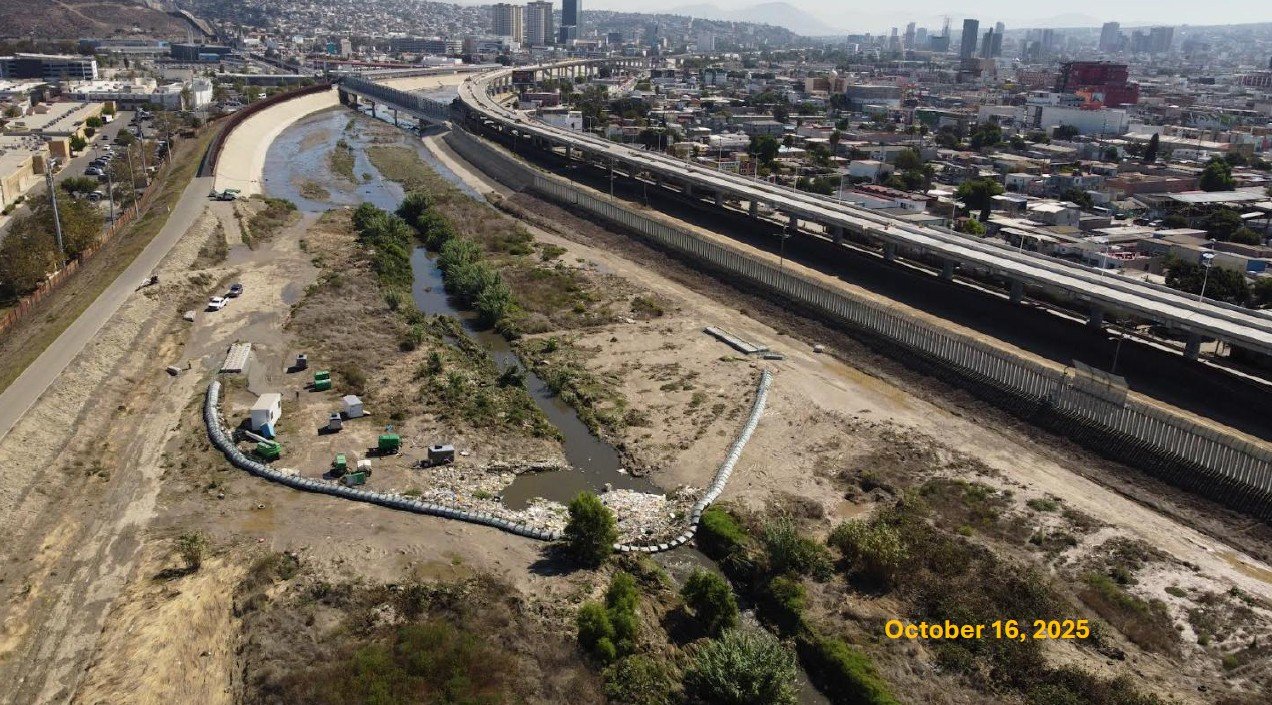
The president appears to have had a harder time cleaning the Lincoln Memorial’s reflecting pool than he did cleaning up the sewage-tainted Tijuana River, even though he hired the same contractor to do both.
The New York Times revealed over the weekend that Green Water Services was awarded a $1.7 million no-bid contract to install a water purification system at a pool on the National Mall earlier this spring. But now the research has come under scrutiny after algae blooms turned the pools a bright shade of green.
Meanwhile, Green Water executives maintain that the Tijuana River treatment has been very successful.
Green Water last year won a $2.5 million no-bid contract to conduct experimental water treatment on the Tijuana River, which is contaminated by Mexican sewage and industrial wastewater and flows into San Diego.
Federal authorities hired the company to test so-called “nanobubble” treatment of the polluted Tijuana River. This involves injecting aerosolized ozone into the water to purify it.
The science of microbubble and nanobubble technology has been around for years, but has focused on confined spaces such as sewage treatment plants and aquaculture. Not much is known about its use in natural bodies of water such as lakes and rivers.
In an interview in March, Green Water executives said tests in the Tijuana River removed 91.5 percent of potential contaminating bacteria.
“What happens when the ozone bubble bursts…the ozone is going to attack biology, whether it’s algae or toxins,” said Chas Antinone Jr., the company’s chief operating officer.
Activists strongly opposed the experiment, saying it could have unintended consequences.
“There is little transparency in this project, and we have raised legitimate concerns about the potential air quality impacts from the chemicals in the river,” said Philippe Musegers, executive director of the environmental advocacy group San Diego Coastkeeper.
The experiment didn’t go perfectly. A storm in October 2025 washed away the equipment trailer, effectively ending the experiment.
CEO Al George said the company is conducting research with Ohio State University and is in talks with the state of Florida to address reducing nutrient levels in South Florida’s Lake Okeechobee and possibly the Everglades, the state’s protected wetlands.
“We’re looking for more business,” George said. “All the studies done so far show it to be very effective in treating harmful algae growth and bacteria.”
George said the International Boundary and Water Commission, the federal agency that awarded the Tijuana River no-bid contract, hopes to move forward with the larger project.
When I asked him what he thought about testing their skills on the Tijuana River, he said he tried to meet with elected officials in Imperial Beach in 2022, but “didn’t get anywhere.” Federal officials at IBWC contacted them in the spring of 2025, George said.
“We went in and met with (IBWC director Chad McIntosh) and his team and gave a presentation, and we didn’t know him before that,” George said.
Investigative reporter David Fahrenhold reported that the company’s ultimate owner is a mutual fund owned by John J. Cafaro, a donor to President Trump and a neighbor of the president’s private Mar-a-Lago club in Florida.
The company is based in Ohio, where owner Cafaro’s daughter is a state senator. Cafaro’s family business was developing shopping centers, but later moved into other industries such as aerospace. In 2001, he alleged conspiracy to bribe Ohio Democratic Congressman James A. Traficant Jr., and later testified against him, according to the New York Times.
Green Water Services spokesman Dave McKibben said Monday that the company had no further comment on the situation at the reflecting pool. Or why this technology reportedly worked so well on the Tijuana River, but had trouble cleaning reflecting pools?
Fahrenhold reported that the reflecting pool was backfilled before Green Water Services installed a permanent water filtration system, increasing the risk of it becoming cloudy with algae. The National Park Service had been planning for years to upgrade the system with technology that could kill algae with tiny bubbles of ozone gas.
