


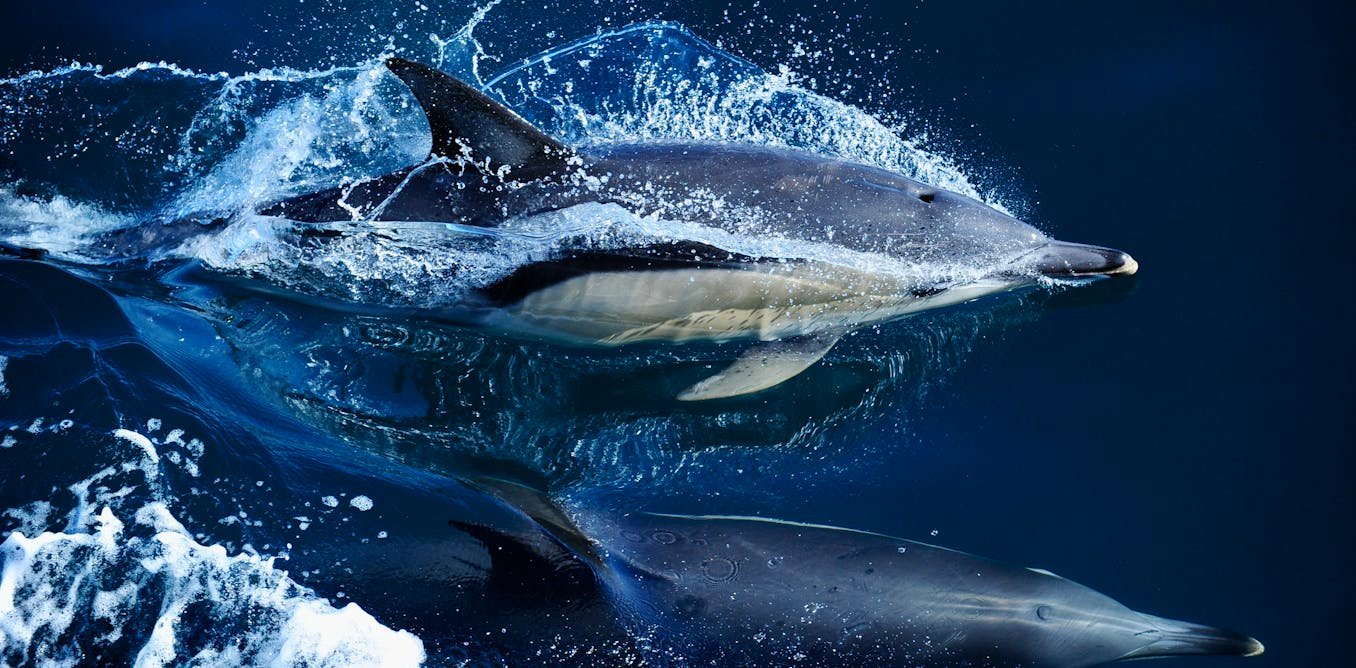
Whales and dolphins inhabit some of the largest and seemingly most pristine environments on Earth, from tropical coastlines to Antarctic waters. But even they can’t escape PFAS, persistent “forever chemicals” that leak into the ocean from homes, factories, and waterways.
Forever chemicals are the secret ingredient in nonstick pans, waterproof jackets, and stain-proof carpets. These chemicals belong to a group of more than 1,400 compounds known as PFAS (per- and polyfluoroalkyl substances). They enter the environment through manufacturing waste, industrial effluents, wastewater treatment facilities, and firefighting foam. But once these chemicals leak out of our homes or factories, they are nearly impossible to remove. They are swept away by the waterways and head towards the sea.
Small organisms absorb them from the water, fish eat them, and larger predators eat the fish. Each step increases the chemical load. Whales and dolphins, which are top predators, can end up with very high concentrations in their bodies. Even deep-sea species that live and feed far from humans are not safe.
Our new study finds that PFAS concentrations in cetaceans have increased globally since 2000. Pacific animals are the most contaminated, with humpback whales having the highest concentrations of PFAS.
These mammals are the guardians of ocean health. They are at the top of the food web, live for many years, and are exposed to pollution in large areas of the ocean. When whales and dolphins show signs of exposure to chemicals, it’s a sign that something is wrong with the broader marine ecosystem.
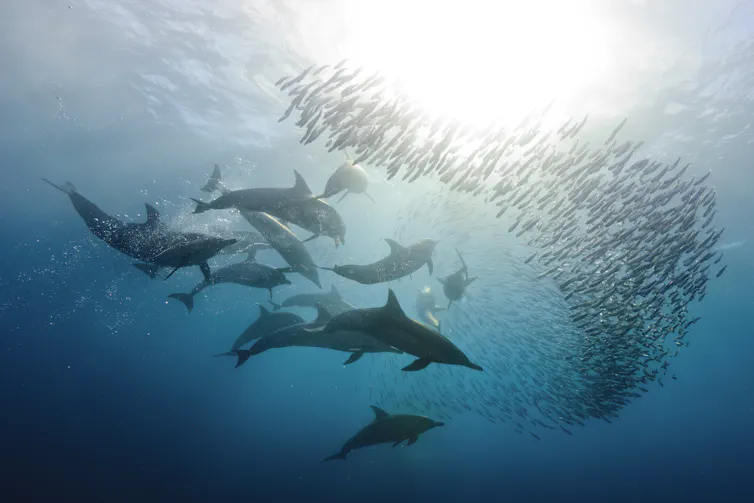
Forever the chemicals move through the food web and end up in the bodies of high-ranking predators such as dolphins.
Dmitry Miroshnikov/Getty
Why do we forever worry about chemicals?
Many of these chemicals have been used for decades. It is highly durable and resistant to heat, oil, and water, making it extremely useful.
Scientists are becoming increasingly concerned because they persist for decades and accumulate over time, not only in our own bodies, but also in wildlife and the wider environment.
The main concern is what effect these chemicals may have on the animals in which they accumulate.
Studies in humans and laboratory animals have linked PFAS to immunosuppression, hormonal changes, reproductive problems, and developmental effects. However, there is still not enough research to understand how different PFAS compounds and exposure levels affect health.
Understanding these effects in whales and dolphins is even more difficult. Marine mammals are long-lived, highly mobile, and exposed to many human-induced challenges at once, from climate change to noise pollution and other pollutants.
Still, there are warning signs. Several dolphin studies have reported changes in immune-related markers associated with PFAS exposure.
How can we permanently test whales for chemicals?
In humans, testing for PFAS levels is typically done with a blood test. It’s not so simple for whales and dolphins.
Collecting blood samples from large marine mammals in the wild is extremely difficult. Scientists often rely on tissue samples from dead animals, especially liver and kidney tissue samples, where many PFAS compounds tend to accumulate. These samples are analyzed in specialized laboratories that can detect trace concentrations of individual PFAS compounds.
This is how scientists have been measuring PFAS in whales and dolphins for decades. Each study added a new piece to the puzzle, showing that these chemicals are present in different species, populations, and oceans.
In our research, we took a step back and looked at the global situation as a whole.
We compiled PFAS data from cetaceans around the world, focusing on liver samples, the most commonly available tissue type, allowing studies to be compared across species and regions.
What did we find?
We found that PFAS contamination varies significantly by species, location, gender, age, and time.
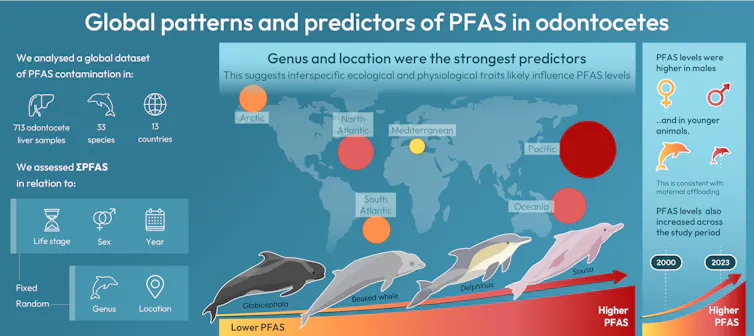
Infographic showing the main findings of the study.
CCBY
The highest concentrations tend to be found in coastal dolphins and porpoises, suggesting that animals living near cities and industrial areas face greater exposure.
Cetaceans in the Pacific Ocean had higher levels than in other oceans. This is likely due to the high level of industrial activity and historical extent of PFAS production in coastal areas.
Female whales and dolphins can permanently transfer chemicals into their bodies during pregnancy and lactation. This means that calves can be exposed to worrying levels of PFAS at a very early age.
Males are unable to pass these chemicals on to their offspring, so they often have higher levels overall than females.
There are some major gaps in the global datasets we collated. This means the extent of PFAS contamination in cetaceans off the coasts of India, Indonesia, and parts of Africa is not fully known.
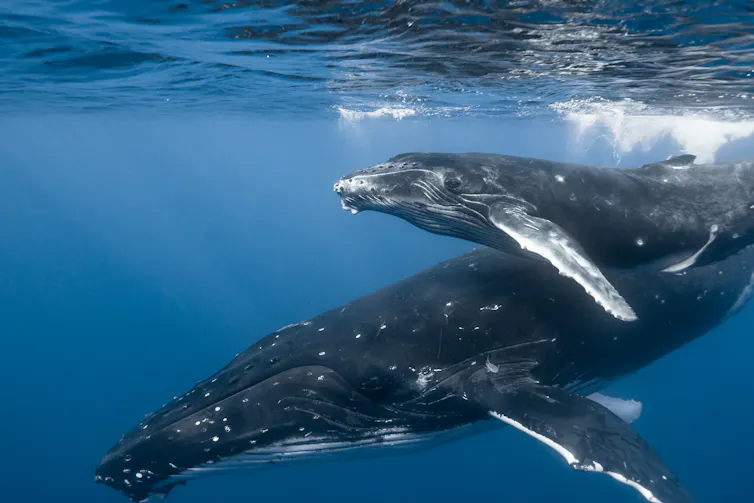
Female whales and dolphins can permanently transmit the chemical to their calves.
Kirstin Meyer/Getty
What should I do?
While important questions remain about the effects of perennial chemicals on whales and dolphins, the widespread contamination we observed is a real concern. We need to strengthen regulations and continue monitoring as we work to reduce the entry of PFAS into the environment.
History shows that global action against harmful chemicals is being tackled. After it became clear that the Earth’s protective ozone layer was being eroded, countries agreed to phase out the chemicals responsible. The ozone layer is currently recovering.
The European Union moved to ban some PFAS compounds 20 years ago. Our study found lower levels of some legacy PFAS compounds in the Mediterranean, which may reflect regulatory influences. While this is positive, it is not enough given that overall PFAS levels in whales and dolphins are increasing globally over time. The EU is currently moving to better regulate this class of permanent chemicals.
Forever chemicals are one of the defining challenges of modern pollution. The more we understand how these chemicals accumulate in whales and dolphins, the better equipped we will be to reduce future pollution and protect marine ecosystems.
Things that reach the ocean don’t just disappear. The same goes for PFAS.
This article is based on collaborative research that also included Lavinia Stokes (University of Wollongong), Jesuina de Araujo (National Measurement Institute) and Gavin Stevenson (National Measurement Institute).
