



The European Chemicals Agency (Echa) has formally recommended the classification of trifluoroacetic acid (TFA), a breakdown product of certain pesticides and refrigerants, as a reproductive toxicant. It may impair fertility and harm the fetus. The decision, announced on June 10 and based on the conclusions of Echa’s Risk Assessment Committee (RAC) earlier this month, could have significant implications for the regulation of pharmaceuticals, pesticides and refrigerants.

The RAC’s opinion, based on animal studies, will be forwarded to the European Commission. Echa also supported the RAC’s conclusion that TFA should be designated as persistent, mobile, and toxic. The EU classifies TFA as a member of the family of environmentally persistent chemicals known as per- and polyfluoroalkyl substances (PFAS). The recommended classification changes will then be sent to a committee for action, a process that is likely to take nine to 15 months, said Hans-Peter Arp, a chemist at the Norwegian University of Science and Technology, whose study classified TFA as a global threat.
“The RAC’s decision is important because it reverses the long-standing message that TFA poses little toxicological concern,” said Ian Cousins, an environmental chemist at Stockholm University. chemistry world. He said that while some voices in academia and industry have repeatedly argued that TFA is inherently harmless, that evidence base has now changed.
What are PFAS?
PFAS, also known as the “forever chemicals,” are a group of an estimated 15,000 synthetic chemicals that have been widely used in consumer products around the world since the 1950s. These are a class of chemicals that contain at least one perfluorinated methyl (-CF3) or methylene (-CF2-) group. The bond between carbon and fluorine is the strongest in existence, so it does not easily break down in the environment. The unique properties of these materials allow them to repel oil, grease, and water, as well as provide properties such as heat resistance and friction reduction. This helps, for example, in creating non-stick and stain-resistant products.
However, PFAS are also highly mobile in the environment and can bioaccumulate as well as bioproliferate up the food chain. PFOA and PFOS, the most well-studied of these substances, are thought to be associated with serious health conditions such as reproductive and developmental disorders, weakened immune function, and certain types of cancer.
“Recognizing this as a reproductive toxicity forces regulators to confront the long-term effects of relying on fluorinated chemicals that inevitably break down to TFA,” Cousins said. “This should also serve as a wake-up call to the industry,” he said, predicting a strong backlash as “substantial commercial interests are at risk.”
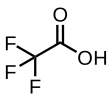
TFA is Several classes of fluorinated chemicals, including the degradation products of PFAS-based pesticides, and some drugs. The main source of TFA in the environment is fluorinated gases used as refrigerants in air conditioners and heat pumps, said Philip Crook, a spokesperson for the environmental group ChemSec.
Cousins added that millions of tonnes of fluorinated gases are produced for refrigeration and cooling worldwide, far less than the total tonnes of all other PFAS. He expects Echa’s move to accelerate the phase-out of PFAS-based pesticides across Europe.
“Significant change”
“So far, only Norway and Denmark have adopted national bans, but the reproductive toxicity classification of TFA strengthens the case for broader action,” Cousins said. “Since these pesticides also contribute to long-term TFA accumulation in water resources and the food chain, I expect to see them banned in more countries and eventually phased out in Europe.”
ChemSec agrees that the RAC recommendation on TFA represents a “significant change”. “While previously considered to be harmless to humans, this reassessment highlights the need for strict measures to prevent further environmental and health impacts,” the group said.
Jonathan Clymark, program director at ChemSec, noted that ChemSec added TFA to its list of hazardous chemicals seven years ago, and said Echa is finally catching up. He urged the committee to “act immediately to stop the spread of TFA and other PFAS.” PAN Europe, the European branch of the International Pesticide Action Network, is also calling on EU authorities to take immediate action to ban all PFAS pesticides that break down to TFA.
Cousins warns that once TFA enters waterways, it cannot be removed without significant investment. He suggests that the only effective strategy is to cut off key sources of information. “That means phasing out F-gas and so-called PFAS pesticides, which are the main sources of TFA,” Cousins says.
Experts argued that the global chemical community needs to unify terminology when it comes to PFAS, noting that many competing definitions are in use. For example, the OECD defines PFAS as molecules containing a single fully fluorinated carbon, and thus also includes TFA. On the other hand, U.S. regulators have specified that TFA is not considered a PFAS because at least two adjacent fully fluorinated carbons are required for a substance to be considered a PFAS.
“Echa’s move to include TFA as a PFAS and classify it as highly hazardous to early childhood development shows that even the simplest PFAS are not without risks to human health, especially to the most vulnerable subpopulations of society, developing organisms,” said Jamie DeWitt, an environmental and molecular toxicologist at Oregon State University.
Back in March, RAC was one of Echa’s two scientific committees to support EU-wide restrictions on the production, sale and use of PFAS.
A recent analysis by Lancaster University estimated that more than 335,000 tonnes of TFA were released between 2000 and 2022 due to chemicals replacing chlorofluorocarbons and certain anesthetics.
