


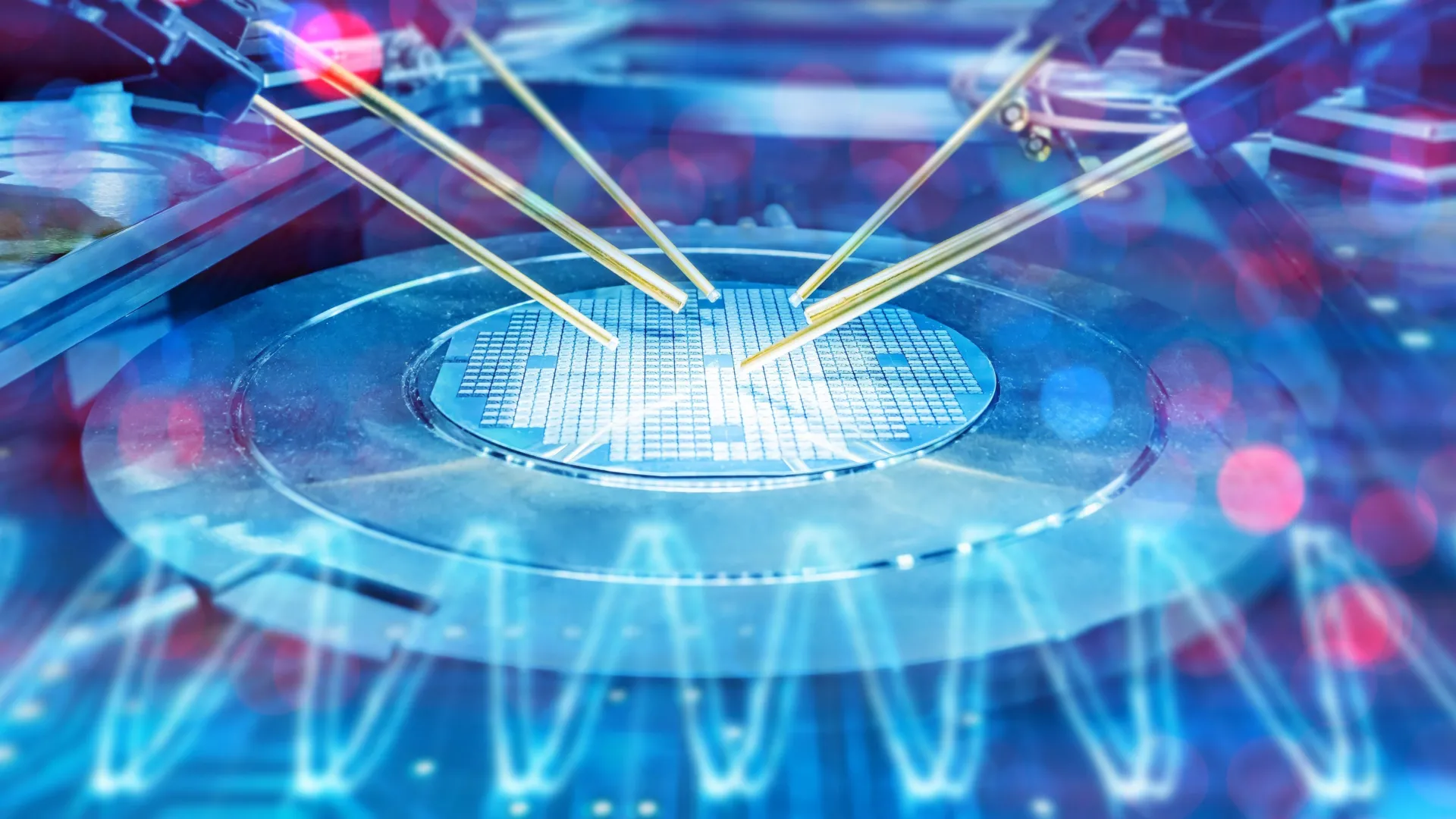
Silicon has powered computer chips for decades, but engineers are increasingly facing the material’s physical limits. To continue making electronic devices smaller and more powerful, researchers are exploring ways to combine silicon with new ultra-thin materials.
One group of promising materials is known as transition metal dichalcogenides (TMDs). Among the leading candidates is molybdenum disulfide. Molybdenum disulfide is a three-atom-thick material that consists of a layer of molybdenum between two layers of sulfur.
Single atomic layer removal
For future transistors that combine silicon and TMD materials, manufacturers may need to selectively remove atoms from just the top sulfur layer, leaving the underlying layers untouched.
One common method for removing surface atoms uses plasma, an energetic state of matter found in the Sun and other stars. Plasma research has also been a primary focus at the U.S. Department of Energy’s (DOE) Princeton Plasma Physics Laboratory (PPPL) for the past 75 years.
Under carefully controlled conditions, particles in the plasma can collide with the surface of the TMD material and knock off atoms. The challenge is to achieve enough energy to remove sulfur atoms from the top layer without damaging the molybdenum layer below. Developing reliable processes has proven difficult because the difference between success and damage is so small.
Using computer simulations, the researchers found that treating molybdenum disulfide with oxygen or fluorine before exposing it to plasma gave them more control over the process. Their discovery is physical chemistry letter journal.
Oxygen and fluorine expand the safety margin
Simulations revealed that pretreatment dramatically lowers the energy required to remove sulfur atoms.
On an untreated surface, approximately 30 electron volts are required to remove a sulfur atom. Adding fluorine lowers the threshold to about 10 electron volts, and using oxygen lowers it to about 14 electron volts.
This difference is important because not all plasma ions carry the same amount of energy. Some people have more energy than others. On untreated surfaces, the range between removing sulfur atoms and damaging the underlying molybdenum layer is very narrow, so some ions can cause unwanted damage.
Lowering the sulfur removal threshold to 10 or 14 electron volts increases the operating range. As a result, manufacturers have more flexibility to cleanly remove the top sulfur layer while preserving the rest of the material.
let chemistry do the work
Rather than relying entirely on physical shocks to free atoms, researchers have discovered a way to use chemistry to aid the process.
When incoming ions strike an oxygenated surface, two oxygen atoms combine with nearby sulfur atoms to form sulfur dioxide, a stable gas that can naturally leave the surface. Fluorine works similarly, producing sulfur-fluorine compounds that are easier to remove.
“We’re not directly severing ties,” said Yuri Polyachenko, a chemistry graduate student at Princeton University who will also work at PPPL in the summer of 2025 and lead author of the study. “Intermediate products such as sulfur dioxide are being produced, which are much easier to break down.”
Expanding our approach to other materials
Researchers plan to continue studying the technology to better understand its effects.
“The next step is to figure out not just whether it causes damage, but how much damage the process causes,” Polyachenko said. “We then want to see if the same approach can be applied to related materials, such as replacing molybdenum with tungsten and sulfur with selenium, to see how broadly applicable this idea is.”
The research team included PPPL’s Igor Kaganovich and Shoaib Khalid, as well as PPPL graduate Yuri Barsukov.
This research was supported by the Department of Energy, Office of Science, Fusion Energy Sciences and Basic Energy Sciences as part of the Microelectronics Science Research Center, Extreme Lithography & Materials Innovation Center, under contract number DEAC02-09CH11466.
Simulations were performed at the National Energy Research Scientific Computing Center (NERSC), a DOE Office of Science user facility at Lawrence Berkeley National Laboratory, operated under contract number DE-AC02-05CH11231. Additional computing resources included Princeton University’s Stellar, Della, and Tiger clusters and NERSC award BES-ERCAP36136.
