


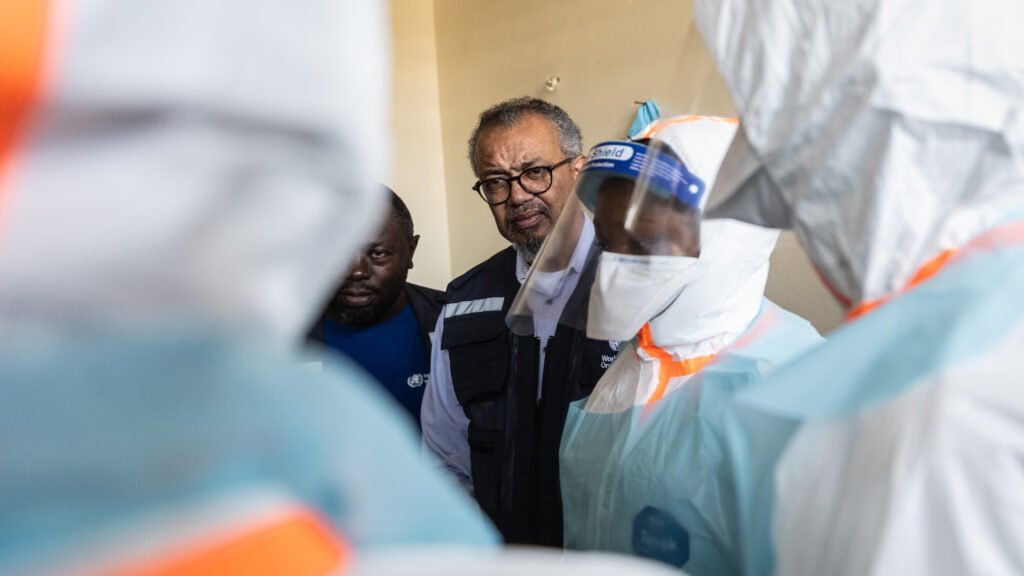
The World Health Organization’s director-general said he was “genuinely concerned” that the Ebola outbreak in the Democratic Republic of Congo and Uganda was already the third largest on record.
In an exclusive interview with STAT, Tedros Adhanom Ghebreyesus described the situation he saw after returning from his second visit to the affected area since the outbreak was declared on May 15 and declared a public health emergency of international concern on May 17. At least 708 people have been confirmed to have been infected in both countries, of which 141 have died.
WHO staff working on the ground in the Democratic Republic of Congo are facing death threats. Monitoring of contacts of infected cases remains well below the level needed to contain the outbreak, with only 28.4% of contacts of known cases being traced as of June 11. People on the ground told WHO leaders that they either did not believe Ebola existed or that it was not a top concern.
“It’s very difficult when the community doesn’t see that as a priority,” Tedros said in a rare one-on-one interview with STAT.
He recalled discussions with some regional leaders who were pressed about why the world only cared about their region during the ongoing Ebola outbreak. Against the backdrop of a prolonged conflict, hundreds of thousands of people displaced, widespread hunger, and a host of diseases that kill more often than Ebola, the conclusion some have reached is that the rest of the world is only concerned because they fear Ebola will spread beyond the borders of the Democratic Republic of the Congo.
“Ebola is a lesser evil, that’s what they say,” Tedros said.


STAT Plus: NIH cuts weakened networks to respond to outbreaks like Ebola
Uganda is politically stable and has significant experience in containing Ebola. The outbreak there now appears to be largely under control, with only 19 confirmed cases and only two deaths among those confirmed cases. But in the northeastern Democratic Republic of the Congo, the deadly disease is spreading unchecked.
A transcript of this conversation has been edited for length and clarity.
What have you heard from people on the ground in the outbreak areas of northeastern Democratic Republic of the Congo?
Why not ask how many people die from other health problems? Or how many people die from armed conflict? For us, the number of deaths from Ebola is probably small or not that important. Malaria deaths are probably even higher. Many more people die in armed conflicts.
So what’s the answer, Dr. Tedros?
So the answer is that there is no peace. Their lives are chronically affected. And for them, Ebola is not even a priority. They are actually wondering why we are thinking seriously about Ebola but not about other afflictions.
So forget about case reports. Even now, cooperation for monitoring is not required. they don’t care. They even think this Ebola outbreak is a conspiracy. It doesn’t exist. That’s a hoax. It is also said that foreign powers are inventing this to make money for themselves.
There is no monitoring. There is no medical system. And because of the Ebola outbreak in the region between 2018 and 2020, the people who were trained years ago (on how to safely identify and treat Ebola patients) are no longer there.
I was wondering if some sort of knowledge from the 2018-2020 fads was being carried over.
It doesn’t exist because people fear for their lives. Anything can happen to them. Death can also be caused by other things. Ebola has the lowest mortality rate. That’s what they think.
Some people who knew about the spread of infection in 2018 even said, “We invested a lot of money back then.” So you sealed it. You prevented it from coming to you. But what did we get in return? They said: nothing.
That’s the problem now.
They are also aware of other health issues they have. Many people die every day. And we also see people losing their lives because of conflict. So the numbers of people dying (from other causes) seem dwarfed by the numbers they see due to Ebola.
Since it was from 2018 to 2020, I would have thought there would be some kind of memory of Ebola there.
Not much. Conflict is chronic there, so people really move. And even if they have memory, health issues can leave people completely demotivated and overwhelmed.
How will the world solve it?
So when I spoke to the leaders, Felix Tshisekedi (President of the Democratic Republic of the Congo) and Yoweri Museveni (President of Uganda), they told me that what the people want is peace. They are tired of decades of chronic war. they are poor. they are evacuated. they are hungry. And they want their livelihoods back.

Leaders of the US Ebola response in 2014 compare then and now
We looked at the number of deaths from armed conflicts in just the past six months since January 2026. And the number of people infected with Ebola is far too small compared to the number of civilian deaths caused by the conflict. Why do they care about Ebola when deaths are rising due to other issues, whether it’s health problems or conflict?
So if we address this, how do we address other challenges?
I don’t know how you do that.
I think it’s a political solution.
There has to be a political solution, but if there is not, I don’t think the surveillance system will improve if the conflict continues to escalate in the region. And it’s very difficult unless other health problems are resolved.
By the way, they also said, “Okay, you’re investing a lot of money. When Ebola comes, the elderly will come to us, too.” But you’re here to stop Ebola from getting here.
It’s not because we want to save our lives. It’s not for us, it’s for you.
Please cooperate in the fight against Ebola hemorrhagic fever. Assist with other medical service needs. Please cooperate with humanitarian aid such as food. they are hungry. They need food aid. And everything we’re investing in now should also strengthen our health system.
There is not just one armed group in this part of the DRC, but many. That’s going to be a big challenge, right?
Although it may be difficult, they may be able to control their anger by talking directly to them through several channels, especially from the community and political leaders. But like you said, it’s a lot, so I don’t think it’s easy. And God knows how to communicate with some of them. They are deep in the countryside and don’t have much communication with the rest of the world.
So it seems like you think this is going to be a very difficult infection to contain.
Yes, I’m really worried.
Contact tracing rates are currently around 50%. It should reach 95%. The virus is right in front of our eyes. Because there is mistrust in the community and the community is not working together. They’re actually hiding some people.
Their movements are large and they cannot find people.
How did you respond to those who denied the importance of Ebola and the broader world’s interest in containing the outbreak?
I’m not here to give orders. I’m not here to tell you what to do. We’re here to hear your story because you live here every day.
you know your problem. you know the solution. So I’m here to listen to you and support you based on the problems and solutions you say.
It brings some understanding.
You recognized their reality.
that’s right. Therefore, we need a solution to every problem.
