


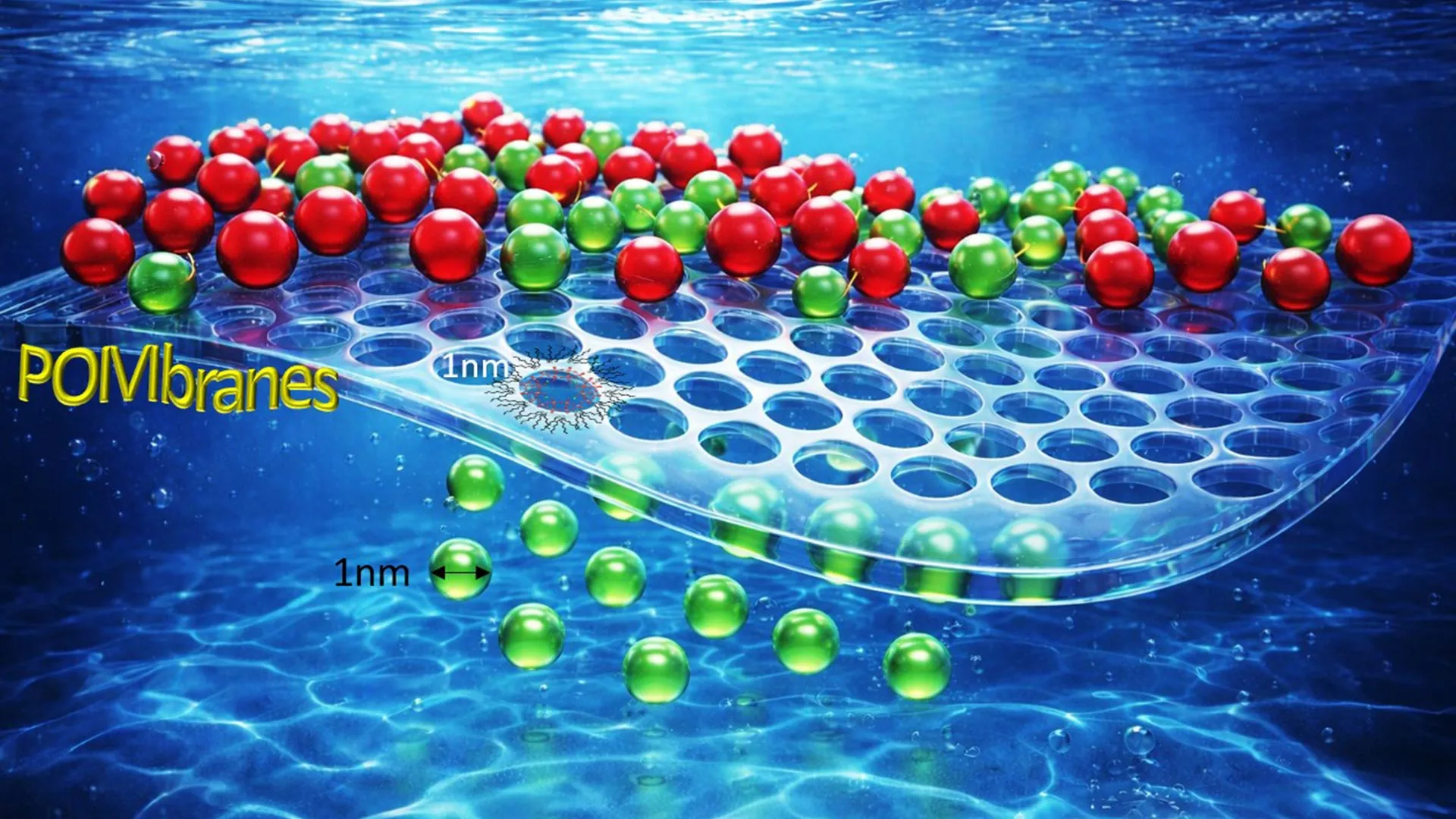
A team of researchers from CSIR-Central Salt and Marine Chemistry Research Institute (CSMCRI), Indian Institute of Technology Gandhinagar (IITGN), Nanyang Technological University, Singapore, and SN Bose National Center for Basic Science has developed a new type of high-precision filtration membrane. This research Journal of the American Chemical Societydescribes technologies that could help industry reduce energy use and dramatically increase water reuse.
Many industrial activities depend on separating different substances from each other. These separation processes are essential for tasks such as drug purification, textile dye processing, and food production. However, they are also the most energy-intensive tasks in manufacturing, accounting for approximately 40% to 50% of global industrial energy consumption.
Most facilities still rely on traditional approaches such as distillation and evaporation. Although effective, these methods require large amounts of energy and contribute significantly to carbon emissions. Although membrane-based filtration is generally considered a cleaner alternative, traditional polymer membranes often contain pores of non-uniform size. Over time, these pores can change shape or degrade, reducing performance and limiting their usefulness in demanding industrial environments.
Naturally derived POMbrane with 1 nanometer pores
“To address these limitations, we have developed a new class of superselective crystalline membranes called ‘POMbranes’ that are approximately one nanometer wide and contain pores thousands of times smaller than a human hair,” said Shilpi Kushwaha, Ph.D., senior research scientist at CSMCRI.
The new membrane takes inspiration from biological systems such as aquaporins, which control the movement of molecules through precisely sized channels. To achieve this level of control, the researchers used polyoxometalate (POM) clusters. Each cluster contains a naturally occurring opening just 1 nanometer wide and is permanently stable.
Priyanka Dobariya, a researcher at CSMCRI and co-lead author of the paper, said: “These POMs are small crown-shaped blocks of metal with a permanent, perfect hole in the center that never changes or loses shape, which is the biggest hurdle for traditional plastic filters.”
Construction of ultrathin molecular sieves
To create a practical film, these tiny ring-like structures had to be arranged into billions of consecutive, defect-free layers. To accomplish this, the researchers attached flexible chemical chains to the POM clusters.
When the modified clusters are placed on water, they spontaneously spread to form ultrathin films over large areas. By changing the length of the connected chains, the team was able to control how dense the clusters were.
“This allowed molecules to pass through the membrane through only one open path, the 1-nanometer hole built into each cluster, allowing the membrane to act like a high-tech sieve,” added Dr. Raghavan Ranganathan, Associate Professor in the Department of Materials Engineering at IITGN.
Ranganathan and Vinay Thakur, a postdoctoral fellow at IITGN and co-lead author of the paper, also conducted molecular-level simulations to reveal how the membrane performs its filtering function.
Almost 10x better separation performance
Tests showed that the membrane could distinguish between molecules that differ by only 100 to 200 Daltons. This is a level of precision that is extremely difficult to achieve with traditional polymer membranes.
According to Dr. Ketan Patel, chief scientist at CSMCRI, this capability could create new opportunities for more sustainable manufacturing processes.
“Our membrane exhibits nearly 10 times better separation performance compared to existing technologies, while maintaining flexibility, stability and scalability,” he said.
“Furthermore, these membranes are flexible, stable over different acidity levels (pH ranges), and can be manufactured in large sheets. This combination is essential if the membranes are to be widely adopted in industry.”
Potential benefits of textile and water recycling
The technology could be particularly valuable for India’s textile and pharmaceutical industries, both of which play important roles in the country’s economy.
India’s textile and apparel sector accounts for over 2.3% of GDP and about 13% of industrial production. The domestic market is currently valued at $160 billion to $225 billion and is expected to expand to $250 billion to $350 billion by 2030.
Textile dyeing and finishing operations generate large amounts of contaminated wastewater, making dye removal and water recycling an ongoing challenge. The new membrane can recycle water while selectively removing dye molecules, reducing both freshwater demand and chemical waste. This advantage is especially important as India’s wastewater treatment market continues to grow.
Application in pharmaceutical manufacturing
The membrane could also benefit pharmaceutical production, where high-precision separation is critical to product quality and manufacturing efficiency.
“Processes like drug purification and solvent recovery are energy-intensive and quality-sensitive,” says Vinay Thakur. “Such selective membranes can reduce energy usage while maintaining the stringent standards required for pharmaceutical production.”
Fundamental technology for sustainable manufacturing
Researchers describe the new POMbrane as a versatile platform technology. The tunable structure, high selectivity, and ability to withstand harsh chemical environments make them suitable for a wide range of industrial separation tasks, from wastewater treatment to advanced chemical manufacturing.
Molecularly engineered membranes have the potential to become an important part of next-generation manufacturing systems, as industry increasingly seeks technologies that combine efficiency, durability, and sustainability. By applying principles commonly found in biology, precise control at the molecular scale, and adapting them to scalable materials technology, researchers have demonstrated how nature-inspired design can help solve major industrial challenges.
