


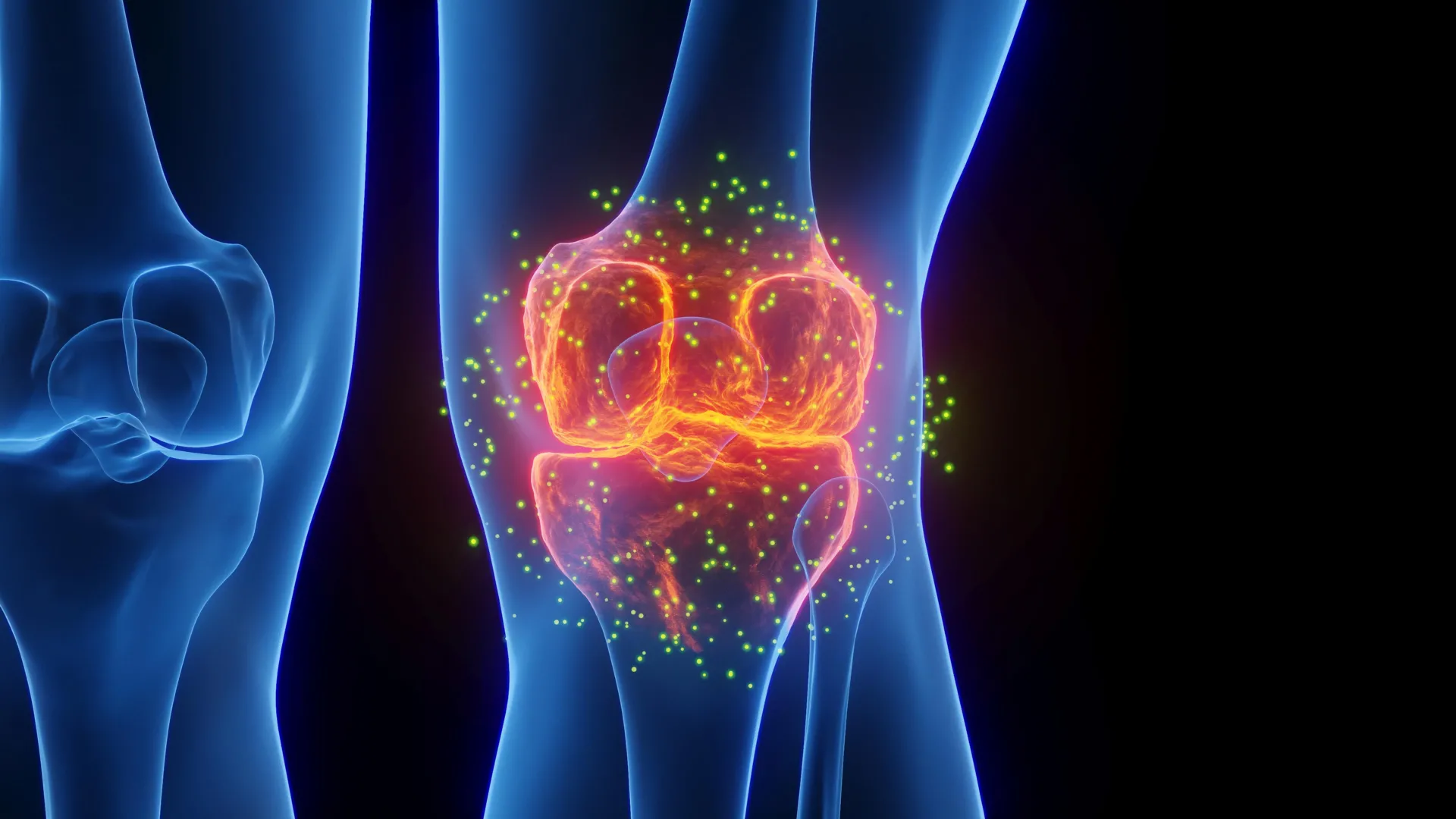
A treatment targeting a protein associated with aging restored lost knee cartilage in old mice and prevented the development of arthritis after severe joint damage, according to a Stanford Medicine-led study.
Researchers also found promising results in human tissue. Samples collected during knee replacement surgery began producing new, functional cartilage when treated.
The findings raise the possibility that damaged cartilage caused by aging or osteoarthritis could one day be repaired using local injections or oral medications. If this approach is successful in humans, it could reduce the need for knee and hip replacement surgeries.
An oral version of this treatment is already being tested in clinical trials targeting age-related muscle weakness.
Targeting the root cause of osteoarthritis
Osteoarthritis is the most common form of arthritis, affecting approximately 1 in 5 adults in the United States. The disease gradually destroys the cartilage in the joints, causing pain, stiffness, and swelling. It is estimated that approximately $65 billion in direct medical costs are incurred each year.
Current treatment focuses primarily on pain relief, with joint replacement surgery in severe cases. Approved drugs cannot slow, stop, or reverse the progression of the underlying disease.
The new treatment works by blocking a protein called 15-PGDH, which researchers call “gelozyme.” This class of proteins becomes more abundant with age and contributes to a decline in tissue function throughout the body.
The same research team first identified gerozyme in 2023. Previous studies have shown that 15-PGDH plays a major role in age-related muscle loss in mice. When researchers block this protein, older animals gain muscle mass and endurance. When you artificially increase protein in young mice, their muscles become weaker and smaller.
Scientists believe that 15-PGDH is also involved in bone, nerve, and blood cell regeneration.
Different types of tissue regeneration
In many tissues, regeneration occurs as stem cells proliferate and develop into new specialized cells. It seems that the cartilage functions differently.
Instead of relying on stem cells, cartilage-producing cells called chondrocytes appear to be able to change gene activity and return to a more youthful state.
“This is a new way to regenerate adult tissue and has great clinical promise in the treatment of age- and injury-related arthritis,” said Dr. Helen Blau, professor of microbiology and immunology. “We were looking for stem cells, and it’s clear that stem cells are not involved. We’re very excited.”
Blau, director of the Baxter Institute for Stem Cell Biology and Donald E. Baxter and Delia B. Baxter Foundation Professor, and Dr. Nidhi Bhutani, associate professor of orthopedic surgery, are senior authors of the study. science. Dr. Mamta Singla, a lecturer in orthopedic surgery, and Dr. Yu Xin (Will) Wang, a former postdoctoral fellow, are the lead authors. Wang is currently an assistant professor at the Sanford Burnham Institute in San Diego.
Significant cartilage regeneration
“Millions of people suffer from joint pain and swelling as they age,” Bhutani said. “This is a major unmet medical need. Until now, there have been no drugs that directly treat the cause of cartilage loss. However, this gelozyme inhibitor causes dramatic cartilage regeneration that exceeds what has been reported in response to other drugs or interventions.”
The human body contains three major forms of cartilage. Elastic cartilage provides flexibility to structures such as the outer ear. Fibrocartilage is strong, shock-absorbing material and is located in disc-like locations between vertebrae. Hyaline cartilage is smooth and slippery, allowing joints such as the knees, hips, shoulders, and ankles to move freely.
Osteoarthritis primarily damages hyaline cartilage, also known as articular cartilage.
As joints age or become overstressed by injury or obesity, cartilage cells begin to produce inflammatory molecules and break down collagen, the main structural component of cartilage. When collagen is lost, cartilage becomes thinner and softer. Inflammation then causes the pain and swelling associated with osteoarthritis.
Unlike many other tissues, articular cartilage rarely repairs itself. Although researchers have identified the potential for cartilage-generating stem cells within bones, similar cells have not yet been successfully identified within articular cartilage.
Why researchers focused on 15-PGDH
Previous research from Blau’s lab showed that prostaglandin E2 is important for muscle stem cell function. The protein 15-PGDH degrades prostaglandin E2.
When the researchers inhibited 15-PGDH or increased prostaglandin E2 levels, damaged muscle, nerve, bone, colon, liver, and blood tissue in young mice regenerated more effectively.
The research team suspected that the same mechanism might influence cartilage aging.
Comparing the cartilage of young and old mice, they found that 15-PGDH levels approximately doubled with age.
To test this idea, the researchers treated older mice with a small molecule drug that blocks 15-PGDH activity. Some animals received injections in their abdomens, exposing their entire bodies to the treatment. Some people received injections directly into their knee joints.
Both approaches yielded remarkable results. Cartilage, which had become thinner and less functional with age, became thicker across the joint surfaces. Additional testing revealed that the regenerated tissue was not less effective fibrocartilage, but rather hyaline cartilage, the type needed for healthy joint function.
“We were surprised to see so much cartilage regeneration in older mice,” said Professor Bhutani. “The effect was noticeable.”
Prevention of arthritis after ACL type injury
The researchers also investigated whether this treatment could protect joints after injury.
They used a mouse model that mimicked an ACL tear. ACL tears are a common sports injury seen in activities that involve sudden stops, turns, or jumps, such as soccer, basketball, and skiing.
Although ACL injuries can be repaired surgically, about half of those affected will develop osteoarthritis in the injured joint within about 15 years.
Mice that received gelozyme inhibitors twice a week for four weeks after injury were much less likely to develop osteoarthritis. In contrast, untreated animals exhibited approximately twice the 15-PGDH levels of uninjured mice and developed osteoarthritis within 4 weeks.
The treated mice walked more normally and put more weight on the injured limb.
“Interestingly, prostaglandin E2 is thought to be involved in inflammation and pain,” Blau says. “However, this study shows that at normal biological levels, small increases in prostaglandin E2 can promote regeneration.”
Reprogramming of aged chondrocytes
A closer look at the chondrocytes reveals important differences between young and old joints.
Older chondrocytes were more likely to activate genes associated with inflammation and the unwanted conversion of cartilage to bone. They were less likely to express genes associated with healthy cartilage formation.
This treatment appears to reverse many of these age-related changes.
One group of chondrocytes, which produced 15-PGDH and expressed a gene involved in cartilage destruction, decreased from 8% to 3% of cells after treatment. Another group related to fibrocartilage production decreased from 16% to 8%.
Meanwhile, the cell population involved in hyaline cartilage construction and extracellular matrix maintenance increased from 22% to 42%.
Overall, the results suggest that this treatment transitions cartilage to a younger, healthier state without the need for stem or progenitor cells.
Human cartilage also reacted
The researchers then examined cartilage removed from people who had undergone total knee replacement surgery for osteoarthritis.
After 1 week of treatment with a 15-PGDH inhibitor, the tissue had fewer cartilage-degrading cells and decreased activity of genes associated with cartilage destruction and fibrocartilage production. The samples also started producing new articular cartilage.
“This mechanism is quite surprising and has revolutionized our view of how tissue regeneration occurs,” Bhutani said. “It is clear that the large pool of cells already present in cartilage has altered gene expression patterns, and targeting these cells for regeneration may provide an opportunity to have a greater overall impact clinically.”
Dr. Blau added, “A phase 1 clinical trial of a 15-PGDH inhibitor for muscle weakness showed that it is safe and effective in healthy volunteers. Our hope is that similar trials will be initiated soon to test its effectiveness in cartilage regeneration. We are very excited about this potential breakthrough. Imagine regrowing existing cartilage and avoiding joint replacement.”
Researchers at Sanford Burnham Prebys Medical Discovery Institute also contributed to the study.
This research was supported by the National Institutes of Health (grant R01AR070864, R01AR077530, R01AG069858, R00NS120278), Baxter Stem Cell Biology Foundation, Li Ka-Shing Foundation, Stanford Heart and Vascular Institute, Milkyway Research Foundation, Canadian Institutes of Health Research, Stanford Translational Research, and Applied Medicine Pilot Grant, GlaxoSmithKline Sir James Black Postdoctoral Fellowship, and Stanford University Dean’s Postdoctoral Fellowship.
Blau, Bhutani, and several co-authors are inventors on a Stanford patent application for 15-PGDH inhibition for cartilage repair and tissue rejuvenation, licensed to Epirium Bio. Blau is a co-founder of Myoforte/Epirium and holds stock and stock options in the company.
