


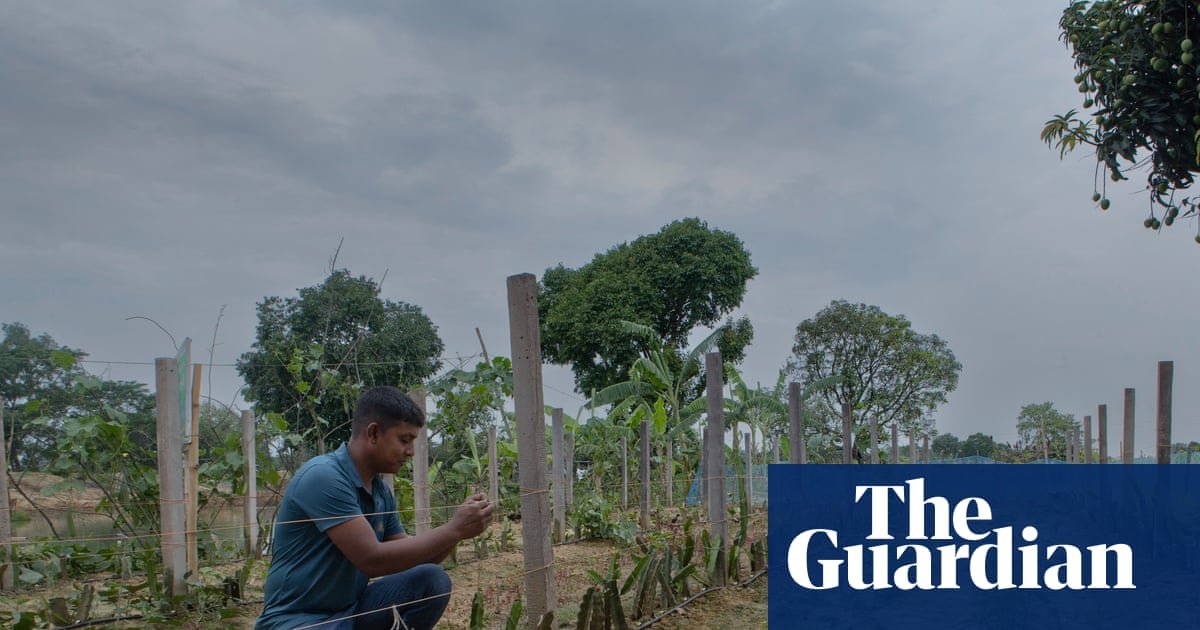
IIn the parched fields of northwestern Bangladesh, where the unforgiving sun has hardened the earth into cracked red clay, farmers in the Barind region say they are watching the foundations of their rural life disappear underground.
Over the decades, groundwater has transformed Barind, one of Bangladesh’s driest regions, into a productive agricultural region. Thanks to deep tube wells, farmers were able to grow rice, wheat, corn, and vegetables all year round on land that was once formed by drought.
But now the aquifers that drove that change are collapsing under the combined pressures of the climate emergency, extreme rainfall, and decades of intensive mining. Recent studies show that more than 82% of the region is already under severe water stress.
“We have to put the pipes deeper underground than before,” says Ataur Rahman, a 48-year-old farmer whose family has cultivated the same land for generations. “Even if we go deeper, we don’t get water like we used to.”
Ataur Rahman (48) and his wife outside their home in Barind. There, farmers claim that aquifers are being depleted. Photo: Farzana Hossen/Guardian
Fear is growing across Barindo as irrigation becomes more expensive, less reliable and more competitive. In some villages, tube wells rarely provide sufficient drinking water during the dry season.
“Sometimes, even if you pump the tube well, nothing comes out,” said Sreemoti Shobdrani, 40, a farmer from the nearby village of Thilibari. “We think maybe the motor is failing, but the groundwater itself is actually decreasing.”
The crisis reached a tipping point last year when the Bangladeshi government banned the extraction of groundwater for irrigation in around 5,000 villages in Rajshahi, Naogaon, Chapainawabganj and Natore districts and declared them “water-stressed areas” for the next 10 years. Under the order, groundwater can only be used for drinking purposes, and irrigation and industrial mining are prohibited.
For most farmers, the announcement felt sudden and unsettling. Many people had already borrowed money for seeds, fertilizers and land preparation before the restrictions took effect. The government quietly lifted a two-year ban in January, but many fear the reprieve is too short given the already tightening crisis.
“There is no clear roadmap for farmers,” said Mohammad Shamsdouja, a professor of water crisis and risk reduction at University College London, who studies Bangladesh’s groundwater crisis. “Introducing a ban without viable alternatives risks triggering a serious humanitarian and economic crisis across rural areas.”
Sreemoti Shobdrani, 40, believes that digging the pond deeper will allow rainwater to be collected for irrigation during the dry season. Photo: Farzana Hossen/Guardian
SThe Barind region, which traverses upland plains, has always faced difficult growing conditions. Rainfall is sparse and unpredictable, but the region’s dense clay soils trap heat and resist moisture.
Since the 1980s, the state-run Barind Multipurpose Development Authority (BMDA) has installed around 18,000 deep tube wells in Rajshahi and Rangpur districts, helping expand irrigation and rebuild agricultural production.
This system significantly increases crop yields and allows many farmers to grow crops year-round. But it has also increased dependence on groundwater, particularly in the cultivation of water-intensive Boro rice (a high-yielding winter rice variety widely grown throughout Bangladesh).
Sorry for the double quotes, but… You can’t cultivate without irrigation, and you can’t survive without cultivation Ataur Rahman, Farmer
For farmers like Rahman, it is impossible to escape this contradiction. Without irrigation, crops cannot grow, and continued mining threatens the future of agriculture itself.
“It doesn’t feel right lifting water like this,” he says. “But what choice do we have? You can’t cultivate without irrigation, and you can’t survive without cultivation.”
Rahman walks through rice fields that his family has cultivated for generations. Photo: Farzana Hossen/Guardian
Rahman worries that future generations will no longer be able to survive on agriculture. His teenage son recently graduated from middle school, and while Rahman hopes to stay connected to the land that is central to his family’s survival, he also encourages him to develop his computer skills and pursue opportunities outside of farming.
For women in Barind, the groundwater crisis is exacerbating an already exhausting labor burden. Shobdrani’s day begins before sunrise and continues until late at night, as she constantly moves between fields and home, planting rice, carrying soil, caring for livestock, cooking meals, and raising her children.
Shobdrani takes care of the cows in Tilibari. The water crisis has made her job less profitable. Photo: Farzana Hossen/Guardian
Her family cultivates a combination of owned and communal land, growing rice, corn, lentils, mustard, and vegetables, while also raising ducks, chickens, and cows to supplement their income. But rising irrigation costs and declining yields are making farming increasingly difficult, she says.
“An hour of irrigation water used to cost 90 taka (55 pence),” she says. “Now it’s 120 yen. Fertilizer prices have gone up. Labor costs have also gone up. But crop production has gone down.”
Farmers across Barind are switching to crops that require less water. Still, irrigation remains unpredictable. Farmers purchase water by the hour using prepaid cards connected to deep wells, but due to low groundwater pressure, they often receive far less water than before. “Now, even though we pay more, we get less water,” said Mohammad Asif, 27.
Many young men from nearby villages have already migrated to Dhaka and other cities in search of work. Asif’s greatest fear is the future his children will inherit.
“By the time my son is 20 years old, this land will have changed a lot. I sometimes worry that conflicts over water will become so brutal that people will start wars over water.”
Mohammad Asif, 27, and his wife fetch water from a well near their home. Wells are delivering less water even though people are paying more. Photo: Farzana Hossen/Guardian
That sense of fear and hopelessness is increasingly underpinning the efforts of researchers and development organizations working in the region.
A recent study led by the development NGO Black, in collaboration with the Global Adaptation Center and the International Water Management Institute, found that rising temperatures, decreasing rainfall and expansion of Boro rice cultivation will push the region toward severe groundwater depletion within the next 20 years.
Double QuotesIf ponds were dug deeper, rainwater could be stored for irrigation…I don’t see enough efforts to conserve water Sreemoti Shobdrani, Farmer
In response, Black continues to work with farmers on a pilot program to train them on climate-resilient agriculture and water-saving irrigation methods such as alternating wet and dry cycles (rather than constantly flooding rice fields, they are allowed to dry for several days before being watered again without negatively impacting the crop).
On a sunny afternoon in a small courtyard in the village of Sindukai, about 20 farmers sat cross-legged in a circle under a tree, listening to Burak’s staff lead an information session.
Farmers will attend training sessions on water-saving irrigation methods conducted by Brac. Photo: Farzana Hossen/Guardian
“Building climate resilience requires more than just improving access to water,” Mohammad Ali, program director of the Water, Sanitation and Hygiene Program in Bangladesh’s Brak province, told the group. “That means investing in water-efficient irrigation, climate-resilient crops, climate-smart agriculture, and community-driven water management systems.”
Ali says women need to remain at the center of long-term solutions because they often bear the heaviest burden of water scarcity. “Incorporating gender-sensitive approaches into water service delivery is essential to ensure equitable access, strengthen community resilience and promote inclusive decision-making,” he says.
For many farmers, the answer lies above ground, not underground. That means collecting rainwater, restoring wetlands and rebuilding ponds that can store water through the dry season. “If the ponds were dug deeper, they could store rainwater for irrigation during the dry season,” Shobdrani said. “I don’t think there’s enough effort being put into properly conserving water.”
Government officials said they are aware of the seriousness of groundwater depletion and are considering alternative irrigation systems to ensure continued cultivation.
Farmers fear that without solutions to sustainably irrigate their crops, their livelihoods will be threatened. Photo: Farzana Hossen/Guardian
Experts estimate that more than 2.5 million hectares (6.2 m acres) of farmland could remain uncultivated, which would reduce crop yields by 2.7 million tonnes. For households already struggling with rising costs of living and repeated climate change, crop failure could deepen debt, accelerate migration and exacerbate food insecurity.
The challenge facing Bangladesh is no longer simply how to conserve groundwater. It’s about how to conserve, without abandoning, rural areas whose land has been cultivated for generations and whose survival depends on groundwater.
