


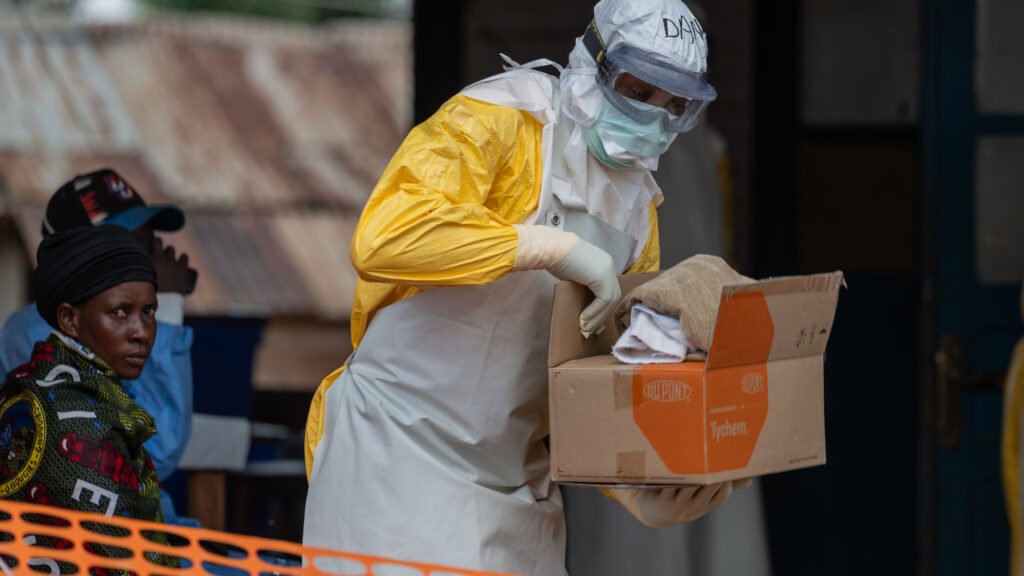
NEW YORK—The Ebola outbreak in Central Africa could spread to more than 20,000 people, depending on how quickly infected people are isolated to slow the spread, according to a new analysis from U.S. health officials.
The Centers for Disease Control and Prevention on Friday released a variety of scenarios generated by computer models, ranging from 10,000 to more than 20,000. If accurate, the worst-case scenario could bring the virus closer to the worst-ever Ebola outbreak in West Africa from 2014 to 2016, which infected more than 28,000 people and killed more than 11,000.
“Modeling work suggests that without strong public health interventions, an outbreak of this magnitude could occur,” Satish Pillai, the CDC’s Ebola response incident manager, said in a briefing with reporters.
Jennifer Nuzzo, director of the Brown University Pandemic Center, said the model “confirms what we’ve feared all along: If we don’t do more to stop the spread of Ebola, this epidemic is on a dangerous trajectory.”
But she warned that it could be very difficult to predict how the epidemic will develop. “I don’t read too much into specific numbers. It’s very difficult to make accurate predictions when you have limited data,” she added.


STAT Plus: US turns itself into a fortress as Ebola outbreak spreads in Central Africa
The Africa Centers for Disease Control and Prevention announced on Friday that about 400 cases have been confirmed so far, of which 63 have died. Experts say there are likely more cases that have not yet been diagnosed or reported.
The virus that causes Ebola is spread through contact with body fluids such as vomit, blood, and semen. There is no specific treatment or vaccine for Bundibugyo virus, which is at the center of the current outbreak. This disease is often fatal.
The World Health Organization declared the outbreak a global health emergency in May. Some experts believe the infection may have occurred in February, but health officials initially tested for a different type of Ebola virus.
The response to the spread of infection has been complicated by armed clashes between the Congolese government and the Rwandan-backed M23 rebel group, as well as attacks by the Islamic State-affiliated group Allied Democratic Forces. Officials say the violence has led to large-scale displacement of people living in conflict areas.
Nuzzo said earlier this week that the risk to the United States appears to be low. “I can’t imagine a scenario where it gets here and spreads widely,” she told reporters. The CDC reiterated that assessment in a paper published Friday.
This was partly due to a decision by the U.S. government to bar entry to people without U.S. passports and U.S. green card holders who had visited Congo, Uganda, or South Sudan in the past 21 days. Additionally, people who have traveled to these countries with U.S. passports are undergoing health screening and gathering at four receiving airports.
The CDC’s modeling report attempts to predict how things will play out depending on a variety of factors. This includes the number of cases and deaths that have already occurred and how successful responders have been in quickly identifying and isolating infected people before they spread to others.
Most simulations suggest at least 20,000 cases and 4,000 deaths in Africa over three months, assuming about 50 people have died by late May and about 20% of those infected are successfully isolated.
Pillai said the actual isolation rate is unknown but is believed to be “on the lower end of the scenario” modeled by the CDC.
According to CDC officials, if the isolation rate were to reach 50% or 70%, the number of infected people could reach nearly 10,000. But CDC officials said the outcome could be even worse if the actual number of deaths in late May is higher than currently known.
Some of the CDC’s modeling during the Ebola outbreak in West Africa turned out to be off the mark. The CDC released modeling numbers in 2014, when the outbreak was spiraling out of control and international health officials were trying to quickly build a response.
The CDC estimated that up to 1.4 million people could be infected in a worst-case scenario if no action is taken. The amount turned out to be more than 50 times the amount that actually occurred.
___
The Associated Press Health and Science Department receives support from the Howard Hughes Medical Institute’s Department of Science Education and the Robert Wood Johnson Foundation. AP is solely responsible for all content.
