


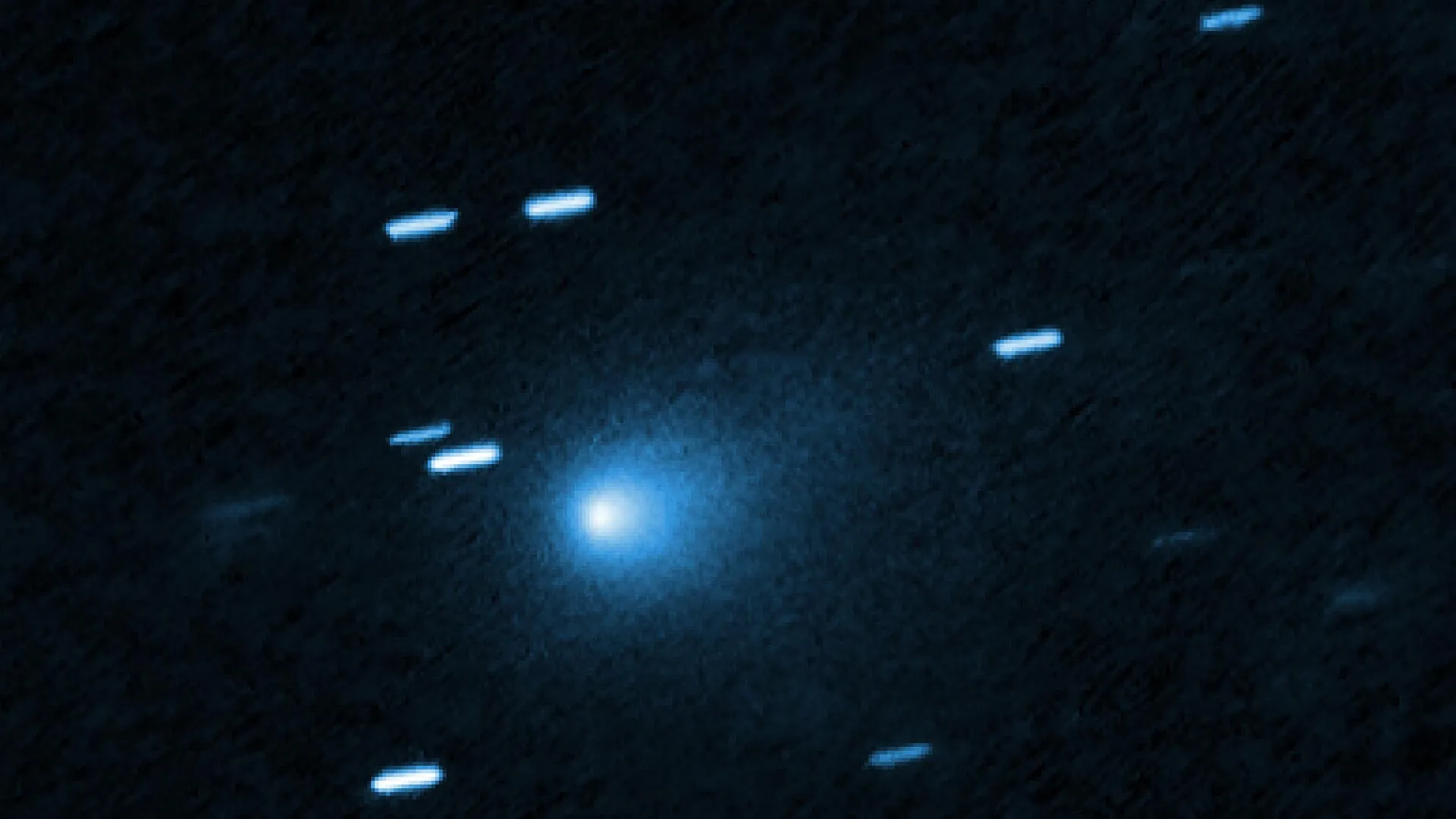
NASA’s James Webb Space Telescope has captured the first mid-infrared chemical fingerprint of an interstellar object, providing new insights into the composition of comet 3I/ATLAS as it moves away from the Sun. The results of this research have recently Astrophysics Journal Letter.
The researchers used Webb’s MIRI (Mid-Infrared Instrument) during two observing sessions after the comet made its closest approach to the Sun. The first series of observations took place on December 15 and 16, when 3I/ATLAS was about 205 million miles (329 million kilometers) from the Sun. The second round was held on December 27th, and the comet flew approximately 236 million miles (approximately 379 million kilometers) away.
Webb detects methane in interstellar comet
For the first time, scientists have directly identified methane gas in an interstellar visitor.
Methane is a highly volatile substance that can change from solid ice to gas quickly. Its appearance only after the comet has already passed close to the Sun suggests that methane is buried beneath the Earth’s surface. The comet’s upper layer likely protected the methane ice until the sun’s heat penetrated deeper into the ice, the researchers said.
The amount of methane compared to water also surprised researchers. This ratio is much higher than what is typically seen in comets in our solar system, and there are only a handful of known examples that exhibit similar properties.
Abnormally rich in carbon dioxide
This observation also confirmed another unusual feature of 3I/ATLAS. This comet emits an exceptionally large amount of carbon dioxide compared to water, far exceeding levels commonly measured in solar system comets.
The methane and carbon dioxide measurements show that the formation history of most comets around the Sun is very different. This result suggests that 3I/ATLAS formed in a very different chemical environment before it began its journey through interstellar space.
As the comet moves away, gas production decreases.
Webb also tracked how the comet’s activity changed as it moved away from the sun.
Scientists observed that gas production decreased sharply, with water decreasing most rapidly. This behavior is expected because the comet receives less solar energy. As temperatures drop, less ice evaporates from the surface and near-surface layers.
Water is less volatile than methane or carbon dioxide, meaning gas production stops sooner as the comet cools.
How Webb measured the chemistry of comets
The observations were performed using MIRI’s medium-resolution spectrometer, an instrument that separates infrared light into individual wavelengths. By analyzing these wavelengths, researchers can determine which gases are present.
The spectrometer also functions as an integrated field unit, allowing scientists to obtain spectra anywhere in a small area of the sky. This ability allowed the team to not only identify the gases around the comet’s core, but also map how those gases are distributed around the object.
