


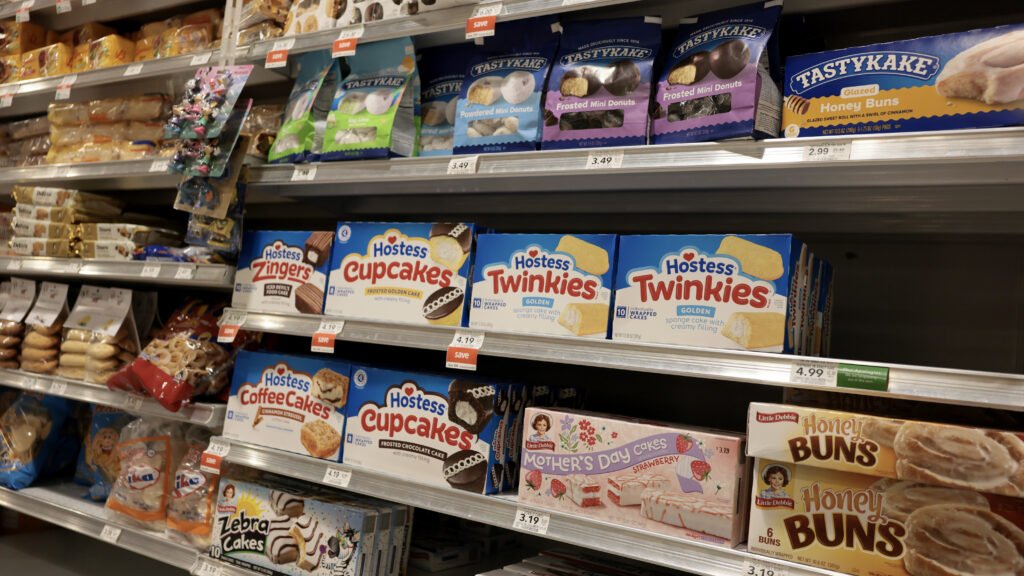
The all-star lineup of ultra-processed food researchers teaming up for a new special issue of the American Journal of Public Health delivers an overarching message to policymakers: “Do the policy!”
The directive, proposed by food political scientist Marion Nestle at a press conference ahead of the issue’s launch, also comes with new polling showing widespread cross-party concern about the health risks associated with ultra-processed foods.
A survey of 2,000 U.S. adults included in the new issue found that an overwhelming majority of Democrats, Republicans, and independents agree that ultra-processed foods are addictive and a leading cause of obesity, type 2 diabetes, and cardiovascular disease. The survey also found majorities across all political parties for government intervention, including testing food additives for safety before including them, banning artificial colors, requiring warning labels, and ordering companies to reduce the amount of sugar and salt in food.
“In a polarized era where Americans have so many different opinions, this actually shows a lot of agreement and public support, and it should be a catalyst for policymakers,” said Lindsay Smith-Taley, a nutritional epidemiologist at the UNC Gillings School of Public Health. Lindsey Smith-Taley, a nutritional epidemiologist at the UNC Gillings School of Public Health and co-author of a new paper on the environmental impact of single-use plastics used to package many ultra-processed foods.
But despite public support and Robert F. Kennedy Jr.’s emphasis on ultra-processed foods as a major health issue during his current tenure as U.S. Secretary of Health, experts say the federal government is not doing enough against the food industry. Chief among them was President Kennedy’s promise that the Food and Drug Administration would soon issue an official definition of ultra-processed foods, and Taley said it was important to get that right. “What’s at stake here…is that we’ll only be able to capture a small fraction of the ultra-processed foods in our food supply, which will also have minimal health impacts,” she says. (The assembled experts expressed support for the widely used Nova classification system.)

Efforts to transform Big Food into the new Big Tobacco
President Kennedy’s “Make America Healthy Again” campaign “is not a science-based movement, it’s an emotion-based movement, and we believe that personal experience is far more important than what science claims,” Nestlé said. In a paper in the special issue, she writes that the government’s new dietary guidelines seek to shift the responsibility to avoid highly processed foods onto individuals, rather than focusing on industry regulation. But she said the MAHA movement is doing some things right, such as working hard to eliminate certain additives, artificial colors and glyphosate from the food supply. “For decades, there have been advocates trying to eliminate these things from the food supply,” she says. “I just hope the government acts on that.”
The 17 articles in this special issue also include new research on topics such as how tobacco giant Philip Morris Co. developed Lunchables from its tobacco playbook in the 1980s and 1990s when it owned Kraft General Foods, and how the flavor-enhancing technology that helped the company make low-nicotine cigarettes was applied to make more palatable fat-free cheeses and processed meats. Another surprising study found that there may be a link between consumption of ultra-processed foods and dementia in older adults. (There are some important caveats to this study, including the fact that surveys asking people to remember what and how much they ate are notoriously inaccurate, and the fact that dementia was assessed based on tests rather than clinical diagnoses.)
This special issue also presents strategies to counter the dominance of ultra-processed foods in the American diet. Kelly Brownell, an obesity expert at Duke University, said in an editorial that lawsuits from attorneys general at the state, city and county levels are an important tool in the fight against the food industry.
“One of the biggest threats to progress in this area may be the food industry’s attempts to enforce preemption laws that allow the federal government to preempt state and local actions on their own,” Brownell said. There are already signs that the food industry is trying to do just that by protesting patchwork requirements after passing laws across the country cracking down on ultra-processed foods.


Sign up for the morning round
Understand how science, health policy, and medicine shape the world every day
The assembled group of researchers also had many ideas for policies that would make fruits and vegetables more affordable and easily available. For example, Laura Schmidt, a professor at the University of California, San Francisco, who focuses on the root causes of chronic disease, said the 22 states that have banned low-income people from purchasing foods like soda and candy with food benefits could redirect those resources to subsidize local farmers. “Sometimes you’re actually missing out on opportunities,” she says.
When asked whether corn subsidies should also be directed to fruit growing, several experts answered, “Yes!” On the other hand, some people nodded and gave thumbs up.
Researchers also agreed that simply educating people about healthier eating habits is not enough to solve the problem of ultra-processed food consumption and related chronic diseases.
“These are some of the most profitable products in supermarkets. The system is rigged,” Nestlé said. “When you go to the supermarket wanting to eat healthy, you’re fighting the whole system all by yourself.”
STAT’s chronic health coverage is supported by a grant from. bloomberg philanthropy. our financial supporter It has no role in any of our journalism decisions.
