


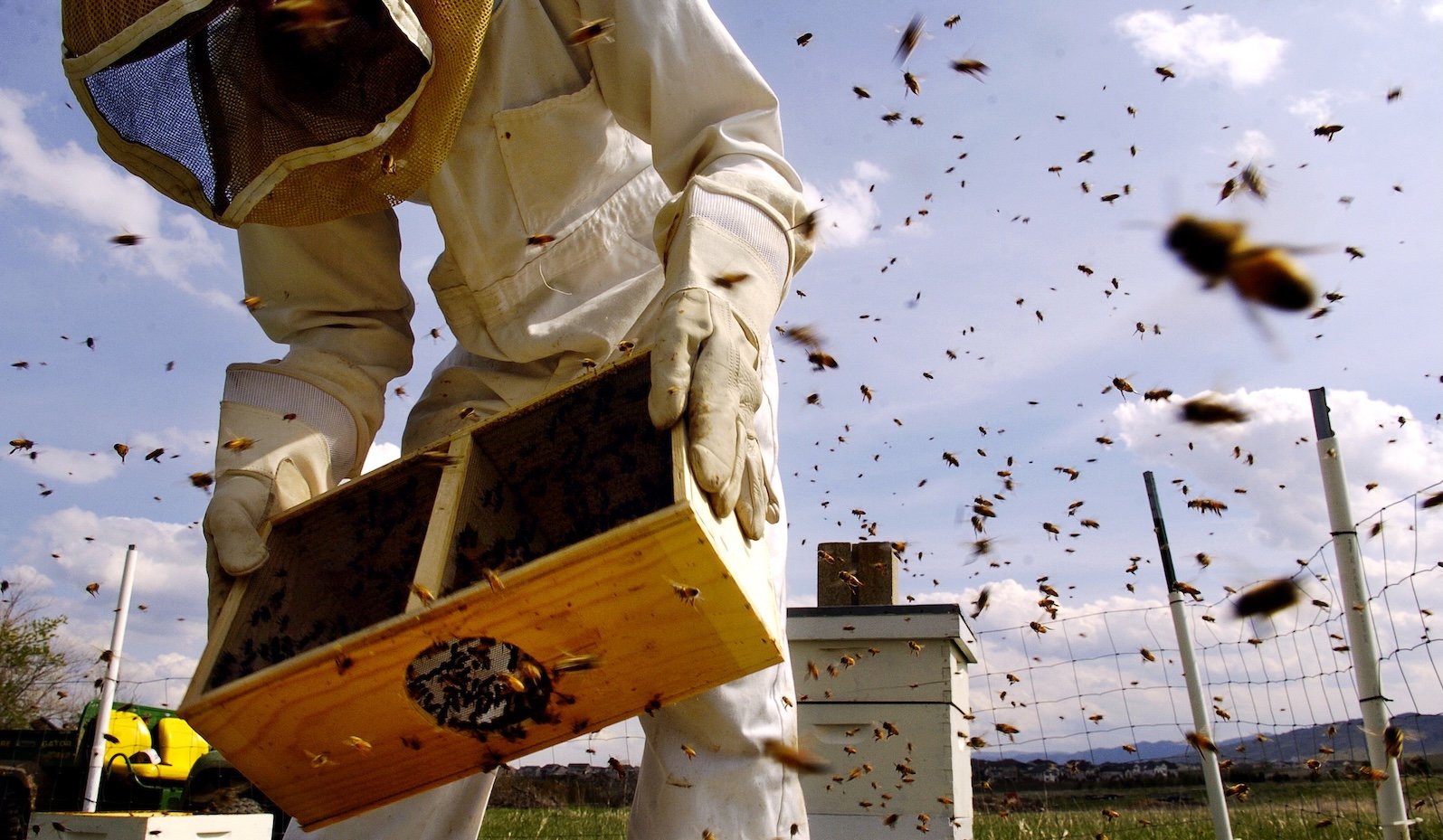
Born and raised in Colorado, Cory Kreft started working on honey farms at the age of 15. He returned to beekeeping after college and eventually bought the business from his former boss. But in 2021, his bees suddenly started dying. He lost 85 percent of his hives. The deficit continued the following year and the following year. After extensive testing, he determined that the culprit was a relatively new class of pesticides called neonicotinoids. It was often shortened to neonicotinoid.
These chemicals are commonly used to coat crop seeds before planting, ostensibly to protect plants from pests and insects during early growth. Thanks to loopholes in federal regulations, the use of neonic-treated seeds has quietly exploded in recent years with little regulation or oversight. In the United States, nearly all conventional corn and more than half of soybean seeds are now treated with neonics.
A loophole in the law called the treated product exemption allows companies to apply these toxic chemicals to products such as seeds without registering them separately as pesticide products. The seeds are in the same class as antibacterial toothbrush coatings and treated wood sold at major hardware stores, and there are few legal restrictions on how they can be monitored, used and disposed of. “Anyone can legally go buy this pesticide-treated seed, dump it in the river, and contaminate the entire water system,” Kreft said.
Promises to be safer, but still toxic
Neonics were first introduced in the 1990s with the promise that they were safer than older pesticides. “Neonics are neurotoxins that work by attacking key parts of an insect’s nervous system,” says Jennifer Sass, a scientist at the Natural Resources Defense Council (NRDC). The chemical targets nerve receptors that are more common in insects than in mammals.
Neonics are systemic, meaning they move from treated seeds to tissues throughout the plant, including pollen, nectar, and fruits and vegetables eaten by humans. Manufacturers and government regulators have argued that these properties make neonics relatively harmless to wildlife and humans, and also reduce soil and water contamination, as the pesticides remain in the factory.
Sass, who has been researching pesticides for more than 25 years, says these claims don’t hold up. “They were thought to be safe for humans and wildlife. But it turns out none of that was true.”
Since then, research has shown that neonics pose serious health risks to pollinators, ecosystems, and perhaps even humans. Pesticides can persist in the environment long after application, moving through wind and waterways and contaminating ecosystems and communities miles from where they were first used. Overall, the amount of land treated with pesticides continues to increase.
Studies on seed coatings have also shown that they typically don’t help corn farmers’ bottom lines either. Treated seeds have little or no impact on crop yields, so farmers pay more for unnecessary chemicals. Still, pesticide-treated seeds are so prevalent that it is often difficult for farmers to source untreated seeds, and many farmers use neonic pesticide-treated seeds when they don’t need to.
It has become nearly impossible for pollinators and people to avoid neonics. “Bees are everywhere,” Kreft said, noting that she buys food to put in her hives during the summer to prevent them from foraging on contaminated plants. “It’s in corn pollen in Colorado and the Midwest, and almond farmers in California are injecting neonics into their trees and into their irrigation systems. There’s absolutely no place where bees aren’t exposed to neonics.”
When bees encounter neonic-contaminated pollen, the neurotoxin disrupts the neurological functions that bees rely on to navigate, forage, and survive. The nest then slowly declines and dies. “We’ve seen 60 to 85 percent nest mortality each year for the past five years,” Kreft said. “It’s a loss of about $1 million a year for us.”
Effects of neonic pollution
Loopholes in regulations surrounding neonics extend beyond the seed sales stage. This also applies to waste disposal. Judy Woosmart, an entomologist at the University of Nebraska-Lincoln, has dedicated her career to studying pollinators. In 2017, she and her team made a disturbing discovery when they examined a beehive at a research site near Mead, Nebraska. The bees in all the hives were dead. This pattern continued year after year. “From 2017 to 2020, the mortality rate was almost 100 percent,” she said.
The research team discovered that an ethanol plant called AltEn was operating near the research site. Major agrochemical companies use such facilities to dispose of unpurchased seeds before they rot. Wusmart said AltEn plants process much of North America’s surplus neonic-treated corn seed, contaminating the surrounding ecosystem. Because neonic-treated seeds are exempt from many regulations that typically govern similar pesticide products, this facility was not subject to the same regulations and oversight as other pesticide disposal sites.
At the same time, residents of the nearby town of Mead begin to experience troubling situations, including the death of wild animals, sick family pets, and mysterious health problems. The seed processing factory ground the seed residue treated with pesticides and sold it to nearby farms as a soil conditioner. Farmers were unknowingly spraying high concentrations of neonicotinoids on their fields.
As a result of intense scrutiny, the AltEn ethanol plant was closed in 2021. But Woosmart points out that no one currently knows where the surplus neonic-treated seeds will be disposed of. “It’s a big black box,” she said.
There is a growing movement to strengthen regulations.
While the harm neonics cause to pollinators is well documented, their effects on humans are not yet certain. A recent study found that more than 95 percent of pregnant women have neonic substances in their bodies. These chemicals are thought to be associated with neurological, reproductive, and developmental harm. Sass said neonics are now so prevalent in food and water that exposure has become nearly constant. “It’s everywhere now,” she said. “It’s found in breast milk, tap water, and even baby food.”
Sass highlights research that shows a link to autism and learning disabilities in children from families who live and work around agricultural chemicals such as neonics. “We want people to understand that neurotoxic chemicals have negative effects on the brain, especially when exposed to the fetus and early childhood,” she says. “Early childhood exposure is more likely to cause permanent harm, similar to lead and mercury.”
However, although research into human health effects continues, the regulatory gaps surrounding neonic-treated seeds remain vast. Wusmart said state and federal agencies could not intervene when the bees were dying because there were no obvious legal pesticide violations, such as using the product in a way that violated label instructions or other regulations. Instead, bees were being exposed through neonics spread into their surrounding environment, something current pesticide enforcement mechanisms were not designed to address. Similar to the loopholes that allow treated seeds to avoid full pesticide oversight, there are also regulatory gaps regarding storage, disposal, contamination, and exposure that extend far beyond the fields covered by pesticides.
Advocacy groups like NRDC are looking to state-level legislation. In Colorado, lawmakers recently considered a seed law that would expand farmers’ access to seeds that are not coated with pesticides while limiting unnecessary uses. The bill highlights how a small number of large agribusiness companies dominate the seed market, leaving many farmers with few options other than chemically treated seeds.
At a hearing on the seed law in the Colorado Senate, opponents of the law argued it could increase costs and administrative burdens for farmers, while supporters highlighted data showing limited benefits from pesticide-treated seeds and evidence of harm neonics cause to pollinators and human health. They argued the bill would protect pollinators, waterways and public health while giving farmers more options.
The bill ultimately failed in Colorado, but similar laws were passed in New York and Vermont, and neonic regulation proposals have been floated in other states, including Minnesota, Massachusetts and Hawaii.
common sense solution
There is an urgent need to close the neonic regulation gap by limiting unnecessary neonic use, expanding seed options free of harmful pesticides, and advocating for policies that move agriculture away from default chemical use. Critics say farmers shouldn’t automatically use pesticides because most neonic seed treatments aren’t actually needed to address pest problems and usually don’t provide any overall benefit. Instead, they propose a needs-based model that preserves farmers’ ability to use treated seeds when truly needed, while limiting unnecessary uses that increase contamination. Quebec adopted this approach in 2019 with surprising results. Neonic treatment of corn seeds has gone from near universal to nearly nonexistent in just a few years.
These protections cannot come quickly. In Meade, Nebraska, the environmental damage caused by neonic-treated seeds did not end when the plant closed in 2021. Woosmart said pesticide contamination remains. “We are still seeing large amounts of neonics in honey from hives in this area,” she says. “I won’t eat it.”
Colorado beekeeper Corey Kreft isn’t sure if he can continue to farm honey. “There’s so much work that goes into beekeeping,” he said. “If we can’t keep bees alive because this pesticide is everywhere, why do we continue to do this?”
Seed We Need is a coalition of farmers, scientists, educators, and advocates working to change the system. We support eliminating unnecessary neonic use in Colorado and bring safer, more transparent seed options to the table. Because our land, our health, and our future depend on it.
Join us in the fight for safer seeds and a healthier Colorado.
