


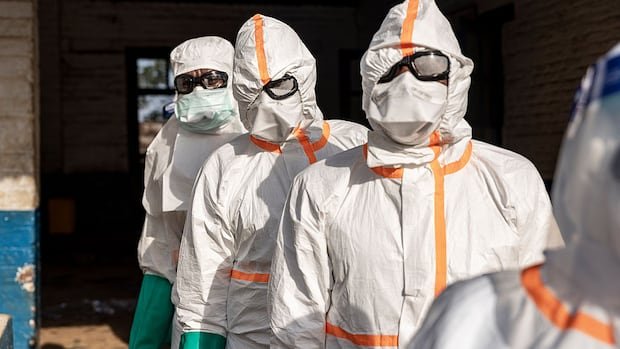
When news of the Ebola outbreak in the Democratic Republic of the Congo broke more than a week ago, Jason Kindrachuk was feeling optimistic, knowing the capabilities of the local responders and medical workers he’s worked with on the ground.
But Canadian microbiologists say their optimism about containing the outbreak has waned in recent days.
There are now more than 1,000 suspected cases and hundreds of deaths, mainly across northeastern Congo, with seven deaths in neighboring Uganda.
Scientists suspect the true number of cases may be much higher, as the infection likely spread for weeks or more before global health authorities were aware of it. It has also been linked to the relatively rare Bundibugyo variant of the Ebola virus, for which there is no approved treatment or vaccine.
“It’s really a race against time,” Kindrachuk, an associate professor at the University of Manitoba, told CBC News.
“The sooner we can identify suspected cases, the sooner we can contain the situation. Unfortunately, I think the reality is that we haven’t seen this for weeks.”
Hear | Congo’s health workers face an uphill battle:
as it happened6:02Congolese health workers face public distrust and armed attacks
People working full-time to respond to the Ebola crisis in the Democratic Republic of Congo are facing hostility. Medical facilities have been attacked by armed groups three times in the past week. Ahmed Mahato, manager of the International Medical Corps, spoke to As It Happens host Nir Koksar about his work building isolation wards for Ebola patients, while trying to build trust within the wider community.
Outbreak ‘will get worse before it gets better’
On Monday, the director-general of the World Health Organization echoed similar sentiments.
In a virtual briefing with African officials, Dr. Tedros Adhanom Ghebreyesus said the late detection of the outbreak meant teams were “catching up with an infection that is progressing very quickly” and that he expected “it’s going to get much worse before it gets better.”
The challenges facing healthcare workers are enormous.
In addition to the lack of a vaccine to prevent new infections, violence has escalated in Congo’s war-torn Ituri and North Kivu provinces, and there is a deep sense of distrust in outside authorities. Tensions have escalated over recent incidents, including a fire at a medical facility and dozens of Ebola patients being evacuated from treatment sites.
“We are urgently expanding our operations,” Ghebreyesus said, “but at the moment the epidemic is outpacing us.”
WATCH | Congo suspends gatherings amid Ebola outbreak:
Democratic Republic of the Congo suspends mass gatherings as WHO raises Ebola public health risk to ‘very high’
The World Health Organization (WHO) has raised the public health risk from the current Ebola outbreak in the Democratic Republic of the Congo (DRC) from “high” to “very high.” Bronwyn Nicol, President of the International Federation of Red Cross and Red Crescent Societies, said the Federation of Red Cross and Red Crescent Societies has launched a local emergency appeal to strengthen local responses to the outbreak.
Vaccine shortage puts first responders at risk
Kindrachuk and other Canadian experts with personal experience in the fight against Ebola say the road ahead will be tough.
This is a much more complex situation than other recent Ebola outbreaks, said Kindrachuk, who worked in Liberia during the 2014 Zaire-type virus outbreak in West Africa, infecting tens of thousands of people over two years.
There was no vaccine at that time. But as a result, the current Ebola vaccine is tailored to the Zaire virus.
Efforts to test experimental vaccines against the current outbreak are currently expanding, according to media reports, including a vaccine developed at the University of Oxford that incorporates the genetic code of the Bundibugyo Ebola virus. But it won’t happen overnight.
Darryl Falzarano, a Canadian vaccine researcher who has been working on antiviral strategies for Ebola, said there is frustration among scientists that there is no effective, approved vaccine against the non-Zairean virus, even though the science already exists.
“It’s not a technical reason,” Falzarano said. “It’s for social and economic reasons.”
 Canadian microbiologist Jason Kindrachuk (fourth from left) was working in Liberia in September 2014, during the unprecedented Ebola outbreak in West Africa. (Courtesy of Jason Kindrachuk)
Logistics makes the situation “difficult”
At a basic level, the logistics of tracking infections and moving workers and supplies through Congo are difficult, given the country’s massive size and ongoing conflict.
“As a result, many people became internally displaced,” Kindrachuk said.
“As people move out of zones where infections and diseases are prevalent, it becomes increasingly difficult to trace, right? All these factors combine to make things even more difficult.”
Kindrachuk said from his experience that reaching remote parts of Congo can be difficult because there are vast expanses of land without paved roads. He recalled one trip involving malaria treatment. The trip required what was a short trip from Kinshasa, the Congolese capital, actually a treacherous journey that took several days.
 A Liberian man walks in front of an Ebola awareness painting in downtown Monrovia, Liberia, in 2015 during the virus outbreak. (Ahmed Jaranzo/EPA)
Discontinuing treatment, contact tracing
According to the WHO, nearly 5 million people live in conflict in Congo’s Ituri province, the epicenter of the current Ebola outbreak.
The group said people fleeing violence in the region include health and humanitarian workers, “severely hampering efforts” to identify infections early enough to provide supportive care.
Dr. Rob Fowler, a critical care physician at Toronto-based Sunnybrook Hospital who has helped with past outbreaks in Congo, Guinea, Liberia and Sierra Leone, stressed that the volatile situation is also leading to daily disruptions to contact tracing – efforts to trace people who may be infected with the virus, which is likely to be transmitted through bodily fluids.
Africa’s climate also makes it difficult to work, given the need to wear personal protective equipment at all times, he said. Fowler has been instrumental in popularizing PPE that is reusable and has fans to keep workers cool. Otherwise, he said, it would be impossible for the team to care for patients over the long term.
In the pre-vaccine era of 2014, Kindrachuk recalled, teams working in the field were at great risk and relied heavily on personal protective equipment. “We’re back in that situation again…We need to make sure that people get diagnostic tests if there’s something wrong and get treatment if they develop symptoms.”
What supports those challenges? Fowler said public health infrastructure is limited to begin with and relies on resources from international partners to ramp up diagnostic testing and safe care.
“And in recent years, international support and assistance has decreased significantly.”
